


If you are planning a long and demanding sea voyage and are looking for a suitable vessel, an aluminium yacht will at least be an option. Aluminium is tough, resistant and can withstand hard mechanical loads better than many other materials. What's more, the material is comparatively light in relation to its strength, which makes it an interesting option for ocean-going yachts.
But aluminium also has its downsides. Construction requires great care, especially when it comes to the strict separation of different metals in order to avoid electrolysis. Aluminium also shows weaknesses in terms of insulation. More constructive effort is required against heat, cold and noise than with other materials. Visually, aluminium also remains a matter of taste: technical, sober, functional. But if you're going on a long journey, you're not looking for a boat to make a glamorous appearance in the marina, but one that can withstand a lot and is reliable.
More from the shipyard:
The Alubat shipyard in western France has been consistently building yachts from seawater-resistant aluminium since 1973. The material suits the core of the brand, which enjoys almost cult status among blue water enthusiasts. With the Ovni 370the Ovni 430 and the all-new Ovni 490, Alubat has completed a visible generation change. Fresh lines and modern design approaches give the young series a clearer profile. The designs were created by Mortain & Mavrikios in collaboration with Jean-Pierre Brouns' CBA design office.
With a yacht like the Ovni 490, sailing characteristics are not the core competence. What is needed is reliability, robustness and a harmonious package for long voyages. This is where the strengths of the smaller sister models Ovni 370 and Ovni 430 lie. In the YACHT test, they showed solid and reliable performance under sail, but did not shine with much temperament or dynamism. A sail carrying capacity of around 4.0 speaks in favour of this rather conservative approach to sailing.
The measurement results from the test


The designers have gone one better with the new Ovni 490. The hull shape has been revised and the sail area increased. The theoretical performance potential is now 4.4 sails, which is already considered high for a boat of this size. Work has also been carried out on the underwater plan. The profiles of the integral centreboard and the double rudder blades are now milled from the solid aluminium block and designed as standardised NACA profiles.
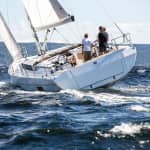
The adjustments are having an effect: although the Ovni 490 clearly remains a cruiser, it sails more briskly than its smaller sisters. The test conditions in front of the Alubat home harbour in Les Sables-d'Olonne are difficult: 4 to 5 Beaufort and high swell from a receding storm depression. Exactly the kind of weather in which a boat like this has to show what it can do. The Ovni 490 does a good job upwind. The test boat with a large genoa and optional square-top mainsail runs at around 6.5 knots with a tacking angle of 90 degrees. The yacht sails very balanced and gets through the waves well.
Thanks to the double rudder blades, the rudder pressure is low, yet the beefy boat reacts cleanly and surprisingly directly in the wave. However, the lack of rudder pressure does not make it easy for the helmsman to steer the boat cleanly along the wind edge. The autopilot, on the other hand, has an easier time on long journeys, requires less force for course corrections and saves power, which is an argument in its favour on long journeys.
Cockpit and pilothouse for handling while travelling
The pilothouse also fits in with the concept. The cell between the cockpit and companionway can be completely sealed off and creates a dry space for long passages in bad weather. With remote control for the autopilot and engine switch, this area also becomes the inside control station.
The cockpit is also designed for controllable handling under way. Halyards, sheets and trim lines are routed consistently aft through two channels. The winches are easily accessible on the coaming or on the side of the companionway. Alubat gives the owners plenty of room for manoeuvre: the line routing can be set up for small crews as well as for larger crews, depending on the operational profile. However, the generously planned cockpit comes with restrictions. There is little space behind the steering columns for the helmsman, and sitting sideways is hardly possible. Prolonged manual steering is therefore uncomfortable.
On the cockpit coamings and to the side of the companionway are a total of six Antal 62 winches, shipyard standard. Nevertheless, electric drives are recommended because the loads on the sheets are high, especially for the large overlapping genoa. The side winches are slightly recessed. Although this looks elegant, it inevitably leads to dangerous overrunning of the sheets. The shipyard needs to make improvements here.
Falling dry made easy
The integral canting keel has always been at the heart of the Alubat brand, and the Ovni 490 also consistently follows this principle. The ballast centreboard can be completely retracted into the hull. This means that the boat, with its hull built in a multi-buckling frame, can easily fall dry and stands securely on the base plate and the rudder blades. This is a real benefit, especially for cruising sailors who want to sail into shallow bays, tidal areas or remote moorings.
The solution remains simple and robust. The aluminium daggerboard weighs just under 500 kilograms and is raised via the cockpit winch without hydraulics using a sheet hoist alone. The actual ballast sits deep in the ship: in the form of lead blocks, just under six tonnes, which are packed in aluminium boxes and cast into the hull with epoxy at the lowest possible point.
Two separate drives
Alubat is also taking a special approach to the motorisation of the Ovni 490: instead of a centrally installed drive, the shipyard is using two engines that are installed around three metres apart in the hull. Two Yanmar engines with 57 hp each are standard, while the test vessel is optionally equipped with two 20 kW electric motors from Bellmarine. Although this adds weight on board and increases costs, it offers clear advantages when manoeuvring in port.
With the two separate drives, the yacht can be manoeuvred as precisely as a catamaran. The counter-rotating effect of the engines in particular makes tight harbour manoeuvres much easier. During the test, this worked extremely well, with the ship practically turning on the plate using engine power alone. Accordingly, a bow thruster can be dispensed with. In addition, there is more redundancy in the event of an engine failure and lower fuel consumption with the same performance.
Below deck of the Ovni 490
The flexibility of the Ovni 490 is evident in the foredeck, where the design options are virtually unlimited. The owner's cabin with a double bed built into the side and a large forepeak, which serves as a sailing load but can also be used as a workshop, come as standard. As an option, an additional wet cell can be installed in between, as on the test boat. Alternatively, a second cabin in the foredeck or even a separate office are possible. A total of four cabins can be realised. However, the shipyard has deliberately retained the side installation of the double berth for the owners. Leeboards are included as standard. Alubat has consistently dispensed with a free-standing island bed; according to the shipyard, such a solution would hardly be practical at sea.
As a true deck saloon yacht, the central living area is raised and offers an almost unrestricted view of the outside through the large windows in the cabin superstructure. The saloon table, which can be lowered along the entire length, transforms the entire seating area into a huge sunbathing area. Using it as a large berth on long journeys is not only pleasant due to the panoramic view, but can also prevent seasickness.
The galley is designed as a long side row and impresses with large work surfaces and plenty of storage space. There are also well thought-out mooring options throughout the boat and excellent ventilation options. The tanks for water and fuel are installed centrally and deep under the floorboards in the saloon, providing a low centre of gravity and additional righting moment.
Equipment and prices
At around 1.2 million euros, the Ovni 490 is anything but a bargain. However, the price is difficult to categorise because the competition in this market segment has very different concepts for long-distance cruising. One thing is indisputable: the Ovni 490 is very complete, high-quality and robustly equipped from the shipyard. Many things that would be extra elsewhere are already standard here.
- Base price ex shipyard: 1.231.650 €
- Standard equipment included: Sail, engine, sheets, railing, navigation lights, battery, compass, sails, cushions, galley/cooker, bilge pump, toilet, sailcloth, fire extinguisher, electric cooler, holding tank with suction, underwater paint
- For an extra charge: Anchor (bow and stern) with chains € 7,930, fenders/mooring lines € 1,810, clear sailing handover € 17,930
- Price ready to sail: 1.259.320 €
- Guarantee: 2 years
- Surcharge for comfort equipment: Line adjustment, Hole points incl.; Traveller not available; Electric windlass incl.; Tube kicker incl.; Backstay tensioner not available; Spring cleats incl.; Sprayhood (pilothouse) incl.; Teak in cockpit (synth.) incl.; VHF radio E-package; Log and echo sounder E-package; Wind gauge E-package; Autopilot E-package; Electric package 27.740 €; Charger incl.; Shore connection with RCD incl.; 230-volt socket (one) incl.; 12-volt socket in the sat nav incl.; Heating (hot water) 31.240 €; Pressurised water system incl.; Hot water boiler incl.; Shower WC room incl.; Cockpit shower incl.
- Comfort price: 1.318.300 €
- Included in the price: Aluminium equipment rack, bathing platform with bathing ladder, genoa furling system, cockpit table, swing keel
As of 2026, how the prices shown are defined, read here!
If you look at the build quality, equipment and freedom of cruising together, you get a clear idea of what this yacht offers for the money - and that is remarkable.
YACHT review of the Ovni 490
The Ovni 490 is not a yacht for the big show, but for the big journey. Robustly built from aluminium, with an integral canting keel, pilothouse and plenty of variability, it impresses in the test as a coherent, high-quality long-distance boat with reserves.
Design and concept
Very solid aluminium construction
Uncompromising concept
Easy to fall dry
Protected pilothouse
Sailing performance and trim
Decent sailing performance
Sails very balanced
Efficient handling
Little space for helmsman
Living and finishing quality
Deck saloon with all-round view
Flexible expansion options
Good expansion quality
Perfect ventilation
Equipment and technology
Double motorisation
Top equipment ex shipyard
No rolling mast available
Danger of defectors
The Ovni 490 in detail

Technical data of the Ovni 490
- Designers: Mortain & Mavrikios / Cabinet CBA
- CE design category: A
- Torso length: 14,90 m
- Total length: 15,95 m
- Waterline length: 13,98 m
- Width: 4,80 m
- Draught Swivelling keel: 1,00 - 3,10 m
- Mast height above WL: 21,80 m
- Theor. torso speed: 9.1 kn
- Weight: 17,0 t
- Ballast/proportion: 6,48 t/38 %
- Mainsail: 65,0 m²
- Furling genoa (110 %): 64,0 m²
- Stagfock: 32,0 m²
- Motorisation: 2 x 42 kW/57 hp
- Fuel tanks (2): 2 x 500 litres
- Fresh water tank: 700 l
- Holding tank: 2 x 55 litres
Hull and deck construction
Aluminium construction in multi-buckling frame welded over a frame. Seawater-resistant aluminium (standard 5083) is used in thicknesses of 10 mm (floor plate), 8 mm (hull above the waterline) and 6 mm (deck). Standard insulation above the waterline with sprayed cork and 50 mm foam on top. Internal ballast moulded in the form of lead blocks. Integral aluminium canting keel.
Rig and sail
The two-reef aluminium rig from the manufacturer Z-Spars is standard. The shipyard does not offer a furling mast as an option. A set of Dacron sails from Incidence (main and genoa) is part of the basic equipment from the shipyard. Additional sails and upgrades are available in equipment packages.
Motorisation
Two Yanmar built-in diesels (4JH57), each with 57 hp and shaft drive, are installed ex shipyard. On request, two electric motors from the manufacturer Bellmarine with an output of 20 kW, also with shaft drive, are possible, as on the test ship.
Batteries
2 x 10⁵ Ah AGM (service), 2 x 90 Ah AGM (starter). Lithium batteries are offered as an option.
Shipyard and distribution
Alubat Chantier Naval; 85180 Les Sables-d'Olonne (France); www.alubat.com
The Ovni 490 is not alone on the market - the competition
Allures Horizon 47

Allures-Yachting France presents a new model with many fresh and innovative design elements. The hull is made of aluminium, the deck of GRP.
Bestevaer 49

The aluminium yachts from the Bestevaer series from KM Yachtbuilders in Holland are very popular with blue water sailors. Available with fixed keel or swivelling keel.
Boréal 47.2

The attractive competitor from France impresses in the YACHT test with excellent sailing characteristics. It also has a closed deckhouse. Read the test here.
Garcia Exploration 52

Very robustly built aluminium explorer yacht with an uncompromising orientation for demanding tours. Suitable for dry-docking with integral swivelling keel. Read the test here.

Michael Good
Editor Test & Technology
