


- Towards the scow-bug as an established form of construction
- Prices of the Mojito 32
- Ideal for one- and two-handed operation
- Sporty and can be used in a wide variety of areas
- Advantages of the scow design below deck
- Conclusion of the test
- YACHT review of the Mojito 32
- The Mojito 32 in detail
- Fun makers in a handy format: the competition
The first impression at the jetty is disconcerting. Where other yachts score points with pleasing lines and an elongated silhouette, the almost ten metre long Mojito 32 from the western French shipyard IDB Marine seems to focus on uncompromising practicality. The unusual hull shape is not a figment of the imagination, but a concept - and it is precisely this that gives the design a certain presence. It is a scow, i.e. a boat without the usual tapered bow - visually special and not very elegant for the spoilt eye. Anyone looking for pleasing lines will be disappointed. On the other hand, those who want a pragmatic sailing boat with a crystal-clear mission and that certain something will be all the more curious.
Also interesting:
The concept is not entirely new. With the smaller Mojito 650, IDB Marine already realised the scow idea in a very compact format a few years ago - based on the design of the Classe Mini 6.50 boats, those uncompromising offshore racing yachts in dwarf format. YACHT has the Mojito 650 extensively tested and the design was not only recognised for its excellent sailing characteristics, but also for its remarkably accessible handling. The Mojito 32 now takes this approach a step further - larger, more family-friendly and with a significantly extended range of uses.
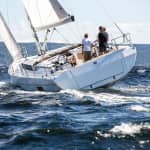
Towards the scow-bug as an established form of construction
A scow carries its volume far forwards instead of running out into a narrow, strongly tapered bow. The waterline is wider and the buoyancy in the foredeck is greater. The construction, which is pressed flat at the front, does not cut through the waves, but rather slides over them - similar to a surfboard. This increases control, agility and, above all, speed, especially on space and downwind courses.
French designer David Raison provided the decisive impetus for the development. With his radical Mini 6.50, he won the legendary Mini-Transat in 2011, consistently challenging the design dogmas that had prevailed until then. Since then, the scow bow has established itself as a design element from an oddity to an integral part of the development of modern ocean racing yachts. David Raison also drew up the design plans for the Mojito 32, this time in collaboration with his professional colleague Pierre Delion.
Prices of the Mojito 32
- Base price ex shipyard: 227.335 €
- Price ready to sail: 244.465 €
- Guarantee/against osmosis: 2/2 years
As of 2026, how the prices shown are defined can be found here!
For the YACHT test off Concarneau in Brittany, the conditions are anything but tame: 15 to 20 knots of wind, a good 5 Beaufort, plus a high Atlantic swell of at least two metres. Challenging conditions and an honest test for a design with such a pronounced scow bow. The well-known characteristics of this design are also revealed on the courses towards the harbour. Crossing is not one of its favourite disciplines. The measured tacking angle remains on average beyond 90 degrees, and the height sailed upwind is correspondingly modest.
In the steep, short waves, the wide, flattened forecastle sets in noticeably hard. Nevertheless, the log records a solid speed of 6.7 knots on a course of 50 degrees to the true wind. The Mojito 32 is easy and lively to steer over the waves. The double rudder blades respond immediately, direction changes are quick and surprisingly agile. Despite the wide bow section, the design is by no means sluggish, but reacts very sensitively to the smallest impulses at the helm. The behaviour in rough seas is also remarkable: even when the foredeck hammers very hard into the waves, the deck remains dry. No overflowing water, no spray in the cockpit. This fact was already emphasised as surprising and particularly positive in the test of the small Mojito 650.
Measured values of the Mojito 32


With the rather radically stepped chine edges and the unusually flat underwater hull and plenty of volume in the foredeck, the Mojito 32 also has enormous dimensional stability. In addition, there is a lot of righting moment via the deep-swept keel with an impressive 34 per cent ballast ratio. Overall, the design sails very stiffly and upright.
The cockpit concept of the Mojito 32 also favours sporty functionality. The cockpit and running deck are on the same level, creating a continuous open working area with plenty of freedom of movement for an active crew. As a replacement for the cockpit coamings, attached deflectors separate the working area from the side deck. This saves weight, creates room to manoeuvre and also underlines the overall very sporty design.
Ideal for one- and two-handed operation
A moulded storage compartment for the life raft under the rear cockpit floor is easy to reach, but only has a simple fabric cover. Although this looks good and sporty, it harbours dangers because you can very quickly hurt your foot here. A fixed cover at this point would undoubtedly be a better solution.
The halyards and trim lines run over the coachroof onto winches and clamps on the side of the companionway. The headsail sheets are led into the cockpit via the side decks, where they are optimally positioned for easy access and efficient operation, both for the helmsman and for an active crew.
The shipyard and designers have specifically designed the cockpit of the Mojito 32 for use in single or double-handed operation. This means that almost all functions can be reached easily and effortlessly over short distances. The well thought-out layout is therefore also expressly recommended for use on offshore regattas such as the Transquadra, where efficient handling with a small crew over days is crucial.
Sporty and can be used in a wide variety of areas
The Mojito 32 is built exclusively with a canting keel. This enables the shipyard to combine good sailing characteristics with flexibility in the area. An alternative with a fixed keel is not planned. The mechanism works electro-hydraulically, allowing the keel to be swivelled under the hull at the touch of a button. This allows the draught to be reduced from a maximum of 2.73 metres to a minimum of 1.00 metres. What's more, the structures of the keel and its supporting structure in the hull are so robust that the boat can be parked on them without any problems if it falls dry - even for long periods of time. For this purpose, the shipyard can equip the boat with telescopically extendable wading supports on request. The aluminium legs can be extended and locked in place using tubes integrated into the hull on both sides. The shipyard even holds a patent for this smart idea.
The sail plan is quite sporty and provides for a square-head mainsail with a wide top and a short overlapping genoa. The sail load factor (ratio of sail area to displacement) is a relatively high 5.4, although the Mojito 32, with a total weight of 3.65 tonnes ready to sail, is not exactly a lightweight compared to the competition. The aluminium rig with two spreaders is rigged without a backstay due to the wide mainsail. Unfortunately, this means that the forestay sag cannot be trimmed away efficiently. However, regatta sailors have the option of additional backstays (runners).
Advantages of the scow design below deck
A significant advantage of the scow design for cruising is revealed below deck. The voluminous hull forms and, above all, the flattened bow section allow a new, unusually generous utilisation of space. The saloon and foredeck are spatially connected, there is no fixed partition. Only a curtain creates privacy when required. Although this initially appears purist in terms of racing, it also creates an open, very generous feeling of space.
The double berth in the foredeck is particularly comfortable. Thanks to the wide scow nose, an almost rectangular double bed with a continuous width of 1.60 metres is possible in the foredeck. This is a format that is rarely found in this size of boat. The saloon berths are also long and wide enough for sleeping. The back cushions can be folded up and back in a few simple steps. However, the aft berth is only 1.30 metres wide for double occupancy. Only one person can sleep comfortably here.
As expected, the bathroom on the starboard side is compact, but offers all the necessary functions. The washbasin, toilet and basic fittings are sensibly integrated - the design does not allow itself any more space than absolutely necessary. The direct, open passageway from the bathroom to the forecastle is a practical solution. The large storage space is therefore easily accessible both from inside and outside the cockpit. There is plenty of space for additional sails, fenders or other bulky equipment, especially as the cut-out in the cockpit is also generously dimensioned. This is a real plus, especially for regattas or longer passages with a lot of equipment. The galley, on the other hand, is comparatively small. Storage space is limited and the work surfaces are also tight.
Conclusion of the test
For all its conceptual consistency, the assessment of the Mojito 32's build quality is clearly sober. There is a recognisable need for improvement here. French pragmatism in all honour - but in the present case, some details simply seem immature and carelessly finished. Some surfaces are left untreated or roughly finished. Gaps appear inconsistent. The bunk boards are very thin, creak under load and give way noticeably. The electrical system does not leave a good impression either: the wiring is confusing, disorganised and not labelled at all. In this discipline, the Mojito 32 cannot keep up with its otherwise well thought-out and imaginative concept.
The Mojito 32 is not a boat for traditionalists. Instead, the concept of this smart Frenchwoman favours innovation and bold shapes - visible, tangible, uncompromising. The bottom line is that it is a well-sailing, independent boat with a strong character that is deliberately offbeat - which is probably why it is so fascinating.
YACHT review of the Mojito 32
Sporty cruising boat with strong sailing characteristics. The enormous amount of space below deck is particularly pleasing, but the workmanship is less so.
Design and concept
Independent construction
Barely overflowing water
Suitable for falling dry
Sailing performance and trim
High performance potential
Ultimately suitable for one-handed use
Little sailed height
Living and finishing quality
Generous sense of space
Huge bed in the foredeck
Partly unsightly finish
Equipment and technology
High-quality equipment
Electric motor as an option
Tiller too short
The Mojito 32 in detail

Technical data of the Mojito 32
- Designer: D. Raison / P. Delion
- CE design category: A
- Torso length: 9,80 m
- Total length: 11,50 m
- Waterline length: 8,60 m
- Width: 3,45 m
- Draught (swivelling keel): 1,00-2,73 m
- Mast height above WL: 13,92 m
- Theoretical torso speed: 7.1 kn
- Weight: 3,65 t
- Ballast/proportion: 1,25 t/34 %
- Mainsail: 37,0 m²
- Furling genoa (106 %): 33,0 m²
- Gennaker (top): 111,0 m²
- machine (Yanmar): 15 kW/21 hp
- Fuel tank: 40 l
- Fresh water tanks: 2 x 100 litres
Hull and deck construction
GRP sandwich construction with PET foam core and partial flax fibre inserts. The laminate is constructed using vacuum infusion. Bulkheads made of GRP composite.
Motorisation
The three-cylinder diesel engine from Yanmar (3YM20) with an output of 20 hp is fitted as standard. A more powerful engine with 30 hp is offered as an option. The alternative is the electric drive from Bellmarine with Saildrive and an output of 11 kW.
Rig and sail
Ex works, the boat is equipped with an aluminium mast from the manufacturer Sparcraft with two spreaders. A carbon fibre mast is available as an option. The sails are not yet included in the basic price. The simple set (main and genoa) costs around 10,000 euros extra.
Shipyard and distribution
IDB Marine, F-29900 Concarneau; www.idbmarine.fr
Fun makers in a handy format: the competition
Beneteau First 30

She has just been awarded the title of European Yacht of the Year 2026. The First 30 from Beneteau is a multi-purpose sports boat with plenty of potential and good touring capabilities. And it's affordable. You can read the test here.
Django 9.80

Sporty coastal cruiser from the Marée Haute shipyard in Brittany. The boat is available with either a fixed keel or bi-keel and can be fitted with two or three double cabins below deck. Click here for the test.
Pogo 30

The design for the sporty Frenchwoman comes from the Finot-Conq studio and is available in versions with a fixed keel or a swivelling keel. The family-friendly interior features two double cabins.
RM 980

This exciting alternative has a plywood hull and a GRP deck. The RM 980 is the latest model from the yacht builders in La Rochelle and is due to be launched in autumn 2026.
ADVERTISEMENT

Mojito 32 insurance from 1,462.72 euros per year* - liability and comprehensive cover. Many options available, for example: protect your crew with passenger accident insurance. Simply calculate online and take out cover: yachting24.de
* Yachting24 offer valid for a sum insured of 228,000 euros (with current value cover), excess of 1,200 euros, liability cover of 8 million euros.

Michael Good
Editor Test & Technology
