


When the One Ton Cup was no longer held with the more delicate 6mR yachts in the mid-1960s, but with ocean-going regatta boats, one of the most exciting development phases in yacht building began. In just three decades, the rather classic, heavily built cruiser-racers became highly specialised racing machines that shaped the offshore scene like no other class.
During this hot phase of sailing, the US designer Dick Carter constructed the one-tonne "Optimist" and caused quite a stir on the regatta courses. At first glance, the yacht, which was only around 11.40 metres long, looks almost dainty and antiquated from today's perspective - but technically it was a revolution at the time. Carter ventured away from the good-natured cruiser-racer and towards the uncompromising offshore racing machine: with the ribs retracted at the top, flat hull and large beam, borrowings from dinghies were transferred to ocean-going yachts for the first time. The widest beam was slightly aft, plus a deep fin keel with a trim tab. This could be set up to five degrees, which was an innovative way of finely adjusting the windward yaw and creating more buoyancy at the time.
Also interesting:
The concept and the consistent realisation of the single-tonner built by Abeking & Rasmussen in 1967 was almost provocatively modern for the RORC and later IOR world at the time. New approaches were also evident in the rig. The slip rig with a rather slim main and strongly overlapping headsails consistently followed the measurement - as much power as possible on the wind without incurring too much of a rating penalty. Below deck, it remained simple: enough comfort for long offshore trips, but with a clear focus on saving weight. The overall package was maximally successful. Bremen sailmaker Hans Beilken and his crew won the One Ton Cup with "Optimist" in Le Havre in 1967 and successfully defended it a year later off Heligoland.
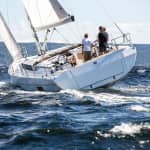
Customised IOR one-tonne trucks never intended for mass production
The boat became the blueprint for an entire generation. Suddenly everyone wanted this new, fast line. The boat showed where the journey in ocean-going yacht building was heading - away from the heavy all-rounder and towards a racing yacht radically designed for performance. A milestone that characterises the "Carter design" myth to this day. The designs were never intended for mass production, but as customised IOR one-tonne yachts for a small handful of regatta owners. At that time, top boats were mostly built as one-offs or in small series - after two or three years they were already considered obsolete under the IOR survey. Not even ten examples of Carter's design were built.
"The design is still fascinating today," says Michael Specht, who now owns a sister ship, an "Optimist". Ten years ago, the Hamburg native came across this rare type of boat by chance. "We wanted a boat with its own history," explains the trained carpenter and architect, "and above all one made of wood." His father had once completely converted a wooden three-quarter tonner, which is where his love of wooden boats was born. During his web search, Specht initially discovered an optimist with a steel hull. "We looked at that, but as a wood lover, it wasn't for me." Then he remembered an advert on the Freundeskreis Klassische Yachten website: The former "Apecist", most recently "Svinga", was offered for sale there. "We liked the boat straight away. Especially because it had a wooden hull - an absolute rarity in Carter construction." However, the purchase was not spontaneous. "It took around a year to get to know each other and negotiate - including introductions to children," recalls Specht. After all, it was important to the owner at the time that the ship came back into the hands of a nice family.
Combining the IOR design with the look of a classic is unique
"Apecist" was launched by Abeking & Rasmussen in 1969 and sailed under the German flag with the sail number G 226. She belongs to the next development wave of these radical one-tonne boats. What makes her so special is her all-wood hull, while the original "Optimist" was built as a steel boat and other ships in the Optimist series were also built in steel and aluminium.
"Anaïs" is believed to be the only wooden construction; there are no confirmed references to another wooden version in Chile. The boat is planked using the Karweel construction method. The khaya planks are 34 millimetres thick, glued and screwed to form-glued oak frames 55 to 65 millimetres thick and spaced 250 millimetres apart. "We are happy to bear the additional weight of the timber construction," says Specht with a grin. "The combination of the IOR design with the look and feel of a solid wood classic is simply unique."
On the regatta course, the then "Apecist" was never able to match the great successes of the "Optimist". Nevertheless, at that time she was already faster than her former role model, the "Optimist", which had been overtaken by the rapid technical developments in the regatta circuit. The ex-"Apecist" changed owners after her racing career and sailed on the US East Coast for a time. A later resale brought her to Glücksburg on the Flensburg Fjord as a training yacht for the Hanseatic Yacht School. Finally, she ended up with the penultimate owner, who put the boat ashore after many years on the Baltic Sea. There she waited on a plot of land near Hamburg for several years for new owners.
Complete refit
When the Specht family embarked on the adventure of buying the old and hard-sailed boat in 2016, they had no idea what a building site the yacht would actually be. "When we put her in the water, she almost sank," recalls Specht. The previous four years on land took their toll: it took a few days and countless strokes of the bilge pump before the wooden planks were tight again.
This was followed by a complete refit of the then 50-year-old lady. In the first two years, the focus was primarily on the structure in order to get the yacht sailing again safely. Specht enthusiastically threw himself into the restoration project on his own initiative - and always with the support of his two daughters Malene and Frederike. The guiding principle was to preserve the character of the ship. The unique aesthetics of purist design and clear lines were retained, and the family of architects appropriately named their new addition to the family Anaïs - "the graceful one".
The cockpit therefore also remained virtually unchanged. In the foredeck, however, the double berth was lowered and a new hatch was installed to increase comfort. The hull was painted white again, the underwater hull is now painted black, and the stern now confidently shows what the boat is made of: dark wood, protected by clear varnish. After the major structural work, other well-proportioned projects followed continuously over the years: a new engine, the entire electrical system removed and reinstalled, new navigation technology and almost all the surfaces below deck refurbished.
"Meeting two young boat builders who had also taken a fancy to the boat proved to be a great help," says the owner. The boat, owner, Henri Jung and Timo Arafa came together at the winter berth of the Henningsen & Steckmest yacht and boatyard in Kappeln. After work or at weekends, the two boatbuilders contributed their expertise - this quartet is now the regular crew both in winter storage and on the regatta course. Last year, "Anaïs" took part in almost all of the events organised by the Freundeskreis Klassische Yachten - and brought the crew to the winners' podium several times. In cruising mode, the daughters then take command on board. The racer has long since become a cruiser - and a member of the family.
Technical data of the "Anaïs"

- Type: IOR-Eintonner
- Shipyard: Abeking & Rasmussen
- Design engineer: Dick Carter
- Construction method: Karweel planking
- Year of construction: 1969
- Total length: 11,40 m
- Width: 3,30 m
- Depth: 2,00 m
- Displacement: 7,0 t
- Mainsail: 32 m²
- Genoa I: 48 m²
- Genoa III: 22 m²
- Spinnaker: 100 m²

Nico Krauss
Freier Fotograf
