


With the Grand Soleil 60 LC, the yacht builders from Cantiere del Pardo in Italy are expanding their blue-water orientated Long Cruise (LC) series upwards. The new model positions itself as the new flagship of the series up to 60 feet and thus also closes the gap to the Plus line from 65 feet and larger. Her world premiere is planned for the Cannes Yachting Festival 2026.
The concept clearly follows the blue water orientation of the LC models: long ranges, comfortable living spaces and easy handling even with a small crew. Once again, a well-rehearsed team is responsible for the design and layout: the lines and interior come from the Nauta Design studio, while Matteo Polli is responsible for the construction and hull lines.
With or without tare bar
The sheer deck design is typical of the LC line. Halyards and sheets are led below deck, leaving the walkways free. This should benefit both safety and freedom of movement. The yacht is optionally available with a permanently integrated tarp bracket above the cockpit or in a version without a bracket. The latter has a sportier design and features, among other things, a fixed mainsheet point in the cockpit between the steering wheels.
Further links on the topic:
The cockpit is ergonomically designed, with seats that are extended forwards and reach under the sprayhood. The two tables in the cockpit can be lowered and converted into sunbathing areas. A folding bathing platform at the stern increases the usable area in the harbour by around one metre. An inflatable dinghy with outboard motor can be stored transversely in the aft peak. The single rudder is pulled far under the boat for this purpose.
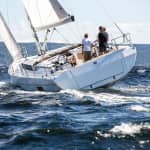
Self-tacking jib above overlapping genoa
Various options are planned for the rig, including a fully battened mainsail version, optionally with a furling boom or alternatively a mast furling main. Hydraulic trimming devices for the backstay and boom vang are also provided. In addition, the customer can choose whether to sail the boat with a self-tacking jib or an overlapping genoa.
The 60 LC is clearly designed for long journeys. The tank capacity is 1,140 litres of diesel and 1,000 litres of fresh water. Stainless steel tanks arranged in the centre of the boat are designed to support a balanced weight distribution. Extensive comfort options are also available, including air conditioning with heat pump, generator, watermaker and an integrated on-board system for controlling lighting, air conditioning and other consumers. A Volvo Penta built-in diesel engine with an output of up to 175 hp is planned.
Three or four double cabins are possible
Below deck, the shipyard favours plenty of natural light through large hull and superstructure windows. The saloon is raised in comparison to the foredeck and stern. In the standard version with three cabins, the galley is located in the foredeck area and extends over both sides between the saloon and the owner's cabin. It offers space for a tall fridge/freezer. Alternatively, a fourth cabin with two Pullman berths can be installed here on the starboard side.
The owner's cabin in the foredeck is equipped with an almost free-standing double bed built into the side and a private bathroom with shower in the foredeck. Aft there are two guest cabins (one double and one twin cabin), also each with its own bathroom and shower cubicle. In addition, a separate cabin in the foredeck with its own access is possible in place of the large sailing cabin.
The new Grand Soleil 60 LC is now under construction and will undergo its first tests this spring. The world premiere is then planned for the Yachting Festival in Cannes at the beginning of September 2026. However, the yacht builders in Italy have not yet announced a price range.
Technical data Grand Soleil 60 LC
- Designer: Matteo Polli
- Exterior/Interior Design: Nauta Design
- Hull length: 18.30 m
- Overall length with bowsprit: 19.68 m
- Width: 5.80 m
- Draught: 2.80 m
- Weight: 27.0 tonnes
- Sail area downwind: 205.0 m2
- Motorisation: built-in diesel Volvo Penta / 175 hp
- Fuel capacity: 1,140 litres
- Fresh water capacity: 1,000 litres
- CE design category: A

Michael Good
Editor Test & Technology
