


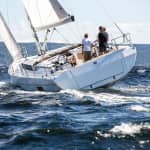
The Italian shipyard Solaris Yachts presents the CNB 68 as the direct successor to the CNB 66. The new model comes with two VIP cabins instead of one. It retains the open galley and enlarges the guest and owner's cabins. The overall length is 22.22 metres including bowsprit and stern flap, the pure hull length is 20.66 metres.
Hull and rigging
Philippe Briand adds more chines to the upper part of the hull. According to the manufacturer, this change promises greater efficiency and seaworthiness. At the same time, the living space below deck has been increased. The superstructure adopts the new design language of the CNB 62, with Briand stretching the lines for a balance between protection and sportiness. Buyers can choose between three rig variants. The standard aluminium rig offers a mainsail of 132 square metres, a furling genoa of 111 square metres, a jib of 91 square metres and a staysail of 53 square metres. The asymmetrical spinnaker measures 352 square metres. The mast height reaches 30.8 metres. The performance carbon rig increases the mainsail to 141 square metres, the genoa to 116 square metres and the jib to 96 square metres. The spinnaker grows to 371 square metres and the mast height to 32.4 metres.
Cabin layout
The CNB 68 now offers two fully-fledged VIP cabins. There is also an owner's cabin, a crew cabin and a utility room. This layout sets the boat apart from comparable yachts of this size. The owner's suite is located in the forward area. The two VIP cabins are located amidships. The crew cabin is located aft with separate access. The utility room is next to the crew cabin. The open galley remains a central element. It connects the saloon and dining area without partitions. The dining area offers space for six to eight people. Large windows bring daylight into the saloon and all cabins have their own bathrooms.
Interior design
Jean-Marc Piaton favours lighter tones and contemporary shapes, but retains the CNB DNA and adds fresh accents. White upholstery contrasts with dark accents. The lighting utilises LED technology for indirect light. Wardrobes and storage spaces are seamlessly integrated into the walls. The owner's suite has a double bed, wardrobes and a large bathroom. The VIP cabins each have double beds and en-suite bathrooms.
Deck design
The deck follows the open concept of the CNB 66 and the cockpit has two steering positions. All lines run back to the steering positions. This enables single-handed or crew operation. The bathing platform folds out hydraulically. It facilitates access to the water and the dinghy. The foredeck remains free of obstacles.
Sailing characteristics
The CNB 68 utilises experience from the CNB 62 and CNB 78, and the second chine is designed to increase stability and reduce drag. The carbon rig reduces the weight in height. The various keel options adapt the boat to different sailing areas. The shallow keel is suitable for coastal waters and anchorages. The deep keel offers advantages when cruising and in heavy weather. The standard rig is suitable for long journeys with a crew. The performance rig is aimed at sporty sailors.
Technology and equipment
The electrical system operates on 24 volts. A generator supplies power for longer stays without shore power. The air conditioning cools or heats all cabins. A watermaker produces fresh water from seawater. The navigation system uses modern electronics with touchscreens. Autopilot and chart plotter are standard equipment. The winch system comes from Harken or Lewmar. Hydraulic cylinders support heavy-duty work. The anchor winch works electrically with remote control. A bow thruster facilitates harbour manoeuvres. The engine delivers between 150 and 200 hp, depending on choice.
Technical data
- Brand: CNB Yachts
- Model: CNB 68
- Architect: Philippe Briand
- Interior design: Jean-Marc Piaton
- Manufacturer: Solaris Yachts SRL, Aquileia, Italy
- Overall length: 22.22 m
- Hull length: 20.66 m
- Waterline length: 19.30 m
- Maximum width: 5.64 m
- Draught standard cast iron keel: 3.45 m
- Draught optional: 3.45 m / 2.95 m / 2.50 m
- Fresh water: 1000 litres
- Diesel: 1200 litres
Standard aluminium rig
- Mainsail: 132 m²
- Furling genoa: 111 m²
- Jib: 91 m²
- staysail: 53 m²
- Asymmetric spinnaker: 352 m²
- Mast height: 30.8 m
Standard aluminium rig with tare bar
- Mainsail: 132 m²
- Furling genoa: 114 m²
- Jib: 91 m²
- staysail: 53 m²
- Asymmetric spinnaker: 352 m²
- Mast height: 31.5 m
Performance carbon rig
- Mainsail: 141 m²
- Furling genoa: 116 m²
- Jib: 96 m²
- staysail: 54 m²
- Asymmetric spinnaker: 371 m²
- Mast height: 32.4 m

Fridtjof Gunkel
Deputy Chief Editor YACHT
