


Over 99 per cent of all sailing yachts have an internal combustion engine. Sailing boats also need them for harbour manoeuvres, in calm conditions or to supply power on board. Two of the world's largest yacht builders now want to work together to change this. Groupe Beneteau and Fountaine Pajot Group are pooling their electrification efforts in a new joint venture: E-LEKTRA MARINE. Seven brands - Beneteau, Jeanneau, Lagoon, Excess, Fountaine Pajot Sailing Catamarans, Fountaine Pajot Yachts and Dufour - will be working on a common standard for electric propulsion and intelligent energy management. The alliance is unique in this form in the yacht industry.
More than just electric drive
The challenge of electrifying sailing yachts goes beyond pure propulsion. Unlike an electric car, which can be charged at any time from a socket, a sailing yacht must also be able to generate its own energy wherever possible. Solar modules, batteries, generator, propulsion, on-board comfort - all energy flows must be coordinated in real time. E-LEKTRA MARINE addresses precisely this complexity: the management of the entire energy autonomy on board.
Bruno Thivoyon, Chairman of the Board of Groupe Beneteau, explains: "With E-LEKTRA MARINE, two major players in the sailing industry are joining forces in an unprecedented alliance to accelerate the electrification of sailing. By pooling our industrial expertise, we want to establish open standards and make low-emission solutions simpler, more accessible and scalable."
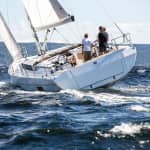
60 per cent market share as leverage
Together, the two groups account for 60 per cent of the global sailing yacht market. This mass should help to reach the industrial thresholds that make electric solutions competitive with combustion engines.
Mathieu Fountaine, Deputy Managing Director of Fountaine Pajot, says: "The E-LEKTRA MARINE joint venture with Groupe Beneteau shows that our industry can mobilise around common environmental goals. Today, electrification is becoming essential; it must now be made accessible to the entire sailing yacht market."
Technology is already tried and tested
Both groups have already gained experience with electric drives. Groupe Beneteau has been offering low-voltage electric solutions for sailing yachts up to twelve metres for several years, for example in Beneteau's Oceanis models. Fountaine Pajot uses high-voltage hybrid solutions for catamarans over 15 metres, such as the Aura 51 and the Samana 59. These technologies are now fully developed. Instead of each group developing its own technological basis, they now want to agree on a common standard.
E-LEKTRA MARINE works together with strategic partners: Alternatives Energies from La Rochelle, specialised in electrical system integration; Cirtem from Toulouse, expert in energy conversion and management; and EVE System from Lyon, specialist in battery pack design. The task of the E-LEKTRA MARINE experts for electric ship architectures is to define, specify and validate standardised solutions for electric propulsion and energy management - adapted to different yacht sizes and usage profiles.
Ambitious target by 2030
E-LEKTRA MARINE offers electrification solutions for sailing yachts from 9 to 24 metres. Depending on the size and application profile, all-electric systems, low-voltage hybrid or high-voltage hybrid solutions will be used. The system is also designed to optimise energy management between solar energy, engine, generator, comfort equipment and shore power.
The two groups are pursuing a clear goal: 10 to 15 per cent of the global sailing yacht market should be electrified by 2030. Groupe Beneteau began its electrification journey over 20 years ago, including with the first Lagoon 421 models. In recent years, all-electric solutions have followed in the Beneteau Oceanis monohull yachts from 30 to 40 feet, as well as hybrid solutions in several models such as the Excess 11 and the Jeanneau Sealoft 480.
Fountaine Pajot positioned itself in the electrified cruising catamaran market with the Aura 51 and the Samana 59. Building on these technical validations, the Group is now taking the next step and introducing electric solutions for all Fountaine Pajot Sailing Catamarans, Fountaine Pajot Yachts and Dufour monohulls brands.
Open standard for the industry
By pooling the volumes of seven brands representing 60 per cent of the global market, E-LEKTRA MARINE aims to create an open global standard. The creation of E-LEKTRA MARINE is a remarkable step in an industry traditionally characterised by competition. Two major competitors are working together to achieve a common goal: the decarbonisation of sailing. After jointly developing methods to analyse the life cycle of their boats, the two market leaders are now taking a further step and forging a joint decarbonisation roadmap.
What does this mean for boat owners?
Firstly, it is a declaration of intent by the two shipyard groups to find a common standard. If that were easy, they would not have to undertake this endeavour together. Up to now, electric drive solutions have only been economical for very small boats. The prices are currently still too high and there is a lack of efficient charging infrastructure in the marinas. It's not as easy with boats as it is with electric cars. It's not possible to simply pull over to stop for a charge while travelling. And without fast-charging stations, charging a large battery bank can be a test of patience lasting several days. So the hurdles are still very high at the moment, and a common standard would certainly be a step in the right direction.

Michael Rinck
Redakteur Test & Technik
