


Have they forgotten the stern? The "Zeeslang" - Dutch for sea serpent - must have seemed to the sailing world of the late 1950s like a yacht that had had its rear end sawn off. Because there are no overhangs! Worse still, the boat barely tapers towards the stern - common today, but almost sacrilegious in those days. The blunt transom looks like a dinghy. A comparatively vertical stem rises up at the front. All in all: outrageous! Well, the designer of this anticipation of modern yacht features had a certain success with his "Valk", an economy dinghy for short Sunday outings, designed in the hardships of the pre-war period, and an inland boat to boot. Had this concept simply been stretched in length? Who would venture out to sea in it, especially in the notorious waters of the Cape of Good Hope?
Also interesting:
Michael Baumann, 56, is now the owner of this sailing yacht affronts. Several coincidences led him to the deck in 2005 and later to the purchase. The aircraft manufacturer had just been transferred to Cape Town when he caught sailing fever during a team-building exercise on the 60-footer "Diel". "I've got another small boat back there," said "Diehl" owner Bernhard Diebold, pointing to the "Zeeslang", "why don't you get a sailing licence and take her?"
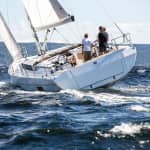
"I booked a sailing course with Atlantic Yachting that same evening," says Baumann on board the "Zeeslang", which is now moored on Lake Constance. As an aircraft designer, the lightweight construction immediately appealed to him. "A few weeks later, I had my day skipper licence from the Royal Yachting Association (RYA)." Use against care, that was the succinct agreement. But it soon emerged that a costly repainting was due. Both wrote down the purchase contract on a beer mat and signed it.
Rebellion against conventions
The "Zeeslang" may have foreshadowed the 1968 movement, in which conventions were generally questioned. The previous conventions of yacht design were pulverised here. At the time, it broke with almost all the values that were valid for a yacht at the time. The lightweight construction had far fewer frames. Load-bearing parts of the interior were only nine millimetres thin. Boats made of plywood were considered makeshift at best. The "Zeeslang", on the other hand, was deliberately built from it.
That was fitting: Dutchman Cees Bruynzeel ("C. B."), who commissioned the "Zeeslang", had already snubbed the yachting scene. As a door manufacturer, first in Hamburg and later in his home country, he produced "Hechthout" (hecht, Dutch for closely bonded), a new type of plywood in which the layers are glued together with Kaurit and phenolic resin instead of the previous glues, which dissolve in water and heat. Cees Bruynzeel had already floated one of his plywood doors in a pool of water to demonstrate its durability. He loved sailing and enjoyed winning. He didn't care about winning by calculated time. He won the Fastnet race in 1937 with the Sparkman&Stephens design "Zeearend".
While strolling through Zaandam, he is said to have revealed his brainwave to his friend Ericus Gerhardus van de Stadt shortly afterwards: The task for the designer, who was only known to a minority at the time, was to build a boat out of waterproof plywood, i.e. doors. The project was also a job creation measure, as Bruynzeel did not want to make anyone redundant during the economic downturn of the time. But not that the workers could now take a break: The boat had to be finished in 150 hours, the limit applied to employees and the designer. Cees Bruynzeel was a successful timber and door magnate, but now he wanted to set up a series shipyard. So was this a job that was doomed to failure? E. G. van de Stadt took the plunge, a handshake that would later earn him many pats on the back and recognition.
Polyvalk and "Zeeslang" are close relatives
He drew the first lines on a Friday, 1 September 1939, the day of the German invasion of Poland, which triggered the Second World War. The "Valk" boats, three doors long, rolled out of the factory in January 1940 and immediately met with approval and buyers. The designer van de Stadt was suddenly the talk of the town in the Dutch sailing world.
The "Valk", which weighed only 450 kilograms with a keel, sailed excellently and the first hundred boats were sold quickly. During the war, however, the successful streak ended with construction number 250. Temporarily: "Valks" from these first series are still sailing today. A design based on them is now built from fibreglass-reinforced plastic as the "Poly-Valk". E. G. van de Stadt had made a virtue out of necessity and thus anticipated what later towing tank tests confirmed: short keels with a flat bottom and chines are fast. And van de Stadt also applied precisely these design features to the larger sea yacht "Zeeslang".
She is moored at the classic yacht jetty in the Interboothafen Friedrichshafen for our trip. Michael Baumann is now back at Lake Constance and has brought his yacht with him from Cape Town. But despite being built in the right year, she looks strangely alien among the high-gloss varnished mahogany toothpicks with their pointed bows and wide projecting sterns. And it also doesn't fit in between the high-sided new constructions on the pontoons opposite. Yet it is much closer to them in terms of design.
"Zeeslang" can also be paddled
Without a motor - as in the past - the boat first goes out onto the lake with the crew paddling on the foredeck, then pulled by one of the exhibition motorboats.
Meanwhile, Michael Baumann recounts the constructive path from the "Valk" to the "Zeeslang": door manufacturer Bruynzeel planned to move to Cape Town in 1956 and had a weekend boat designed for the new waters there: fast, easy to sail and seaworthy enough for the open water off the Cape; there was no question of cosy living on board. After all, on Bruynzeel's predecessor yacht, the crew had to do without sleeping mats, which were now socially acceptable on the Grammfuchser.
E. G. van de Stadt used these specifications to construct "an oversized dinghy that we wouldn't even trust in Table Bay, the only sheltered area of the Cape coast", the "History of the Royal Cape Yacht Club" quotes the outspoken sceptics in Cape Town. Van de Stadt himself had withheld a skeg from the boat, the rudder blade is exposed, the short keel with its visionary swept fin and the bomb as well as the mast, which was almost centred at the time, gave the boat a silhouette that took a lot of getting used to. The low freeboard also contributed to this. This can still be felt today, the water of Lake Constance can be reached from the cockpit with an outstretched arm.
The sails are set quickly using the winches on the spruce mast. But now, at just 1 Beaufort, a disadvantage of the construction can be recognised: The transom dives. This was no problem for the prevailing winds on the Cape, the water flows off smoothly even at low speeds.
"Zeeslang" dupes the elite
However, it is reported that the V-shaped hull at the front and flat aft began to planing at 5 Beaufort. Even during the test runs on the North Sea at the time, the needle of the Kenyon log is said to have been at 12 knots. In the stormy 70-mile race from Cape Town around Dassen Island, all opponents gave up except for "Paragon 3", a 16-tonne cutter that was considered the fastest boat in the club. On board, they thought they were first and saw a fishing boat running towards them.
But by then "C. B." was already on his way back. He had made up 40 minutes at the finish and sailed one of the devil's ears off. "Length runs", it had been said beforehand; but the "Zeeslang" is stingy with overhangs, and she runs anyway. She owes this to her lightness: 1.8 tonnes at nine metres was quite something back then. This was achieved thanks to a largely self-supporting hull. Today, lightweight racing yachts are referred to as ocean-going dinghies, and admiringly so. At the time, the "Zeeslang" was considered a "sailing cigar box" - which was meant rather pejoratively.
Plywood boats were predicted to have a short lifespan, but they were wrong. However, the fact that "Zeeslang", this turning mark of yacht design, is still sailing today is thanks to several foster parents. In 1960, Bruynzeel sold the boat and it continued to be raced. Podium finishes were followed by a victory in the Cape Town to Saldanha Easter Race. She also won the 250 miles to Gansbaai and back. She once logged 73 miles in 6 hours and 20 minutes - 11.5 knots. On average!
Saved from destruction
With the advent of new settlements, however, victories became increasingly difficult and the boat fell into disrepair. After several changes of ownership, the South African sailor Colin Farlam founded an "Action Group" to rescue the boat. The group searched - unsuccessfully - for sponsors and liaised - unsuccessfully - with the Maritime Museum in Cape Town. Eventually, Tony Randall acquired and restored the now mangy racing goat, but his work was obviously too superficial, because when Bernard Diebold, Michael Baumann's previous owner, took her over, a refit had to be carried out that was so thorough that the cockpit, deck and superstructure had to be rebuilt. Fortunately. Intermediate owners had replaced the most striking part of the boat with an ordinary cabin superstructure.
Now the previously installed canopy made of greenish "Perspex" (polymethyl methacrylate, acrylic glass) and plywood scaffolding arches over the heads again: the view and the flood of light are similar to those in the observation car of the Rheingold Express or one of the dome cars of the Canadian railway: heavenly, in two respects!
Did design engineer E. G. van de Stadt get the idea for this light-coloured bonnet during a company outing? A historical photo from the 1950s shows the employees of the design office in a fully occupied convertible coach with rounded skylights.
There were very practical reasons for the pulpit on the boat, as it meant that the course and sails could be kept in view from the warm and dry cabin. A second tiller protruded forwards under the cockpit floating on the deck. Between the aft berth and the two lockers at mast height, van de Stadt had placed bucket seats across the centreline for steering. How comfortable they are! Your hips just fit between the side walls, so the support must have been excellent, especially in rough seas. The winches had additional cranks below deck.
Remarkable details
Neither were reinstalled on the "Zeeslang" during the refit; the owner at the time reported that he preferred to stick his nose into the wind. However, Cliffie Leih, the owner after "C. B.", reported that he regularly used this special feature "when sailing in with nobody on deck, much to the consternation of onlookers".
However, the hinged cockpit cover and the extremely technical-looking main boom, a board with side mouldings, have been retained. It has the historic fittings, but is a replica: "I had signed up with a skipper for the 1700-mile race to St Helena and equipped the boat accordingly," explains Michael Baumann. "I imagined it would be a calm, tailwind race, because yachts and crews come back with the mail boat." But then it blew at 8 Beaufort, and in a patent gybe the boom crashed into the backstage and broke. "I was also very upset. We lashed the boom and sail to the deck and returned to Cape Town. Today I would sail with three people and, above all, set a bullstander."
Cees Bruynzeel would probably have raved. In fact, he didn't just have to be tough in enduring the breakers on board. A fellow sailor on his later "Stormvogel" reported that "the crew had to pay two Rand per man per day. I asked Bruynzeel why, because that was negligible for a man of his wealth. He smiled and said the measure separated the men from the boys."
Cigarettes were allowed on board - lit with halved matches. Another speciality: the door tycoon was never seen at award ceremonies, he always turned towards home at the finish line. "Zeeslang" previous owner Bernard Diebold had to travel to the Netherlands to finally obtain the necessary plans for the refit from van de Stadt, which "C. B." had not handed over at the time of the sale: "Why?" he is said to have said. "They cost me more than I'm getting for the boat now."
Model for replicas
It is known that a slightly modified form of the "Zeeslang" was built in several units as the "Black Soo" version, which is also linguistically very close to the original: "Soo" means "little snake" in Sioux Indian. The construction of the Royal Cape One Design yacht (RCOD) is also very reminiscent of the "Zeeslang". As Cees van Tongeren, the twelfth draughtsman employed by the van de Stadt design office, told YACHT: "The main difference is the jump, otherwise they are almost the same boats. In addition, the 'Zeeslang' has a 7/8 rig; all similar designs are top-rigged."
The reason: Bruynzeel wanted one-offs and was able to enforce this with the designer. One of these "Zeeslang" blueprints was built as design number 509 for a client in Los Angeles, but the boat fell off the freighter during delivery. In 1960, another one, number 519, was built for him. Number 596, a similar design, went to San Francisco in 1968. E. G. van de Stadts designs of the following years, even those for Bruynzeel, were not as radical as the "Zeeslang", although he continued to pursue the separate lateral plan and lightweight construction.
The "Zeeslang", on the other hand, had a famous predecessor, the "Zeevalk": the design, also commissioned and steered by "C. B.", sailed to second place in the 1951 Fastnet Race as a small and particularly light boat. "The designer Rod Stephens from Sparkman & Stephens, the hottest office at the time, took one look at the runner-up," recounts a fellow sailor, "and asked rather rhetorically: Should we go to sea with this?" The yachting world was only able to grasp the profitable advantages decades later, instead dismissing the early success as the accidental result of skilful sailors.
The dinghy-like keel yacht was certainly far ahead of its time, as was the construction method. In 1953, at the time of the classically planked long-keel yachts, YACHT reported on plywood constructions in a somewhat fatherly and distanced manner. It was not until 1963 that the material was established in boatbuilding - and was then quickly replaced by glass fibre reinforced plastic.
Ericus Gerhardus van de Stadt was part of this change, which also became very well known in Germany. From 1965, the Dutchman was successful with the "Varianta" and various other GRP yachts, which he designed for Willi and Heinz Dehler and their shipyard in Freienohl, North Rhine-Westphalia.
Technical data of the "Zeeslang"

- Design engineer: E. G. van de Stadt
- Total length: 9,00 m
- Waterline length: 7,95 m
- Width: 2,00 m
- Depth: 1,80 m
- Weight: 1,8 t
- Ballast: 750 kg
- sail area: 32,9 m
This article was published in May 2020 and has been updated for this online version.

Nils Theurer
Freier Mitarbeiter, Südkorrespondent
