


"Spatz IV": 20-metre dinghy cruiser is not a racing boat and therefore exotic
Nico Krauss
· 08.03.2026


- More clog than flounder
- How does a two-tonne dinghy cruiser sail?
- With the dinghy cruiser simply on the beach
- "Spatz IV" was exhibited at Hanseboot
- Dinghy cruiser presents an almost immaculate appearance
- Sophisticated, pragmatic and extremely cosy
- Technical data of the 20-person dinghy cruiser "Spatz IV"
Sailors regularly turn their heads in the harbour of Kappeln when the wooden dinghy with the distinctive superstructure heads towards Arnis. "The hull looks like a dinghy. But then this large superstructure - it doesn't go together." Or does it? "The hull, the cockpit and the rig: it's clearly dinghy cruiser style. That can't be right!" Great guesswork on the pontoons.
Other special boats:
- "Unea Grey": Small cruiser made from sauna tree becomes a masterpiece - and a real eye-catcher
- Mini Colin Archer: A fully-fledged classic in miniature format
- Special boat: From fishing boat to sailing jewel - the Chiemseeplätte
- "Sir Shackleton": Pilot cutter went aground and serves as a training ship after refit
The solution can already be found in a 1953 YACHT: "The other extreme" was the title given to the small boat by our colleagues in an article about the building regulations for dinghy cruisers and the different needs of racing and travelling dinghy sailors. The dinghy cruiser, originally designed as a touring boat, increasingly developed into a pure racing boat from the 1950s onwards and polarised the scene.
There were fears of a material battle at the expense of an affordable class boat suitable for sailing. According to the YACHT commentators at the time, this was not really a problem, but rather an advantage of a design class: "The joke of such a class is that it should cater more to individual wishes than a standardised class can do. At the same time, you have to accept that extremes will emerge on both sides," the author concludes Solomonically. And that brings us to "Spatz IV".
More clog than flounder
At first glance, the superstructure and hull do indeed appear somewhat ponderous; the proportions do not yet seem to match the visual habits of sailors' eyes: Surely a "real" dinghy cruiser is petite and very flat, more like a flounder than a clog? Exactly not. Because this is the other "extreme". And indeed, the "Spatz IV" is a "real" 20-metre dinghy cruiser.
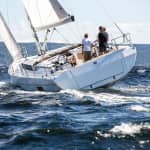
"The first owner and client wanted as much space as possible below deck and a solid hull," explains the current co-owner Behrend Oldenburg, 51, from Hamburg. This makes the "Spatz IV" - the name has not been changed to this day - one of the rare examples with an extreme focus on the positive characteristics of cruising sailing. "During construction, the minimum requirements of the class regulations for the use of materials were exceeded by up to 20 per cent," explains Oldenburg. "And the substance of the boat still benefits from this today."
The design was drawn up by designer Adolf Harms, who also designed the 20s "porpoise" for genius Albert Einstein on paper brought. The idea of the travelling cruiser was realised by the Christian Scharstein yacht and boatyard in Strande near Kiel, today the shipyard of the Kiel Yacht Club.
At the request of the client, a building materials dealer from Schleswig who had good connections to the timber market, the panelling was made from 16 to 17 millimetre thick sapele mahogany and joined using screws and plugs. The transom is even made with a wood thickness of 25 millimetres. Additional frames were used in the mast area, and galvanised steel braces were installed in the deck to absorb the forces of the shrouds.
An additional plank walk in the hull and the higher superstructure than required by the construction regulations for the 20 dinghy cruiser class make the "Spatz IV" a small fortress of cosiness and underpin the extreme claim. This is also reflected in the weight: At around two tonnes, the Jolli is a whopping 1270 kilograms above the minimum weight specified in the class regulations.
How does a two-tonne dinghy cruiser sail?
"Let's go sailing. With the breeze, we'll make good time to Lindaunis," says Behrend Oldenburg, already untying the fore line. "You can't understand this boat when it's in the harbour, it's a cruising boat." Together with his partner Heidrun Mylius, 52, he has already made the small cruiser ready for a day trip on the Schlei. An 8 hp outboard motor brings the wooden hull accurately out of the box; originally, a fixed side engine was installed in the cockpit, which had a removable outboard shaft. This was an exotic construction even back then. Behind Arnis, the jib, which is attached to staysails, is hoisted and the mainsail is also hoisted hand over hand from the cockpit by means of a pendant.
But how does a two-tonne dinghy cruiser sail? As expected, it doesn't take off immediately in a light breeze; it takes a moment for the propulsive force to get the heavy planks moving. But then, with a slight shake in the sheets, the 7.74 metre long Jolli gradually gets going. It is good-natured and well-balanced on the rudder, the qualities of a cruising boat are also expressed here. All in all, ambitious cruising sailors have three headsails on staysails plus two gennakers at their disposal.
We cross towards Lindaunis and are overtaken by keelboats with considerably more height and speed, such as folkboats and dragons. The tacking angle is rather modest, and the upstream flow is not optimal in this configuration. Sailmaker Nils Springer from Grödersby had found a suitable solution: Retrofitting a barber hauler in combination with the large jib allows a tacking angle of 100 degrees in a good breeze. On the downwind course back to Arnis, however, the "Spatz" shows what it's made of. Centreboard up, boom out: she easily catches up with the keelboats.
With the dinghy cruiser simply on the beach
In his article on the building regulations for dinghy cruisers, the quoted YACHT author also had an old-fashioned but timelessly appropriate statement on this: "The touring sailors among the dinghy cruiser owners are not really interested in the fact that fast and particularly regatta-capable boats are also being built, because they wouldn't have to be interested in that if they only do touring trips, but rather that the boats mostly used for touring trips lose any chance of success against the fast competition."
The previous owners have amply demonstrated that this dinghy cruiser can take a beating and is a real touring boat. Voyages have been documented from East Frisia via Sylt, Esbjerg, Hvide Sande, Thyborøn, Limfjord, Kattegat, Kiel and back across the channel into the North Sea. The "Spatz IV" is currently enjoying a comparatively quiet retirement and is sailed exclusively on the Schlei, where the owners appreciate the diversity and security of the Baltic Sea estuary. They have been exploring the area for 15 years, anchoring in the countless bays and harbours between Schleswig and Schleimünde. There is always room in the popular harbour, even when all the moorings are occupied. With a draught of just 0.22 metres and the centreboard raised, the owners can sail right up to the beach.
"We're looking for deceleration instead of adrenaline rushes and regatta fever," summarises Oldenburg. "Being self-sufficient for several days and a boat suitable for touring with storage space in the lockers and under the bunks for canisters, food and reading material."
"Spatz IV" was exhibited at Hanseboot
His son Hinrich, 13, has been part of the regular crew since he was two years old and is also pursuing his own sailing career: First in the Opti, now he is gaining regatta experience on the Elbe in the Laser. The Jolli has been the family's floating happiness on many holidays. Now, however, it's getting a bit cramped on the little boat, as the little boy wants to spend his free time with friends as well. In addition to the classic cruiser, father Oldenburg also has an O dinghy moored on the Alster in Hamburg for a quick kick after work.
Before the 20s dinghy cruiser came into the family, they searched and researched thoroughly. Club mates warned them against buying an older wooden dinghy cruiser: "Many sailors advised me against it and painted the horror scenario of a floating wetland biotope." But that couldn't dissuade the future owners from their course; the type of boat was a foregone conclusion and the material was to be wood.
The anecdote in the purchase history: About 20 years ago at the Hanseboot in Hamburg, the "Spatz IV" was exhibited and honoured at the stand of the German Boat and Shipbuilders' Association as an example of special boatbuilding craftsmanship. Visitor Behrend Oldenburg was also there and remembers the time: "I thought: Nah, guys, that's not a real dinghy cruiser! This superstructure and this shape."
Dinghy cruiser presents an almost immaculate appearance
But preferences and needs change - this time, the keen sailors immediately fell in love with the wooden "Spatz". And although it was the most expensive boat on the future owners' wish list, they couldn't resist and bought the dinghy cruiser in the very best condition without further ado in 2006.
This has remained the same to this day, 15 years later and recognisable at first glance. The superstructure, hull, deck and rigging look almost immaculate. An extensive restoration was carried out between 1997 and 2000 by the previous owners themselves, and the renowned boatyard Janssen & Renkhoff in Kappeln also lent a hand. Among other things, frames and seven gangways were replaced and a new deck was laid with a stave deck made of Siberian larch. The original appearance has been preserved to this day.
Apart from new sheet winches, all fittings are made of bronze. The rusted steel brackets on the centreboard box were replaced with newly cast solid bronze brackets. The rudder, fittings and tiller were also completely renewed during this restoration phase. "All of this was first-class work, which is why no major substantial interventions have been necessary to date," reports Behrend Oldenburg.
The annual maintenance work is carried out during winter storage. The next project on the dinghy cruiser will be the renovation of the cabin interior. "Sanding, repairs, a new coat of paint and a colour scheme for the ceiling," the energetic owner couple recite the work list. It is already very cosy below deck. The interior of the "Spatz IV" is extremely spacious for a small cruiser that is just under eight metres long and 2.50 metres wide: "Open all the way to the foredeck, there is a surprising amount of space here, despite the centreboard locker and cupboards. The galley is equipped with a classic spirit cooker and historic ship's china, while the benches in the saloon are well upholstered and cosily decorated.
Sophisticated, pragmatic and extremely cosy
In a 1955 issue of YACHT, the galley concept of the dinghy cruiser is explicitly described as a fortunate solution: "The cooking area is equipped with a two-burner propane gas cooker, which, however, is not set up to swing. It is closed off at the front by an insertable plate. When cooking, the two-part plate can be set up at the side as a protective wall or used (on the right) as a work table. The plates are held behind the cooker. The drawer under the cooker contains cutlery and provisions." This has not changed to this day.
A folding table with two wings is integrated into the centreboard box, which hardly takes up any space when lowered. Well thought-out, pragmatic and extremely cosy: the living space in the "Spatz IV" is anything but a form-glued crawl space in which you live eye to eye with a centreboard box and packed travel bags and sailing sacks. A Spartan racing dinghy cruiser, trimmed for low weight and high speed, is the other extreme.
And once again, the example of this aged dinghy cruiser shows the different possibilities that boat builders of yesterday and today are exploring and developing. Engineers are working on new materials and construction methods to make boats fly on foils, and the dinghy scene is constantly firing up new moulded rockets for the regatta course. A "Spatz IV" can only flap its wings wearily in such a situation, where a peep really has no place. However, on a cruise in the mudflats or on the Baltic Sea with a strong wind and evening anchorage, it is right up there at the front.
Technical data of the 20-person dinghy cruiser "Spatz IV"

- Construction: Adolf Harms
- Shipyard: Christian Scharstein, Strande
- Year of construction: 1953
- Sail number: R 459
- Total length: 7,74 m
- Width: 2,50 m
- Depth: 0,22-1,36 m
- Sail area on the wind: 22,5 m2
- Spinnaker: 19,7 m2
- Class: www.20er-jollenkreuzer.org
The article was first published in 2022 and has been updated for this online version.

Nico Krauss
Freier Fotograf
