


Müggelsee: Historic ice yacht sails for the first time after complete restoration
Fabian Boerger
· 10.02.2026


The cracking begins quietly. The top layer of ice crunches to the right and left of the hull as the runners make their way through it. Then the "Papagena" picks up speed. One and a half tonnes of wood start to move and accelerate. Only a short time later, the 15.60 metre long sledge thunders towards the opposite shore of the frozen Müggelsee at around 70 kilometres per hour. It is a powerful feeling.
The wintry temperatures of the past few weeks have made it possible. Europe's largest inner-city lake is completely frozen over. In most places, the ice measures over 20 centimetres. Ideal conditions for an ice yacht like the "Papagena" - a historical replica from 1996, built according to plans from 1906. Back then, in the north-east of the USA, sledges like this one transported mail and goods across the frozen Great Lakes.
At this point, you will find external content that complements the article. You can display and hide it with a click.
Designed in the USA, built in Finland
The story of the "Papagena" begins in Boston, leads via Finland to Berlin - and almost ends in flames. A Berlin car dealer, himself an ice sailing enthusiast, had her built in Pietarsaari, Finland, in 1996. He had procured historical plans from a Boston library especially for this purpose. Before his death, he gave the yacht to an ice sailing club - as a legacy. The club was to preserve it and sail it on occasion.
The ice yacht was dismantled and stored in a barn. Then the barn burned down. Much could be saved, but parts of the hull fell victim to the flames. What remained was stowed away again. Years passed. The "Papagena" fell into oblivion. Until Matthias Sponholz heard about her.
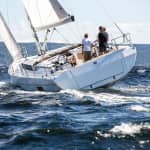
Complete restoration of the ice yacht under own management
"At some point, we learnt that the 'Papagena' was lying around there. Then we made an effort to get it," says Matthias Sponholz. Together with his three sons Felix (26), Niclas (33) and Florian (37), he took over the stored material. Together, they collect what is left. Individual parts, scattered, partly charred.
What follows is a complete restoration. They rebuild the hull, repair fire damage and completely redesign the rear steering block. Mast, gaff, runner plank, skids - the original parts can be retained. A stroke of luck.
They benefited from the fact that they were able to carry out all the work in their own company. The family runs both a metal construction business and a Timber construction company. "Everyone did what they do best," says Matthias Sponholz. "But all of us can do both wood and metal. That mixes together"
The family are also no strangers to ice sailing. Matthias' grandfather used to go ice sailing on Lake Müggelsee in a 15-metre boat. Back then, the lake froze over more often. Matthias grew up with ice sailing, as did his sons. Sailing in summer, ice sailing in winter - a life by and on the water. "It gives everyone a hobby, a goal," he says.
Waiting for the right winter
After completion, the wait begins. "We didn't know whether we would ever sail her," says Matthias Sponholz. "But she's a hobby for us. And the satisfaction of restoring her." The fact that the winter of 2025 will actually bring so much ice - "that's great luck".
At the end of January, the time has come. In front of Borkenstrand on Müggelsee, they lift the individual parts from the trailer with the help of the company's own crane and assemble them on the ice. It takes half a day. "The first time was still a bit of practice," says Sponholz. "We'd never assembled them before. We first had to get to grips with which shrouds and where which part should go." The many years of experience with other ice sailors helps. A lot of things are similar, the moves are right.
More about ice sailing:
A tank on skids
As the "Papagena" stands there, she attracts attention. Curious people stop, talk to the family, want to know more. No wonder. This ice yacht has little in common with the sleek, modern ice yachts that usually glide across the Müggelsee.
Instead of sitting in a closed hull, the sailors sit in pulpits on the centre hull - exposed to the wind. From there, they operate the winches and control the steering skid at the stern with a tiller. The "Papagena" carries 65 square metres of sail, divided between a gaff-rigged mainsail and a historic self-tacking jib.


By way of comparison, modern ice sailers manage with 15, 12 or, in the case of DN sleds, just 6 square metres. The sails of the "Papagena" are made of cotton fabric - heavier and more bulbous than modern sailcloth. The jib is held by a wooden jib arm, the sheet runs over a brass pole. Everything looks massive, bulky, out of date.
"It drives like it's on rails"
"The length and projection make them very cumbersome," says Niclas Sponholz, the middle son. "You feel like you're in a tank on ice." Where smaller ice sailors can slip away even in light winds, the "Papagena" needs one to two wind forces more. It only gets going from ten knots upwards. On the other hand, says Felix, the youngest, "she is much more stable and robust in stronger winds". They have not yet experienced the kind of sideways sliding that can happen to smaller sledges.
She sails like she's on rails - simply a very solid ice yacht."
Teething troubles and big plans
The family's first maiden voyages were not without mishaps. A skid broke in a crevasse in the ice. Another came loose from the wood. Matthias Sponholz waves it off. Childhood illnesses. "The sledge had been lying around unused for decades." Unvarnished wood dries out and cracks. The weak points only become apparent under load - incorrect planks, damaged runners. "That's why we wanted to set it up here for the first time," he says. "Before we get it ready for a bigger tour next time." Because the family has plans. They want to take the "Papagena" up to Scandinavia. Sweden's north, Finland - where the lakes freeze over more reliably than the Müggelsee in Berlin.

Fabian Boerger
Editor News & Panorama
