


"Andrillot": This Bermuda cutter founded Laurent Giles' legendary Vertue Class
Nic Compton
· 25.01.2026


"We felt completely safe. The log often showed more than seven knots. Sailing such a small ship so well above hull speed is fascinating. We felt very safe below deck." For Uli Killer, the challenging journey in the tidal area from Dartmouth in the south of England to Vlissingen in the Netherlands over 380 nautical miles along the coasts of the English Channel was the first trip with his newly acquired, almost eight-metre-long "Andrillot" - and turned out to be more eventful than expected. "We had strong winds the whole time," says Killer. It was a pretty tough job, before the wind at the tiller, with rough seas from astern. "In the passage at Portland Bill, the water was flowing like a whirlpool. Then suddenly a thunderstorm came out of nowhere. Lightning flashed around us. The next day we passed the Needles, and just before the Isle of Wight the tide was against the wind. High waves developed and some of them came in over the stern."
Other special boats:
Not even the stay in Lymington, where the previous owner was to be visited, went according to plan. In the middle of the night, Uli and his son Moritz, who was on board, were woken up by the fact that they had been rammed by another yacht. A shipyard near Cowes took a week to put everything back in order. However, the drama was soon forgotten after sailing between fifty and sixty nautical miles.
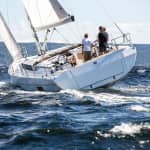
"Andrillot" becomes the model for an entire fleet
Andrillot" was once created for adventures of this kind. And indeed, it was spectacular sea voyages that first made her famous - and then became the model for an entire fleet of small long-distance yachts sailing around the world: the legendary Vertue class. And this is her story.
In 1935, Dick Kinnersley, a lawyer from the island of Guernsey, commissioned the British designer Laurent Giles to construct a yacht. It was the beginning of an illustrious career. Adrian Morgan, also a Vertue owner, sixty years later: "I wanted a flat stern and beautiful lines. As I couldn't afford an engine, I needed a lot of sail area, so I needed a topsail."
According to Kinnersley, the origins of the design lay in the seven-metre Lymington L-Class, which Giles had designed two years earlier. The result was a simple, 7.70 metre cruising yacht whose distinctive lines were influenced by her ancestors, the workboats, with an easy-to-operate gaff rig described by contemporaries as the pinnacle of its kind. The hull shape was moderate in every respect. Giles himself was reserved in his judgement of his creation. "There was nothing extraordinary about the original concept. It was just a contemporary interpretation of the pilot cutter theme, with all the proportions scaled down to a very small size."
Giles never changed the hull lines
In fact, history would show that the Giles design #0015 became something very special. And while there were many different variations of the small long-cruising yacht over the coming decades, Giles never changed the hull lines. The fact that he was firmly convinced that he could not improve them became clear at the latest when the replica in GRP was also built unchanged.
A key role in the Vertue story was played by Giles' colleague Humphrey Barton, who completed a number of long voyages on sister ships, which were widely reported at the time. Further orders for the design were not long in coming. However, almost all subsequent boats had the Bermuda rig designed for Vertue No. 2, "Moni", in 1937. Strangely enough, the class was not given its name until ten years after "Andrillot's" launch. At that time, nine boats had already been built according to the design. One of them was Vertue No. 5, "Epeneta". In 1939, the year the war broke out, her owner sailed a 745 nautical mile voyage on the English Channel and was honoured with the Vertue Challenge Cup. This prize is named after Michael Vertue, the librarian of the London Little Ship Club. It was awarded annually among the members for the best travel documentary. When Giles was looking for a name for the class after the end of the war, he chose the name Vertue in honour of this achievement.
Shortly afterwards, the design underwent its first change with a small doghouse. Vertue No. 12, "Kishtie", was the first to receive the new superstructure in 1946. At the same time, the freeboard was slightly increased and the deck step reduced, resulting in a little more space below deck. However, the cabin is still compact by today's standards, to put it mildly.
Several spectacular ocean voyages in Vertues
Barton completed his most sensational voyage on one of these post-war Vertues. With Vertue No. 35, it took him across the Atlantic to Newport, Rhode Island, in 1950. The book about this voyage, on which he constantly had to battle storms and headwinds, established the reputation of the little Vertue as a seaworthy long-distance vessel.
Barton's Atlantic voyage resulted in a further model upgrade, during which the superstructure was enlarged once again and the mast, which was on deck, was pushed through onto the keel. The first two of these so-called ocean-going Vertues, "Icebird" and "Speedwell", were built by Cheoy Lee in Hong Kong in 1952.
Many other spectacular ocean voyages were sailed in Vertues. For example, the two Atlantic crossings by David Lewis in "Cardinal Vertue", the first of which was part of the OSTAR 1960 race, on which he crossed the finish line in third place after the ocean icons Francis Chichester and Blondie Hasler. Most of these boats were traditionally built from wood, and from 1963 onwards several were even built from teak, again by Cheoy Lee in Hong Kong. Two boats, "Virtue" and "Sarcelle", were built in Holland in steel and one, the "Luana", in aluminium in 1992.
First refit of the "Andrillot"
It was only a matter of time before someone came up with the idea of building the Vertue in GRP. In 1976, a mould was created for the first time. The freeboard was again increased slightly and the hull was made slightly wider than the original. Around forty boats were built from the mould, most of them at Bossoms in Oxford - the most recent example is "The Good Shepherd", built in 2000. 1994 saw the creation of the first Vertue in moulding construction, "Ocean Rambler", and the boat is still built traditionally in wood from time to time.
"Andrillot", which stands at the beginning of this success story, remained with first owner Kinnersley until 1947. Seven followed before the father-son team of Peter and Tim Stevenson took over the helm in 1982. At that time, the ship was in a deplorable state. Peter and Tim moved it into a barn and dedicated two years to a comprehensive restoration. At that time, the original short superstructure had already been extended forwards and the rig had been converted to Bermuda rigging. The jib boom had disappeared, replaced by a double forestay - the so-called slutter rig: a mixture of slop and cutter. The mast, which had originally been set through on "Andrillot", had also been moved to the superstructure. Peter decided to leave all the modifications as they were, but to add the jib boom again.
In the years that followed, Peter sailed the ship intensively from his home port of Lymington. He rounded the eponymous Andrillot Rock on the south-east corner of Guernsey several times. Most years, Tim accompanied his father for a week of sailing together. When the senior died in 2002, Tim took over the care of "Andrillot", which was now at home on the River Exe in Devon.
"She was a fabulous seagoing vessel, fast and not too wet, except when a stern sea came in," recalls Tim. "She didn't like being bumped, but if you dropped ten degrees, she ran absolutely great. We didn't have a guard rail, but we were able to use the forecastles deflected aft above deck like lifelines."
Last change of ownership of the "Andrillot"
After all the hard sailing, it became clear that fundamental mistakes had been made when rigging the Bermuda rig and lengthening the superstructure. At some point, the structure was no longer able to support the mast. There were signs of fatigue, deck beams were breaking and it was time to do something.
Boat builder Michel Le Moigne in Dartmouth - who had already made a name for himself with various restoration projects - was commissioned to get things in order. Le Moigne was given the task of focussing on the structure of the superstructure and deck. The original idea of reconstructing the original gaff rig was dropped due to concerns about the cost of the mast and booms as well as the many new sails. Instead, Le Moigne retained the existing structure and reinforced it with three outriggers.
At the end of the 2019 season, "Andrillot" was finally ready to be rigged and sailed again after three years. As it turned out, "Andrillot" had now become a completely new boat. The old ship, which Tim and his father had sailed up and down the English Channel for years, had been a roughly hewn workboat with only its history to show for it. The "Andrillot", which was now being pushed out of the temporary tent shipyard on Old Mill Creek, was a classic in contrast, whose immaculate paintwork fulfilled all expectations of what a historical gem should look like, no matter how sophisticated.
Then Tim wanted to part with the boat. And in Uli Killer, he found a buyer who was unusual in more ways than one. He left his job as managing director of a financial services provider when it began to make him ill. He completely turned his life around, began an apprenticeship at the boatbuilding academy in Lyme Regis and set up his own boatbuilding business in his home in southern Germany, building dinghies. He began his first major project with the restoration of the gaff cutter "Wild Duck". It soon became clear that this would take longer than expected. In order to be able to sail in the meantime, something handy was needed.
Time on board is the continuation of a beautiful story
"I found 'Andrillot' on the site of the broker Wooden Ships, where she was offered as restored," says Killer. "She looked nice and was affordable. Her history didn't tell me anything, I even had to call my friend Martin Nott, who had also learnt at Lyme Regis, to ask who Laurent Giles was. Then I came across countless articles in English and American magazines and gradually realised what a fabulous story there was behind the boat. And that it is also number 1."
But there is something else that makes Killer an unusual buyer for the boat - he is 1.85 metres tall, but the clearance below deck is only 1.50 metres. But that doesn't bother him. "We'll get used to it," he assures cheerfully. Even if Killer didn't realise what a treasure he was buying at first, he is now fully aware of its importance. "And last but not least, our time on board is the continuation of a beautiful story," he says. "Because the previous owners, father and son, sailed the ship together for 39 years. It had a good influence on their relationship."
"Going on the crossing with my son was a wonderful experience," says Killer. "At first, the high seas demanded a lot of respect from him, but by the end he was completely used to it and enjoyed it. He may not realise it now, but in a few years' time he will look back and realise how important this trip was for us."
Killer also dreams of having the original gaff rig back in place for his ninetieth birthday, and he also hopes that his son will take over the ship one day. And so it looks as if "Andrillot" will pass from father to son once again. The little boat with the strong heart has now found a new home on the Schlei, where it can live out its first century in safe harbour. "Andrillot's" designer Laurent Giles could not have wished for anything better.
From workboat to small yacht


The main topic of the 2018 restoration at Michel Le Moigne's shipyard in Dartmouth was the structure of the deck and superstructure. The rigging placed on deck made supports necessary to better distribute the forces occurring. This also involved replacing parts of the interior, and finally a new cockpit was due. For cost reasons, the "slutter rig" (slop with cutter foresails) was retained. The refit turned the rough working ship into a small, pretty classic that does justice to its maritime-historical significance.
Technical data of the "Andrillot"
- Construction: Laurent Giles
- Shipyard/year of construction: Moodys/1936
- Building material: Oregon pine on oak frames
- Rigging: Bermuda cutter
- Torso length: 7,70 m
- Waterline length: 6,55
- Width: 2,20 m
- Depth: 1,40 m
- Weight: 4,2 t
- sail area: 35,3 m²
- Theor. torso speed: 6.21 kn
- Sail carrying capacity: 3,7
The article was first published in 2022 and has been revised for this online version.
