


Happy Cat Star Carbon test: On the water in 20 minutes with an inflatable cat
Michael Rinck
· 04.04.2026


As we all know, almost every boat is a compromise between speed, comfort, ease of use and other factors such as price. Grabner has a very unique concept with its Happy Cat Star Carbon: comfort only exists in terms of pack size, the inflatable cat fits in a conventional boot. What is special, however, is the speed potential combined with very simple operation. This is because speeds far beyond the 10-knot mark are possible either with elaborate regatta boats or small foils such as the Motte, which are also complicated to steer. The Happy Cat Star Carbon makes the fun of high speeds easily accessible. Of course, there is one catch: the price is high.
Also interesting:
The test begins on the Elbe with unloading the five panniers from the boot. The longest piece measures 1.80 metres. The bags weigh a total of 74 kilograms. However, as it is divided up, the individual packs are not too heavy. This is followed by a puzzle with 19 individual pieces. The two largest are the inflatable hulls. They are connected to the carbon fibre frame without tools. Everything is simply plugged in, pulled into piping rails or locked with quick-release fasteners.
According to Ewald Grabner, head of the Austrian company, one to two hours should be planned for the initial assembly. The manufacturer's video instructions take you step by step to the finished beach cat. With practice, however, we were able to assemble the Happy Cat ready to sail in 20 minutes for the test. The hulls were inflated by an electric pump, a highly recommended upgrade. The design has a number of clever features. For example, the mast base can be swivelled around two axes. This means that the mast is attached and can then be easily folded up by one person. It also rotates with the mainsail, aligning itself perfectly with the angle of attack. The workmanship and fit of the carbon fibre parts make a very high-quality impression. This makes it easier to put together and provides stability under sail.
Greatest sailing fun when sailing single-handed
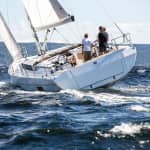
The Happy Cat can easily be carried on the water by two people. The foresail is furled, the main quickly set and off you go. The trampoline with an optional extension in front of the mast offers plenty of space. Nevertheless, the greatest sailing fun begins when sailing single-handed. In 8 to 15 knots of wind, as on the test day, the weight of an additional crew member makes the difference between single and double-digit speed. In small gusts, the speed through the water increases massively. The laminate sails and the lighter frame reduce the overall weight by around 20 kilograms, making fast planing possible. This also lifts the windward float out of the water. After the second attempt, a fairly stable flight phase on a float can be achieved through the correct coordination of steering, sheet tension and weight on the edge. The log speed rises to 14 knots.
However, this also shows the limitations of the construction. Despite the carbon fibre parts and the bracing with wire ropes to stabilise the rig and appendages, there is of course movement. The central rudder dips out a long way if there's too much position, and there's also slight flex with increasing pressure, which leads to uncontrollable luffing and loss of speed. However, if the position is kept moderate using the sail trim, the speed can remain stable for longer. Here comes another special feature: the mainsheet is attached above the rudder system, making it easier to steer with the wrong hand. This makes it easier to control the sheet pull with the aft hand. This is unusual at first, but can be learnt intuitively after just a few minutes.
As the small cat weighs less than even one person, weight trim is of course extremely important. The faster the Happy Cat Star Carbon gets, the further aft the optimum seating position shifts. This keeps the rubber wave piercers nicely out of the water. Nevertheless, the stroke is a wet affair. But that's part of the fun of sailing a beach cat, and the Happy Cat Star Carbon offers plenty of that. The weight savings achieved by using carbon fibre, the larger and higher quality sails and the redesigned floats are significantly more efficient than the version with aluminium parts.
Prices and equipment
Of course, this is reflected in the price of just under 17,000 euros. A lot for a fun inflatable, of course. However, the compromises mentioned at the beginning also come into play: the Happy Cat Star Carbon is almost unique in what it can do. The super space-saving pack size and the gigantic speed. According to Ewald Grabner, many of his customers are motorhome owners. There is plenty of storage space in the camper. If you find a nice pitch on a lake, you can start sailing within minutes. The perfect combination. On larger yachts with the necessary space in the cockpit, the inflatable beach cat is the perfect sailing dinghy. It offers space for up to four people. The rudder and centreboard are retractable and fold up automatically when the boat touches the ground. They are also made of aluminium and are very resistant to damage. Compared to other dinghies, only foilers can reach similar speeds.
- Base price ex shipyard: 16.990 €
- Price ready to sail: 17.300 €
- Total guarantee/boot skin: 2/7 years
As of 2026, how the prices shown are defined, read here!
In this comparison, the high basic price appears in a different light. Because then the Happy Cat offers the huge advantage of easy handling. Not everyone has to sail at speeds of over ten knots, even beginners can have fun from the very first minute. However, the speed potential is easy to access. This looks very different on foilers and requires a lot of practice.
Additional equipment also makes the Happy Cat Star Carbon a versatile dinghy. An engine mount and a sun canopy are available. This turns the small cat into a transporter even without a rig. The sailing experience can also be extended: An optional harness makes it possible to bring more weight to windward. Seat cushions make the trampoline more comfortable, and a strong-wind sail also makes it possible to tack in stronger winds. A capsize protection buoy for the mast stop contributes to safety. Folding wheels are also available to enable single-handed slipping.
YACHT review of the Happy Cat Star Carbon
The Happy Cat Star Carbon combines the smallest possible pack size with very high speed potential and simple operation. Both the fun factor and the price are high.
Design and concept
Fits in a normal car boot
Quickly built up with practice
Sailing performance and trim
High speed potential
Simple operation
Equipment and technology
Catch-up attachments
Rudder flexes slightly under pressure
The Happy Cat Star Carbon in detail

Technical data of the Happy Cat Star Carbon
- Torso length: 4,80 m
- Width: 2,25 m
- Trampoline: 1.70 x 1.30 m
- Draught/alternative: 0,80/0,10 m
- Mast height above WL: 6,10 m
- Payload: 500 kg
- Weight: 74 kg
- Mainsail: 8,0 m²
- Foresail: 3,5 m²
Hull and deck construction The hulls are made of rubber and are inflated. The frame and rig are made of carbon fibre profiles. The centreboard and rudder are made of aluminium.
Werft Grabner GmbH, Weistracherstraße 11, A-3350 Haag, www.grabner.com
Sailing fun devices for the anchor bay


In addition to the Happy Cat, there are other dinghy alternatives that can be sailed and then stowed away to save space. A selection.
ADVERTISEMENT

Happy Cat Star Carbon insurance from 196.89 euros per year* - liability and hull. Many options available, for example: additional skipper liability insurance for cruises on other people's boats. Simply calculate and take out online: yachting24.de
* Offer from Yachting24 valid for a sum insured of 17,000 euros (with current value cover), excess: 150 euros, liability cover: 8 million euros.

Michael Rinck
Redakteur Test & Technik
