


Over the last ten years, the South African shipyard Balance Catamarans has made a name for itself with fast, seaworthy and comfortable cruising catamarans. The almost 18-metre-long Balance 580 has been added to the model portfolio this year and is set to set new standards in terms of performance and space.
The catamarans from Cape Town and St Francis Bay enjoy a good reputation among sporty blue water sailors, as they not only offer a lot of comfort, but are also fun to sail thanks to their lightweight construction and efficient hulls.
Built for worldwide travel
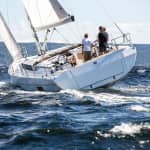
The new Balance 580 model has already shown with its first two construction numbers that it is made for long journeys. Both cats travelled over 12,000 nautical miles in less than six months. The combination of lightweight construction, well thought-out sail plan and comfortable interior makes it an attractive option for demanding cruising sailors with performance requirements. Construction number 1 "Windigo" left South Africa in April bound for Chesapeake Bay and reached speeds of over 17 knots in only 15 knots of true wind. The "Swann" completed a 36-day, 7,350 nautical mile crossing to the south of France via St Helena, Mindelo and Tangier and celebrated its premiere at the Cannes Yachting Festival.
Multiple target groups
The Balance 580 is a high-performance catamaran designed for three different target groups, according to the shipyard. It is suitable for sailors with a regatta background who are looking for maximum performance on the water but also want to explore the world in comfort. It also appeals to sociable couples who want to accommodate and entertain many guests but still want to sail as a couple. Last but not least, it offers enough space for family cruises with several generations on board. The sail plan includes three electrically furling headsails, of which the jib is self-tacking. This enables push-button control of the sail plan and ensures that an optimally dimensioned sail is available for every wind angle and wind force. The mainsail has been designed for easy reefing so that reefing manoeuvres can be carried out by a single watch.
Italian interior design
The lightweight epoxy sandwich construction reinforced with carbon fibre and the long, narrow hulls make the catamaran fast and comfortable. The interior design is Italian modern and the owners have a variety of material options to choose from. The furniture is manufactured in-house with veneer on a foam core. The transition from the saloon to the cockpit is seamless and thus offers a generous living space. The layouts range from three to five cabins and thus cover a wide range of requirements. The owner's cabin occupies an entire hull and offers a king-size bed, a walk-in wardrobe and a generously sized bathroom, while the opposite hull accommodates guests in comfort. In addition, there is a workshop and storage area with full headroom, which is accessible via its own deck hatch.
Innovative technology
An optional hybrid drive system, developed with Integrel Solutions from England, includes powerful electric drives, two diesel engines and a 4.4 kW solar system which, together with hydrogen generators, can cover most energy requirements at sea. The impressive battery capacity supports silent operation and significantly reduces the need for refuelling stops. The swivelling VersaHelm® system at the helm offers the choice of full protection or excellent visibility when steering, while the A-frame mainsheet system enables precise sail trim, using robust components that can be easily replaced anywhere in the world.
"The 580 is a true evolution of our yacht designs," explains Head of Marketing Dean Paarman. "It takes everything we've learnt from the 526 over the years and combines that knowledge with a number of innovative details to create a completely new model that stays true to the balance ethos and extends it."
Technical specification Balance 580
Width 8,6 m
Construction method: Carbon fibre-reinforced epoxy sandwich
Mainsail 140,9 m²
Jib 79,5 m2
Sail area on the wind 209,5 m2
Code 0 125,7 m2
Gennaker 310,83 m2
Draught (centreboard down) 3,35 m
Draught (centreboard high) 1,65 m
Clearance height / mast height 27,43 m
Displacement 16,668 kg
Davit charge 400 kg
Max. Tender length 4,27 m
Engine Yanmar 4JH57 x SD60
Fuel tank 2 x 500 litres
Fresh water capacity 2 x 300 litres
Designer Philip Berman, Anton du Toit
Shipyard Balance Catamarans
PriceEUR 2.55 million (standard), EUR 2.90 million (all options)
History of the shipyard
Balance Catamarans in South Africa was founded in 2013 by Phillip Berman, who already had an intimate connection to multihulls as a Hobie Cat 14 world champion in 1979 and who had repeatedly asked himself the question over many decades as a yacht broker: "Why are there no high-performance catamarans that offer comfortable living?" So he took it upon himself to fill this gap in the market. Today, the Balance range extends from 44 to 75 feet.
Click here for the YACHT test of the Balance 482
Article about the flagship Balance 750

Martin Hager
Editor in Chief YACHT
