


The various models
It all began in 1974 with the one drawn by E. G. van de Stadt Stage 22. It was the Belgian shipyard’s first sailing boat, and some 1,830 were built by 1984 – a very large number. Measuring 6.60 metres in length, 2.40 metres in width, with a displacement of around 1,250 kilograms and 550 kilograms of ballast, it is heavier and narrower than the later 22i. It was available in a A version with a lifting keel and a version with a ballast keel. A striking feature is its almost flush-mounted aft deck, which lacks the cabin superstructure that later became standard.
The Etap 22i followed in 1983 and was thus offered for a short time alongside the original 22. Its designer was Jacques de Ridder, who also designed the Friendship 22. It is estimated that around 550 units were produced by the time production ceased in 1996. At 6.78 metres, the 22i is slightly longer and, at 2.47 metres, slightly wider than its predecessor, but weighs around 975 kilograms – 275 kilograms less.
From 1997 onwards, the Etap 21i takes the place of the smallest cruiser in the shipyard’s programme. Despite its lower model number, it is not a significantly shortened version of the 22i, but a new design by Mortain and Mavrikios. It has a wider hull, two oars and, optionally, a fixed tandem keel with a draught of 0.70 metres or a fin keel with a draught of 1.30 metres. Around 549 boats were built between 1997 and 2009.
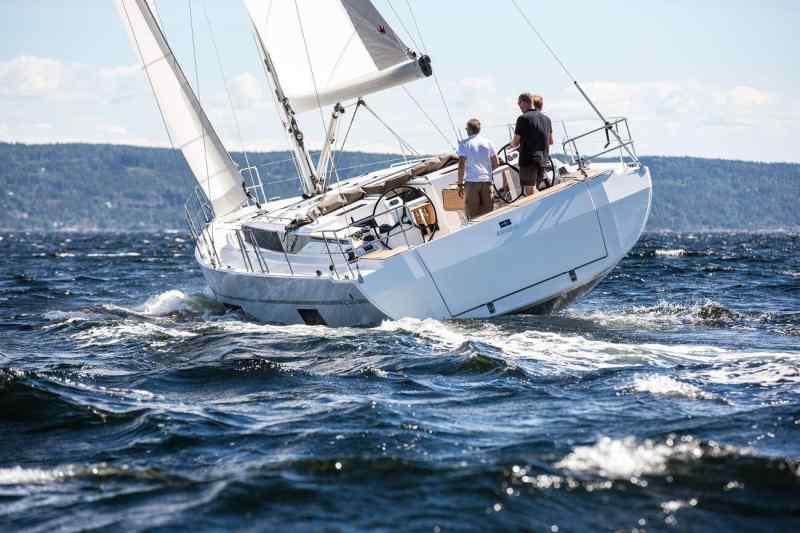
The one presented later Etap 22s is, in turn, based on the hull of the 21i, which is 6.56 metres long, 2.49 metres wide and features the same two fixed keel variants. It is not a new design, but rather the 21i, which was subsequently renamed and revised in detail. These changes included a TBS anti-slip deck covering, an aluminium rubbing strake, a standard mast-lowering mechanism and an optional retractable twin rudder.
Unsinkability as a hallmark
All versions of the Etap 22 and 21 share the hallmark of unsinkability. The shipyard achieves this unsinkability through an outer and an inner GRP hull. The spaces between the two hulls have been filled with closed-cell polyurethane foam. This construction provides sufficient additional buoyancy to ensure the boat remains afloat even after a significant amount of water has entered the hull. Furthermore, the design improves insulation, dampens noise and reduces condensation inside the cabin. Etap has used this principle for decades as a key feature of its yachts.
Under sail
The biggest difference between the smaller Etap models lies in the distribution of sail area. Whilst the original Etap 22, with an 11.1-square-metre mainsail and a jib of almost the same size, still relies heavily on the headsail, the 22i relies less on it. The 22i carries around 19.4 square metres instead of 21.5 square metres when sailing close-hauled, but weighs around 975 kilograms – almost 300 kilograms less. As a result, it accelerates more quickly, responds more directly to gusts and requires less sail area to achieve a comparable level of responsiveness. The heavier Etap 22, by contrast, sails more smoothly and benefits more from its optional large genoa in light winds.
On the 21i and 22s, the size ratio between the jib and mainsail is finally reversed. Their mainsail measures 15.5 square metres, whilst the jib is now only 8.4 square metres. With a total sail area of just under 24 square metres, they carry more sail area than both their predecessors, yet are still easier to handle when tacking than the forewind-biased Etap 22. Instead of hoisting a large genoa over the foredeck, the crew control most of the power via the mainsail. The 22i falls conceptually between the two. Its sail plan is more manageable than that of the old 22, but still more conventional than that of the 21i and 22s.
On downwind courses, the newer models with gennakers of up to 34 square metres offer the greatest potential. The 22i, at around 20 square metres, is considerably more modest, whilst the classic 22 is optionally fitted with a 29-square-metre spinnaker.
Below deck
Despite the different versions, the layouts below deck do not differ greatly. The space has an open-plan design; in the bow there is a large sleeping area, and on either side there are two open berths, each of which also serves as a bench seat. On all boats, the galley is situated on the port side between the side berth and the bow, whilst the optional toilet is housed beneath the forward berth. The main differences between the individual models are the headroom, the width and, in the older versions, the centreboard case, which makes the space appear significantly smaller and more cluttered.
On the Etap 22, the maximum headroom is around 1.60 metres, offering the most headroom compared to the newer models. Nevertheless, the large keel box dominates the saloon and, together with the foam-filled double hull, takes up a lot of usable storage space. The interior works well for weekend trips for two, but with four adults it becomes more of a place to sleep than a living space.
The interior layout of the 22i is almost identical to that of the 22. In the bow there is a double berth measuring approximately 1.36 by 1.91 metres, which has almost the same dimensions as that in the 22. In the saloon, there are two longitudinal berths, each 2.12 metres long and 60 centimetres wide, with storage compartments. The galley consists of a sink and a spirit stove, and the removable table can also be used in the cockpit. A clever solution: when not in use, the table is stowed beneath the cockpit floor. With a headroom of approximately 1.40 to 1.45 metres at the companionway, there is enough space to sit but not to stand.
On the Etap 21i and 22s, the layout is more modern, but is also based on the standard design. The saloon has two long side berths, each measuring 2.00 by 0.60 metres, whilst the open foredeck features a double berth with storage space underneath. The headroom at the companionway is 1.42 metres. Additional storage space is provided by the compartments beneath the saloon berths, open shelves behind the sofas and pockets on the inner hull sides. As mentioned, the 21i and 22s stand out due to the absence of a centreboard case, which gives the new variants a significantly more modern and open feel.


Cockpit and powertrain
The cockpits differ significantly from one another in terms of their interior layout. On the ETAP 22 and 22i, the crew sit relatively sheltered between high coamings. However, the tiller and the engine compartment take up a larger proportion of the aft area. On the 22i in particular, this leaves very limited space behind the helmsman. In return, the engine is positioned closer to the centre of gravity and in front of the rudder, which is a noticeable help when reversing and in narrow pit lanes.
The 21i and 22s have a more open layout in the cockpit. The seating areas extend further aft, whilst the transom forms the rear boundary. Because the outboard motor is mounted outside the cockpit on an optional transom bracket, the interior remains more usable as a seating and lounge area and appears tidier. The downside is that you have to lean over the transom to operate or stow the engine. Furthermore, with the shaft at the stern, the propeller tends to operate in choppy water and does not directly hit the rudder.
The main difference between the two versions is the traveller, or rather the mainsheet attachment point. On the older 22, the shipyard dispensed with the traveller altogether and fitted a fixed attachment point in the centre of the cockpit. On the 22i, there is a traveller situated directly in front of the companionway. The 21i and 22s have created more space thanks to the outboard motor at the stern, thereby offering more options. As with the 22, the mainsheet was secured as standard using a block in the cockpit. A traveller rail was available as an option; this ran centrally through the cockpit at knee height and promised improved sailing performance. It could be dismantled in harbour and then stowed in the lockers. This option thus combined the best of both worlds: good trimming options on the water and an open cockpit in harbour.
The choice of engine therefore had a significant influence on the layout of the various cockpits. The shipyard consistently opted for outboard engines across all models; as mentioned, these were fitted either in the cockpit well or on the transom. Depending on the model and the waters in which the boat is used, engines with a power output of around four to eight PS are common.


How much do the stages cost?
The various Etap models, with their respective model years and specifications, are available on the second-hand market in a range of price categories. The classic Etap 22 currently costs between 2,000 and 6,000 euros, depending on its condition. The 22i, built from 1983 onwards, is available from around 10,000 euros. The 21i is priced between 14,000 and 22,000 euros. As the 22s was produced in only small numbers and is very rare to find, it is not possible to specify a precise second-hand price.
Just as important as the price is the condition of the boats on offer. That is why, when viewing a boat and, if applicable, taking it for a test sail, it is helpful to examine the known problem areas closely and, if necessary, consult an expert.
The main weaknesses in the model comparison
Not every one of these small stages has the same problem areas. Consequently, the points to which buyers should pay particular attention also vary.
Keel and keel mechanics
On the Etap 22i, the weighted lifting keel is the most important point to check. It runs in plastic guides and is moved by a spindle and bevel gears. The keel should turn smoothly when cranked and must not rattle inside the box. Noises or noticeable lateral play may indicate worn guide blocks. Etap recommended servicing the lifting keel system every five years.
With the older Etap 22, the inspection depends on the keel design. Even the lifting keel version requires regular maintenance. There are also centreboard versions, where the centreboard, its bearings and the hoisting mechanism must be checked.
The later Etap 21i and 22s models, on the other hand, do not have a lifting keel. This eliminates the need for complex mechanical systems. Here, you should check the keel-hull connection, the bolts and look for any signs of grounding. Fewer moving parts mean less maintenance, but also mean there is no way to reduce the draught at a later date.
Hull and deck
All models feature the double-skin construction typical of Etap. According to the shipyard, the foam absorbs hardly any water. Owners of early Etap 22 models report that the deck surfaces between the mast and the forepeak are flexible. Later models are said to have been built more sturdily in this area. Furthermore, early and later boats differ in terms of the rubbing strake. Some older models have a wooden strake, whilst later ones feature a more robust metal version.
On the 22i, particular attention should be paid to the mast base. Cracks and soft laminate in this area have been reported on some boats. Dents on the trailer supports have also been documented. The lightweight construction has limited tolerance for poorly positioned or undersized supports.
Rudder system
Stage 22 consists of the rudder on older models, consisting of a wooden core covered with GRP. If water penetrates through cracks or fittings, the core may rot away unnoticed. Furthermore, owners report that the fittings on the rudder blade are relatively short.
The Etap 22i also has a rudder mounted on the transom, which can be raised slightly, but is not a traditional folding rudder. The laminate seams, bearings, hinges and the rudder-raising mechanism should be checked. Some boats have been reported to have soft spots and splits in the waterline area. A new rudder blade is still available, but costs several thousand euros.
The The 21i and 22s differ significantly from the older models, as they feature a double rudder and therefore two rudder blades. This design ensures good control when heeling, but also doubles the number of bearings, fittings and blades. Both rudders must be set to converge by one to three degrees at the front (toe-in) and must move without any play. As they are mounted on the outside of the transom, they are more vulnerable when mooring and launching.
Mast base, shrouds and rigging
On the 22i, as well as the deck beneath the mast, the mast-lowering mechanism also warrants attention. The axle, pulley, retaining rings and mast sleeve must be complete and free of play. However, in the worst-case scenario, many of these parts are still available.
On the older Etap 22 model, the internal load-bearing components of the shrouds must also be checked. Owners have reported instances of corroding metal parts, some of which are difficult to access as they are concealed beneath panelling or laminate. Traces of rust, deformation of the shroud eyes or unusually loose shrouds should therefore be examined closely.
The 22s has stainless steel tie rods between the keel and the hull. Its construction can therefore, at least in principle, be understood. Nevertheless, deck penetrations, backing plates and the connection to the hull must be watertight and free from corrosion.
Regardless of the model, the hull of many of these boats is now very old and should be examined more closely. Missing invoices or an unknown age should therefore be taken into account when planning costs.
Outboard motor and motor well
As already mentioned in the section on the engine, the Etap 22i has an outboard motor in the engine well in front of the rudder. This limits the choice of engine. Modern four-stroke engines are often larger and heavier than the two-stroke engines originally used, which can restrict the choice of a new outboard motor.
On the Etap 22, you’ll find a variety of outboard motor set-ups depending on the year of manufacture and any modifications. The key factors are a sturdy mounting bracket, a securely housed fuel tank and a clean fuel line. Old, homemade engine mounts warrant a more critical assessment than the engine’s actual age.
The 21i and 22s are designed to accommodate an outboard motor mounted on the transom. This makes the engine more accessible and easier to replace than on the 22i. However, it is positioned further aft and is less protected from waves. According to the shipyard’s documentation, the engine mount and the outboard motor were optional extras.
Which Etap is right for whom?
Anyone looking to get started in the ‘unsinkable’ Etap world on a budget, and who prefers a classic small cruiser to modern design, will find the original Etap 22 to be a distinctive choice that is relatively common on the market. It’s ideal for sailors looking for a calm, solid boat for relaxed cruising who are prepared to pay closer attention to the boat’s condition and any maintenance backlog, given that the design is now around 40 years old. The 22i, on the other hand, is the most exciting option for shallow waters, slipways and sailors who also want to transport their boat on a trailer. Its lifting keel combines minimal draught with good upwind performance, whilst its low weight ensures a significantly more agile sailing experience.
Those who are less interested in adjustable draught and prefer a more modern, user-friendly design are likely to be better served by the 21i and 22s. Twin rudders, a mainsail-focused rig and fixed keel variants make them particularly attractive to families, solo sailors and weekend crews who value control under heel and straightforward handling more highly than maximum flexibility when launching. The 21i is the more realistic choice here, as it is available on the second-hand market; the 22s remains a rare and difficult-to-compare special edition.
Data
| STAGE 22 | ETAP 22i | ETAP 21i | ETAP 22s | |
| Construction period | 1974–1984 | 1983–1996 | 1997–2009 | from 2009 onwards |
| Quantity | 1,830 | 550 | 549 | unknown |
| Length × Width | 6.60 × 2.40 m | 6.78 × 2.47 m | 6.56 x 2.49 m | 6.56 × 2.49 m |
| Weight | Approx. 1.25 t | Approx. 0.98 t | Approx. 1.2 t | Approx. 1.2 t |
| Kiel | Lifting keel or centreboard | Ballasted lifting keel | Fixed tandem or fin keel | Fixed tandem or fin keel |
| Draught | 1.25 m or 0.7 – 1.50 m | 0.40 m – 1.25 m | 0.70 m or 1.30 m | 0.70 m or 1.30 m |
| Oar | An oar | An oar | Two oars | Two oars |
| Design Engineer | E. G. van de Stadt | Jacques de Ridder | Mortain & Mavrikios | Mortain & Mavrikios |
| Original price | from around €10,000 | from approx. €20,200 | from approx. €17,000 | not assigned |
| Quoted prices | Often approx. €2,000–6,500 | Often around €10,000–13,000 | Often around €14,000–22,000 | No reliable range |
Book recommendations
Buying a boat By Ralf Neumann, this guide covers the process of buying your own yacht – from choosing the right boat and assessing its value to finalising the contract and taking delivery. For those interested in older sailing boats, the guide supplements the technical inspection with advice on financial and organisational matters.
Refitting made easy by Jens Feddern focuses on the work to be carried out after purchase. Using his 22-foot fibreglass long-keel boat as an example, the author describes the refurbishment of the hull, the interior fit-out and the replacement of the electrical system, propulsion and water supply. Photographs, drawings and detailed descriptions illustrate the individual steps. Anyone wishing to modernise an older GRP sailing boat will gain practical insights into the implementation of an extensive refit.
Which of the small ETAPs would you choose for your everyday sailing?

Janek Struchholz
Volontär