


4721 nautical miles to Flensburg is written on our board in the kitchen. As the crow flies, as the English say, as the crow flies. In reality, of course, there are a few hundred miles more, because the "Marlin" can't fly over islands or sail directly into the wind.
On 31 May, one day before the official start of the hurricane season in the Caribbean, the time has finally come. The rig has been repaired, the forecastle boxes are full, tonnes of vegetables and eggs have been taken on board and the obligatory banana tree is dangling in the pulpit. There are five of us on board, Micha, the girls and myself as well as Micha's grown-up son Julian, who has already accompanied us on the journey from Surinam to Trinidad.
Non-stop to the Azores is the plan, arriving before the first round of 16 of the football World Cup. After weeks of waiting, we are in such a hurry to finally get away from the unloved Montegobay in Jamaica that we set sail in the evening with the sunset behind us. The twilight in the tropics is short, very short, so that we barely have any daylight when we set the main. By the time we reach the cape, which has annoyed us several times with extremely unpleasant waves and cross seas, it is pitch dark.
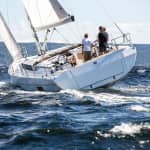
Bumpy start
High in the wind, the "Marlin" throws herself into the sea. We've left the hatches ajar. In the forepeak and in the saloon. Great. Too much cloth on it, reefing in between, then down again, wiping up the salt water, drying, stripping off the washing. By the time the toilet overflows with fine fragrances, my oven is off. Suppressing a few tears, I squat miserably in the companionway, my stomach rebels with every wave, and suddenly this whole Atlantic crossing seems like pure madness. Micha sends me to bed without further ado, and when I wake up again after three hours of comatose sleep, the Cape waves are over, the seasickness attack too, and I'm feeling great again.


We sail, on the wind, high on the wind, once across the channel between Jamaica and Cuba, making as much east as we can. Only 20 miles off the Cuban coast does the wind leave us and the ship's diesel engine has to kick in. Here, between Cuba and Jamaica, the trade wind blows, sometimes more, sometimes less strongly from the east. On the south coast of Cuba, you can use the katabatic winds to your advantage if you're lucky, but the engine has to be used again and again. Until suddenly a loud beeping sound indicates that the Yanmar is overheating. Broken impeller.
No problem, we think, a replacement is on board. But the newly installed impeller also gives up the ghost 15 minutes later. And now? Still over 2500 nautical miles ahead of us. Sure, we're a sailing boat, we'll get there somehow, even without an engine. But it's already late in the season. The idea of bobbing around in the Ross Latitudes in the doldrums while the first tropical storm is brewing somewhere south of us makes us nervous.
Unplanned stopover
A stopover is on the cards, and with great effort, we cruise our way up the Cuban south coast mile by mile and through the Winward Passage into the Atlantic. Great Exuma/Bahamas is the new destination. On 5 June, after a reef passage under sail, we drop anchor in the sheltered anchorage behind Stocking Island off the island capital of Georgetown. Labour Day, Whitsun, a postponed mail boat schedule and bad weather provide us with a one-week dream holiday in the Bahamas. Beach, hermit crabs, surfing, hiking, then finally the supplied impeller can be installed and we are ready to go again.
This time we do it right. We set off in the morning, shortly after sunrise with a cup of coffee in our hands. Not on Friday the 13th, of course, but on Saturday. Once again the fresh supplies are topped up, a whole day of sunshine and 15 knots of wind from the south-east lies ahead of us. A good start.
The "Marlin" makes up 159 miles on the very first day - and slips seamlessly into a weak wind area. We were bobbing in the Atlantic north of the Bahamas with full sail when the sky darkened. Just a small tropical squall? All hands on deck, 1st reef, no 2nd reef, the wind suddenly changes to north-west, a few minutes later we are soaked to the skin.
Alternating strong winds and calm
The squall turns out to be a front that passes over us that night. Behind the front, calm as always. With shifting winds, we continue towards Bermuda, with distances of 80 to 100 nautical miles not exactly making the sailor's heart beat faster, but our fishing luck begins.
An 18-kilogram gilthead bites our bait. Then a decent eight-kilo tuna. There's plenty of fresh fish and tinned tuna for the bilge. Everyday life on board settles in. School, for the children: 1x1 and spelling, for Julian sailing Latin. What is a sheet, what is a halyard, which line is used for what, where is port and where is starboard and which sails do I set in which wind?
Good conditions, because the changeable winds mean we have to make a lot of manoeuvres. From time to time we turn up the engine, let our legs dangle over the railing and enjoy pure sailing. The land is far away, the blue of the ocean very close. Deep blue, deep relaxation. The miles in front of the bow are so many that nobody wants to calculate the day of arrival.
Oilskins and functional underwear are brought out again
About 60 miles north-east of Bermuda we are hit by the second front, with winds of around 20 knots, gusts of up to 25 and cold air from the north. Oilskins and functional underwear have finally found their place on the hook next to the companionway. The "Marlin" yaws down the crests of the waves only with the genoa half set, the wind from astern, everything wobbles, shifts, slides from port to starboard and back again.
We try in vain to press our pillows to our ears at night to get a better night's sleep. But who wants to complain - the boats that crossed the Atlantic five weeks ago had to weather winds of 30 knots and more several times. The door is closed, thick blankets and hot tea are spread around the deckhouse and "Ice Age" is playing on the laptop.
Encounter with a ghost ship
The next morning, the wind continues to blow at 25 knots. The sky is overcast, all the hatches are tight. Suddenly Micha spots another sailing boat on the horizon. "Look there, at 2 o'clock, that's another sailing boat. But they haven't set sail, or am I seeing it wrong?"
A glance through the binoculars confirms this impression, as does the speed at which we are approaching the point on the horizon. "Come on, let's drop down and see what's going on, maybe they need help!" We set course for the ship. And with every nautical mile we approach, we get more nervous.
A ketch drifting in the middle of the Atlantic, the genoa torn out, the main recovered, the mizzen mast flapping uncontrollably in the swell. We call on channel 16, send signals with the secondary horn, no response. The "Elusive", home port New York, is drifting rudderless on the water, no sign of the crew, the companionway is closed.
What to do? Where is the crew? The wind is still blowing and it would be dangerous to explore any further in the swell. We contact the sea rescue centre in Bremen by satellite phone and receive a call back from the American Coast Guard 15 minutes later. It's an old case, they say tersely, the crew was rescued in May and the yacht abandoned to its fate.
And now? A seaworthy yacht that has survived all weathers for four weeks without faltering is drifting not a hundred metres next to us. Should we take her off? Go on board? A heated discussion ensues, but it soon becomes clear that our own crew can't do without anyone. Julian's experience is not enough to sail the "Elusive" all the way to the Azores. I'm needed to look after the children, and the "Marlin" with all its technology needs a skipper.
We don't want to go back to Bermuda, our destination this year is Europe. In addition, the weather prohibits any further exploration of the abandoned ship. And so, with a heavy heart, we set course for the Azores again. The fate of the drifting yacht kept us busy for days.
"Marlin" gets off to a powerful start
Meanwhile, the "Marlin" sails on, mile after mile, a mountain festival, another dorado, the Azores high moves and pulls us into the motorway on its back. We set a full sail, 15 kts on the beam reach and pick up speed. We improve our speed, 120 becomes 150, the wind picks up. The "Marlin" is rushing along with her new Rolly-Tasker sails, and when the GPS shows an average of over 8 knots, we are seized by ambition.
200 miles is possible, isn't it? The autopilot is disengaged, we take the helm by hand and take every wave with us. A rush of speed. Dolphins jump out of the crests of the waves and organise a race. We take the helm all night long. In the morning the wind drops, just a few knots less, and we don't reach the magic limit.
We need more sails, so we set the jib to the genoa, the "Marlin" accelerates, and under cutter sails we reach our 201-mile mark at 12 o'clock on the dot. Afterwards we reef and celebrate. Pea soup and fresh bread, from now on the autopilot can be used again, because after all, we are still a family crew. We don't have to race across the Atlantic, but flying instead of sailing once in three weeks is indescribable.
How much longer?
From now on, it's "When will we be there?" every morning. Julian's brother and a friend are coming to the Azores on 6 July, will we make it? Of course, because the high continues to play along, we have left the back and are now sailing with a steady westerly wind towards the first island in the Azores. On 4 July, the island of Flores comes into view in the morning. The sun is shining, we are once again accompanied by dolphins and even two orcas pass lazily on our port side. The temptation to turn off and return to the harbour in the afternoon is great, but we persevere, still 130 miles to go. Of course, the wind dies down overnight, and now and again the fat Emma, our ship's diesel engine, lends a hand.
Faial hides deep in a cloud cover in the morning. But as soon as we get within five miles, the cloud cover lifts to reveal the view. Lava ash and a half-buried lighthouse in the north of the islands, bizarre rocks, squawking seabirds, schools of dolphins, offshore peninsulas with craters and, again and again, green meadows and fields.
Back in Europe!
How different landfall on an Atlantic island is, how much more exciting and varied than the eternal beaches and palm trees. The children dance with the dolphins on the bow, chocolate ice cream and cold beer are within reach. We hoist the sails, tidy up and head for our anchorage in the traditional harbour of Horta. We are in Europe, after exactly 21 days. The ground shakes under our feet, Julian and the children storm the first ice cream parlour while Micha completes the clearance formalities. Sailing is great, but the tried and tested saying is still true: the best thing is still "the drink on the other side of the ocean."
