


A lifelong dream: Crossing the Atlantic as a couple - the last leg of the journey
Morten Strauch
· 12.04.2026


- The first part of the trip starting in Florida you can find here.
- The second part of the journey with the Azores you can find here.
We leave the Azores with tears in our eyes, we would have loved to have spent more time here. It takes a while for the 2,351 metre high Pico volcano on the island of the same name to disappear in our wake. Instead, whales suddenly appear and seem to be following us! Full of adrenaline, I jump into the saloon to get my camera and telephoto.
The animals seem to smell this and keep a safe distance. Sometimes a fluke rises up and then dives down skilfully, then you see several fountains of blowing water at the same time. The whales seem to be wrestling. A marvellous spectacle that gets the happiness hormones dancing. We later identify the marine mammals in the photos as duck whales. That was a given!
Everyday life at sea has returned
Everyday life at sea has returned. After the night watches, every sunrise starts with a cup of coffee. Scrambled eggs and freshly baked bread from the pan are hard to beat. One food that is found in abundance in almost every meal is onions. We have plenty of them. Not only is it tasty and healthy, it also keeps fresh for weeks. One of the more annoying tasks is shredding rubbish, as the boat is crammed full of surfboards and diving and spearfishing equipment.
So plastic is cut up and stuffed into the empty water bottles, cans are hammered flat. After every meal, the bailer is used to wash up. After three days heading north, I threw a small saucepan overboard that was still hiding in the dirty water. I wonder how long it will take to reach a depth of around 4,000 metres? An eerily beautiful picture.
When the autopilot steers the boat, it sounds as if "Ente" is breathing in and out deeply - or as if Darth Vader is lying behind the galley in the cockpit. To save energy, the wind vane usually keeps us on course. At first, I was still grumbling and swearing, but now I've got the hang of it and have become a big fan of this robust steering system.
The jumper is being used more and more often
When we finally turn eastwards, it has already become noticeably cooler. Long trousers and jumpers are being used more and more often. The woollen blankets have also been pulled out of the vacuum bags. Just under 1,000 nautical miles to the English Channel. Rounding Scotland is not an option, as there is a nasty low off Ireland with a name.
The next morning begins with a calm, then thick fog envelops us. There is an eerie silence, only the shallow splashing of the hull can be heard. The only thing missing is a ghost ship emerging from the white haze, but apart from a Portuguese galley, nothing can be seen. It's also good to know that nowadays all ships sail with AIS.
Tuna till you drop
Shortly before reaching the continental shelf, our meal plans are completely overturned. While the wind picks up to 26 knots and we prepare to change the headsail, the fishing line snaps again for the first time in weeks. Of course, everything happens at the same time. The reward for the temporary stress is soon wriggling on the aft deck: a magnificent bigeye tuna!
Less than two hours later, fat tuna steaks are on the plates. Sashimi, sushi, tartare and burgers followed over the next few days. Feasting like God in France, and "en masse": according to the luggage scales, it was an incredible six kilos of the finest fillet. Priceless.
Two weeks after leaving Horta, the first beacons can be seen off to starboard. Brittany is calling. It's a full moon and dolphins are jumping around us in the glittering water at night. The entrance to the English Channel can be so kitschy and beautiful.
Roscoff: "Duck" is back in Europe
When we reach the harbour in Roscoff in the morning, the marinero in the Rib comes out to meet us. With a beautiful accent, he calls out in English: "Wait, the ferry to England is just leaving. She's only doing it for you!"
I jump ashore at the petrol station to quickly buy some baguettes, cheese and apricots. Back on board, we set off with the fully fuelled "duck" - after all, we want to be in Cuxhaven in a week's time.
At dawn, we pass the south coast of the Channel Island of Sark. The top lights of the anchored yachts sway off the cliffs. It hurts to have to pass them non-stop, but we can't afford to miss the tide as it washes us past the notorious Cap de la Hague. We make it in time, but the tide turns at Cherbourg and we fight against it at snail's pace for hours at full steam.
One last stop in Le Havre
The wind and tide literally force us into the bay of Le Havre. Channel 16 is very busy: A sailing boat is keel up in the Solent with two people on top, two motorboats report engine damage and ask for help quickly. More hectic messages in French that we don't understand. In view of the forecast strong winds from the north-east in the narrow and busy Strait of Dover, we decide to make a final pit stop in Le Havre.
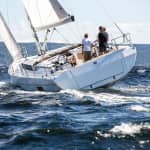
The alarm clock rings at five o'clock in the morning, time for the last departure of our Atlantic adventure. Under full sail, the Hanseat rushes out of the harbour. Other sailors have also discovered the ideal weather window for passing through the most challenging part of the English Channel.
Through the English Channel in the fog
In a small flotilla of boats from Holland, Belgium and France, we set off along the Normandy cliffs in a half-wind. One by one, the other yachts set off, our old blue water cloths are long past their prime. Then the wind slowly dies and fog rolls in.
We cross the traffic separation scheme at Dover, but there is no sign of the famous chalk cliffs in the thick soup. "Damn!", I exclaim. The timing was unbelievably brilliant, as the leaders of the Volvo Ocean Race Europe were due to fly past right here.
With our eyes fixed on the plotter and the camera at the ready, we feel our way into the North Sea. Then the AIS signal of the "Biotherm" actually appears a good ten miles ahead. A little later, the Imoca passes by at some distance and is barely recognisable. Boris Herrmann's "Seaexplorer II" follows a little later.
From Miami to Cuxhaven: done!
Over the next three days, we manoeuvre past countless offshore wind farms, drilling platforms and trawling fishing boats. Exciting, especially at night, even if there is not much left of the boundless freedom of the ocean.
On a Saturday, exactly the planned end date of our nine-week trip, the approach buoy of the Outer Elbe comes into view. We surf at speed along the green line of buoys, while one pot after another pushes past us.
We narrowly miss the harbour entrance - a shame, really, because that seals the end. Nevertheless, the joy of having made it from Miami to Cuxhaven is enormous. It's a unique feeling that makes you proud and humble at the same time - and definitely has addictive potential.
- The first part of the trip starting in Florida you can find here.
- The second part of the journey with the Azores you can find here.

Morten Strauch
Editor News & Panorama
