


Do you think that will fit?" - "Hmm, could be tight, better slow down." We drive slower. "So, does it fit?" "No, I'll radio them." I reach for the radio: "Bridge Control, Bridge Control, this is sailing boat 'Eleanor'. Requesting opening of bridge, please." A crackle on the radio, then nothing more. What doesn't fit is the mast of our boat under the 25th Dutch bridge for today. Or is it already the 26th?
"Bridge Control, Bridge Control, do you read us?" Another crack, then: "Sailing boat 'Eleanor', we are sorry but the bridge is closed until tomorrow morning." So the bridge is no longer open today. This means we have to moor up, explore the city and wait until tomorrow. The city we are currently in is Groningen. The fact that we are in any city at all is very convenient. Supplies on board are gradually running low, so a trip to the supermarket is just what we need. A stroll through the historic centre of Groningen and a freshly tapped beer in one of the many bars isn't the worst way to end the day. We'll just continue our journey in the morning.
You can find more travel stories to escape to the warmth, at least in your mind, here:
Two Hamburgers and their Swede in Groningen
We are Toni and Lukas, both in our early thirties, from Hamburg. And "Eleanor", our sailing boat, in her early forties, from Sweden. Over a year ago now, we decided to fulfil our dream of living on the water for a while. We sublet our flat in Berlin, announced the good news at work that we now only wanted to work part-time and remotely, and have been travelling with our 32-foot Swedish Malö ever since. So here we are, stranded with our boat in Groningen for a night.
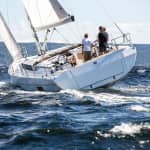
Fortunately, this is not such a big problem in the Netherlands and, as we realise, not at all unusual. We make our way back from the bridge through the Groningen canals along the many typical Dutch cargo ships, some of which have been lovingly converted into residential vessels. The smell of wood fire and the self-built chimney pipes on the ships reveal that we are by no means the only ones who will be spending the night on board tonight.
What is usually still the exception in Germany is nothing unusual in the Netherlands. All the canal walls we pass are occupied and lights are burning on all the ships. So it takes us a while to find a free space where our "Eleanor" fits more or less perfectly. Under the moderately interested gaze of the evening strollers in Groningen, Toni manoeuvres her into her current berth. I jump over, tie the fore line to a bollard and the aft line to a pedestrian railing. Not ideal, but she won't get loose here in the canals. Shortly before eight, we just make it to the nearest supermarket and then have time to critically appraise the typical Dutch art of throwing potato wedges into hot fat.
Inland to the Mediterranean - how it all began
After an all too short night - the bridges open very early here - we continue the next morning, always following the Dutch canal system. Past windmills, old farms and sheep. Through locks and under bridges. Our destination: the Mediterranean and the promise of spending the winter in warmer climes. Inland to the south by boat? Yes, that's possible! Across many rivers, canals and locks. Through the Netherlands, Belgium and finally France, where the Saône and Rhône eventually spit you out into the open sea near Marseille. It was only about two weeks before we were stranded in Groningen that we arrived back in Rendsburg in mid-September with our boat from a two-month training trip on the Baltic Sea. Neither of us knew much about sailing or boats in general, but that's another story.
The lock tally list
In Rendsburg, we now have to get "Eleanor" ready for the canal trip: service the engine, replace the filter and, above all, lay the mast. Without a concrete idea, we first get some wood from the DIY store and use a folding rule and jigsaw. In four long days of work, we build three solid frames on which we want to sail our mast down to the Mediterranean. With the help of friends from the harbour and family members, we manage the feat and set off south at the beginning of October. Or to the west, as our route first takes us via Bremen, then along the coastal canal towards Leer and across the Dollart until we enter the Dutch canal system. From here on, our list of locks fills up every day. We place bets on how many there will be in total before we have salt water under our keel again. (We reveal the solution at the end of our report).
The spectacular south inland course
We make stops in Amsterdam, Groningen and an extended, unplanned break in Maastricht. Our old Volvo Penta needs a little attention, and we reward it for its loyal service so far with a new, no longer leaking water pump and a new alternator. With the last gasps of summer, we make a brief guest appearance in Belgium before crossing the French border in the small town of Givet. Accompanied by fresh croissants and baguettes, the route now really heads south - and in some quite spectacular ways.
The canals often lead over bridges and through tunnels. Steering your sailing boat through a mountain is an unusual experience. But the days often pass in a pleasant monotony. We start our engine as soon as the first lock opens and sail until the last one closes for the day. The lock cascade at Pont-à-Bar on the Canal des Ardennes is particularly memorable. Here we negotiate 15 locks in one day for the ascent, only to lock down again on the other side the following day. Lock open, 100 metres of canal, and the gate of the next lock closes behind us again.
Lock marathon - The French canal system
Our route takes us right through the heart of France, along the Canal entre Champagne et Bourgogne. Always with us is a white service vehicle from the Voies navigables de France (VNF), which accompanies us depending on the department and the condition of the locks. In France, the canal system is part of the cultural heritage and is managed and maintained by the VNF. For a small fee of 120 euros for a month for our 32-foot boat, we are also allowed to navigate it. What you get for this fee is impressive. The highly recommended VNF Navi app provides up-to-date information on the various sections of the canal.
This is particularly helpful in winter, when most maintenance work is carried out. There is also a telephone hotline that sends service technicians to the site if necessary. On the Canal entre Champagne et Bourgogne, for example, our white escort car once pulled us off the mud after we got too close to the edge of the canal. Otherwise, the VNF is on hand to help with locks that are jammed due to driftwood, age or simply a bad day and need to be operated by hand.
Green wedding veil and ice bathing
Apart from moody locks, our biggest enemy at this time of year is the ever-present algae in the canals. A never-ending nuisance! Behind every lock, it's time to get out the boat hook and pluck down the green wedding veil that has wrapped itself around the rudder and sometimes reaches absurd proportions. Here on the canals, you no longer wish for a hand's breadth of water under the keel, but rather hope for the same hand's breadth above the algae. Several times - it's now mid-November - we have to get into the ice-cold water in our wetsuits to clear the propeller and the hatches from algae.
Speaking of ice: it's getting cold, very cold. At the end of November in Saint-Dizier, snow falls on our deck for the first time and hot water bottles and teapots are in constant use. Much worse than the cold is the humidity that comes with it. Our morning ritual, consisting of clearing out and wiping down every cupboard in which mould-prone items are stored, is an extremely tedious Sisyphean task. Despite our best efforts, several items of clothing, blankets and pillows do not survive this winter.
Ports and petrol stations in hibernation
Our mooring options during this time are very limited. While there are always harbours or at least jetties with infrastructure at good intervals in summer, these are usually completely deserted in winter. It is not uncommon for us to simply use a tree at the edge of the canal as a mooring buoy. The supply of diesel also needs to be well planned. The boat refuelling stations are in hibernation. Walks to a conveniently located petrol station, armed with a diesel canister and handcart, make for a change. The days are cold, long and wet. We long for sunshine and warmth. After all, that's the real reason why we set off on this mission: to escape the German winter. And now we're stuck in the centre of France on a damp boat, and there's only one way forward.
Final spurt: the Mediterranean within reach!
One milestone is finally reaching the Saône. At Maxilly-sur-Saône we leave the last canal lock behind us for the time being. Now it's time to make kilometres! While we had previously been chugging along the canals at four to five knots, the river and its current suddenly carried us towards our destination at twice the speed. The Saône takes us through Lyon, bringing us back to civilisation after a long time. The culinary capital of France revitalises our motivation. We sample our way through bistros, brasseries and small restaurants hidden away in courtyards.
This is also where we get our first taste of southern flair. Our destination, the Mediterranean, is within our grasp! After four days, our cultural batteries are recharged and we set off on the last stage. The locks here are huge. It is not uncommon for our little "Eleanor" to share the basin with barge colossi. This and the strong current make the stage a navigational challenge that should not be underestimated. We always keep an eye out for "river crocodiles" - whole tree trunks sent downstream by the winter storms and floating just below the surface.
Palm trees, flamingos and the last lock
We pass Avignon. Seeing the famous Pont Saint-Bénézet from the water is an experience. The landscape has now changed and promises warmth and sunshine. Instead of the forests of northern France, we see the first palm trees and pass salt marshes populated by pink flamingos. Shortly after Avignon, we turn onto the Petit Rhône and lock into the Écluse de Saint-Gilles, we can hardly believe it, for the last time. It was number 283 since we had left the Kiel Canal in Brunsbüttel eleven weeks earlier.
Two more days and we are moored in the small town of Aigues-Mortes, our winter quarters for the next month, a stone's throw from the sea. We can hardly believe that this part of the journey has come to an end. Our boat is mothballed for the time we are not on board. Then we make our way home, this time by the somewhat faster means of transport of aeroplanes. The same journey that took us just under three months now flies by in just under six hours, so that we are home in time for Christmas. But not for long, the return flight is in a fortnight' time. The mast needs to be set and we can't wait to finally set sail again after all this time!

Antonia von Lamezan
Volontärin
