


- We actually had other plans
- Three days of south-westerly wind!
- Have you ever been to Oslo by boat?
- Over to Norway
- Færder and Tjøme
- A fire at the end of the world
- At the Brygga of Tønsberg
- The Ytre Oslofjord
- Through Drøbaksundet
- Oscarsborg and Sandspollen
- Arrival in the metropolis
- From Edvard Munch to the Fram Museum
- Berths for guests in Oslo
- Area information: Oslofjord
The Oslofjord stretches over one hundred kilometres from the Skagerrak archipelago in the south-east of Nordwegen far inland. At its end, the modern metropolis of Oslo awaits sailors.
We didn't actually want to go to Oslo. We still had the warnings from other cruising sailors in our ears: there is either no wind or a headwind, plus heavy traffic in the fairway, lots of ferries, uncomfortable, expensive harbours, lots of buildings on the shore and little variety.
We actually had other plans
"That's not exactly a clear recommendation for travelling," says fellow sailor Torge Fahl dryly - and immediately adds: "Although I do find the city exciting." He enumerates as if he had to see for himself: modern architecture, this new Munch museum that everyone is raving about and warm cinnamon buns somewhere on the harbour promenade.
"But we don't actually want to go to Oslo, do we?" I ask with a grin. Because in Torge's words, Norway's capital suddenly sounds like a place of longing.
Our plan was actually to sail along the Swedish west coast only as far as Lysekil. The red granite skerries there are experience enough, pure travelling bliss: smooth rocks, sheltered bays, the sparkling water. So why go any further - to a metropolis of all places with urban hustle and bustle, jubilation and cheerfulness?
And yet it remains, this idea: it has settled like salt water in our hair and eyebrows after the long cross from Denmark across the Skagerrak.
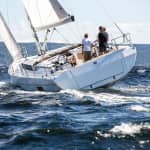
Three days of south-westerly wind!
But then the meteorological joker suddenly comes into play: "There will be a strong south-westerly wind for three days - enough drive to even push your old, tried-and-tested Hallberg-Rassy towards Oslofjord," jokes Torge. "And since you prefer to experience sunsets and sunrises at sea anyway, we'll certainly be at the Koster Islands tomorrow."
Said and sailed: As the morning coffee is served steaming upwards, we are lying across Koster - an island world and underwater park without equal. And our last piece of Sweden. Here we can take a well-deserved nap after eating up the miles. And the morning sun has turned the grey waves into a glittering sea of lights.
Have you ever been to Oslo by boat?
"Have you ever been to Oslo by boat?" comes my own voice from some control room in my brain. "Great city. I've been there by ferry - but not on my own keel." Torge rolls his eyes. "OK, captain: we're on course for Oslofjord. Total distance about 70 nautical miles. ETA and cinnamon bun: twelve o'clock tomorrow."
That's how we do things on board: expressing wishes, comparing them with the weather conditions - and allowing a good dose of craziness. Our main protagonist continues to play along: According to the forecast, the wind should continue to blow from the south for another three days, followed by a sensational 180-degree turn - so we can book our return ticket at the same time. That's how it can happen, because we didn't actually want to go to Oslo...
Over to Norway
Coming from the south from the Skagerrak, the Oslofjord opens up as a wide funnel about twelve nautical miles from west to east. Closer to the coast, the passage looks typically "coastal Norwegian": rocky islands, bathing bays and summer houses - no steep fjord walls as in western Norway.
The Ytre Oslofjord is characterised by countless archipelagos and groups of islands: the Hvaler archipelago to the south-east and the Færder area with its protected island and coastal landscapes to the west. We could spend an entire cruise here alone - strolling from island to island and lying lazily on warm rocks. There are plenty of moorings: natural harbours directly on the rocks - or suitable anchorages and good lee cover.
Færder and Tjøme
One of the many highlights in the outer fjord is Verden's end at Tjøme. You can get there by land or by sea, because of the rocks, salt air and the sweeping view out over the Skagerrak. Opposite the harbour is a summer restaurant and an art gallery, right next to the Færder Nasjonalparksenter.
In summer, the town becomes a stage: concerts, cultural events, long evenings on warm rocks. There are beautiful hiking trails with panoramic viewpoints - and weddings are often held at Tusenårssted directly above the harbour.
The ferry to Tønsberg is handy in summer. You can also get there by bus via the centre of Tjøme. There are also good cycle routes. The municipal guest harbour at the southern tip of the island is well protected. It has a floodlit pier and around one hundred guest berths.
A fire at the end of the world
But it gets really busy here during the season. "Arriving early helps" is the motto at the jetty. There we meet Sigurd Larson, a former fisherman who knows the fjord inside out. "Historically, this is an important sea mark and shipping harbour," he says, pointing to the famous Vippefyr - a reconstruction of an early luffing beacon, built in the 1930s as an attraction
Then Arke gets serious: "Fishing is at rock bottom here." Strict protective measures are in place in the Oslofjord today - cod is taboo all year round, salmon and sea trout are prohibited in certain zones, and lobster fishing is heavily regulated. Far out towards the Skagerrak, Færder fyr - one of the oldest lighthouse sites in the region - shines tirelessly. The first operation dates back to 1697; a tower with a lantern was added in 1802, and today modern optics and lighting technology are standard.
At the Brygga of Tønsberg
Sigurd has set our next destination: "You have to go to Tønsberg - you'll learn a lot about my ancestors there." One of the Vikings' centres of power was once located here on the fjord: ships, burial mounds and old trading centres in the region still remind us of how much history there is here between the skerries and summer houses.
Tønsberg is a lively town with a maritime atmosphere - in summer, as is so often the case in Nordwegen, much of the action takes place on the Brygga: boat watching, eating out, bars right on the waterfront in the evening. From there, it's just a few minutes' walk to Slottsfjellet with the ruins of Tunsberghus and sweeping views over the city and fjord. If you want to delve deeper, visit the Slottsfjellsmuseet (for medieval and maritime history); the "Saga Oseberg" provides a Viking moment in the harbour.
Meanwhile, our boat is moored in Tønsberg Gjestehavn / Marina - in the centre, right by the Brygga. Reservations are not possible: first come, first served. The two drawbridges between the mainland and Nøtterøy are important from a nautical point of view: they have limited headroom and are usually opened at 10:05, 13:05 and 19:05 (VHF 12) in summer.
The Ytre Oslofjord
The coast along the fjord has only a handful of harbours, but there is shelter in the mostly small former fishing harbours, now developed for water sports. From Tønsberg we head north and cross the still very wide fjord: long coastlines until the large island of Jeløya appears. Behind it on the eastern shore lies Son, a pretty town with a large marina and a maritime past - at times even a substitute harbour for today's Oslo (back then it was still called Christiania) when the inner fjord froze over in winter.
To the south of this, well protected by Jeløya, lies Moss: there are guest moorings on both sides of the canal, but there is only around 4.5 metres of clearance under the bridge (best approached from the north). You can also moor at Tollbodbrygga. Provisioning: right next door and also a surprising amount of art, especially around Galleri F 15/Alby on Jeløya.
Through Drøbaksundet
Further north, the character of the fjord changes abruptly: in Drøbaksundet it narrows to the eye of a needle, just seven cable lengths wide. On the western side, the buoyed gate leads over a rocky threshold into the inner fjord. In the middle of the fairway lies Oscarsborg, the old fortress that protected Oslo - we pass the historic island unscathed.
The "Blücher" was a different story: the new heavy cruiser of the Kriegsmarine was sunk here on 9 April 1940 by ancient coastal batteries and torpedoes during the German attack on Norway. This did not stop the German invasion of Norway in the Second World War, but delayed it decisively - the king, government, parliament and parts of the gold reserve were able to escape. Sometimes, it is said, a thin film of oil is still visible on the water above the wreck
Oscarsborg and Sandspollen
Today, Oscarsborg is also a popular stop: Gjestehavn, a freely accessible fortress site with museums, the old 20-centimetre cannons, viewpoints, small bays - plus restaurants and a ferry to Drøbak. The history also remains present in the media: in 2025, the film "Blücher" (internationally "The Battle of Oslo") attracted new attention.
A few miles further west, we enter the large natural harbour of Sandspollen. We are too tired for a mooring manoeuvre on the rocks - the anchor drops in four metres of water and it is very quiet, although the capital seems close enough to touch. The last leg towards Oslo remains surprisingly natural and green. Islands and skerries appear again, with natural harbours and anchorages in between - as if the fjord is showing off its charm once again before it becomes urban.
Arrival in the metropolis
The closer we get to the metropolis, the more the peninsulas such as Nesodden and the city islands shape its character: the classic escape for city dwellers for a swim or a picnic - that's what makes Oslo so special. And this metropolis does not impose itself. It doesn't scrape the Nordic sky with high-rise towers, but stays on the rocks, close to the water and nature.
"Architecture, art, water and nature are close together here," says Waldemar from Aker Brygge Marina, where we can moor our boat in the centre of the city. "And if you take the underground to the terminus, you walk five minutes - and you're standing in the middle of a wild forest." Indeed: it's only a short trip from the glass-steel-stone metropolis - and we're already standing among fragrant conifers and granite boulders. And when we return a few hours later, the next cinnamon bun is already waiting at the harbour as if nothing had happened.
From Edvard Munch to the Fram Museum
Waldemar gives us clear instructions for our city tour: Start in Bjørvika, where the opera house sits in the fjord like a walk-in iceberg - and then dive into the Munch Museum right next door. Then on to the National Museum and Akershus Fortress and follow the timeline of history from the kingdom to the present day.
After all, there has to be a break on the harbour promenade, a view of the fjord and a coffee. But Waldemar has even more to recommend: "Of course, the maritime highlights on Bygdøy are part of it!" Norsk Maritimt Museum, Kon-Tiki and the Fram Museum - on board the legendary expedition ship "Fram", Arctic seafaring suddenly becomes tangible. "Quite a heavy programme," groans Torge." Maybe we'll stay a few more days? Although we didn't actually want to go to Oslo...
Berths for guests in Oslo
Guests on an eugen keel have several options: The Aker Brygge Marina is ideal for cruising yachtsmen. It is centrally located and offers around 50 guest berths - for yachts up to 61 metres in length and with a draught of up to 12 metres. It can be reached via VHF channel 72 or online at akerbrygge.no/marina. If you prefer a quieter berth, there are alternatives: Kongen Marina (Frognerkilen) has 27 guest berths for boats up to 39 feet; you can also book online here (onkongenmarina.no). The KNS Marina Dronningen on Bygdøy is also cosy: in the high season, a well-organised Gjestehavn is operated there, but without fixed guest berths - whatever is available is allocated (kns.no).
The nightlife of Oslo also fits into a walk: along the lively harbour promenade with restaurants, bars and cafés - always with a view of the Oslo Fjord. The path along the waterfront over to Tjuvholmen is particularly beautiful, where galleries, sculptures and the art district round off the tour. Grünerløkka is a casual place, and the day ends in Mathallen with fresh fish and cosy conversations.
On the walk back to the boat, we are almost hit by a car - not because we are drunk, the cash on board is not enough for that, the prices are exorbitant, especially for alcohol. It's the near-silence of the vehicles, almost all of which glide round the corners electrically. Another plus point of this city on the fjord: modern, unobtrusive, quiet - a metropolis to fall in love with. But we didn't actually want to go to Oslo.

Area information: Oslofjord
The Oslofjord
is an approximately 100 kilometre (54 nautical mile) long inlet of the North Sea in south-eastern Norway, which extends from the Skagerrak inland to the capital Oslo. It is not a classic fjord like the Sognefjord in the west of the country, but a depression created by glacial processes. It is divided into the outer (Ytre) and inner (Indre) Oslofjord - separated by the narrow Drøbaksundet strait near Drøbak. Numerous islands, skerries and small bays characterise the inner part, which is lined with wooded shores, beaches and villages. The entire length of the Oslofjord is a major shipping route (partly a traffic separation scheme) and is signposted and lighted accordingly.
Climate and weather
The best time to visit is June and September. Ytre Oslofjord: Sheltered water between islands - but enough open area that a short, steep wave can quickly build up in windy conditions, especially in the south-west against the current or after the passage of a front. Often calm in the morning, sea breeze sets in from midday/afternoon; jet effect between the archipelago. Showers or short thunderstorms are possible after warm days, occasional fog in the morning. Indre Oslofjord: usually few waves, but "moody" wind. Often calm in the morning, later a thermal breeze can prevail. Short squalls on hot days, sometimes mist in the morning.
Navigation
It can get crowded at weekends and during the holiday season (mid-June to the end of August). The marinas usually have finger or Y-shaped jetties with water and electricity supply. Book moorings in advance, prices range from 30-70 euros per night for a 40-foot boat. Natural harbours are often good for anchoring on rocky ground; hooks are anchored to some rocks. Heavy swell is not uncommon in the fairway off Oslo, as well as traffic from commercial shipping and fast ferries. Special attention should be paid to Drøbaksundet: Shallow water and buoyed narrows.
Mobility and shore leave
The crew has many options for leaving the boat in the harbour and exploring the area by bus or train - or taking a flying visit to the capital. Fishing is only permitted to a very limited extent in the Oslofjord
Nautical literature
- NV Charts, set "Norway NO 1 - Norway, Oslofjord North, Oslo - Tønsberg". nvcharts.com
- "Norway NO2 - Oslofjord South, Swedish border to Kragerø". nvcharts.com
- "Havneguiden 1: Svinesund - Langesund". nvcharts.com
Also interesting

Nico Krauss
Freier Fotograf
