


Experts in Greece had assured me that Meltemi was no longer to be expected in mid-October. The stormy wind from the north blows most strongly over the Cyclades in July, August and September. It can make sailing in the Aegean very challenging, as it also causes heavy seas in unprotected areas of the sailing area.
So we had planned for mid-October. The air and water would still be warm and the strong winds would have died down - or so we hoped. We had chosen Parikia in the north-west of the island of Paros as our charter base, right in the centre of the sailing area and without a long journey.
The Meltemi welcomes us
According to the long-term climate table, light winds blow here in October and the sea between the islands tends to be rather calm. But sometimes things turn out differently than planned - because even in the Aegean you can no longer rely on old habits when it comes to the weather.
A dozen sailing boats are moored in the small marina in Parikia, the rest of the harbour is occupied by fishing boats. We are greeted by a loud concert of clattering halyards. Inside the stone piers, the boats are reasonably quiet. There was no room inside for some sailors. They are moored in front of bow anchors with the stern on the outside. Although the bay is largely closed, they are dancing in the Meltemi.
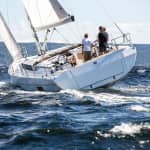
Six Beaufort to greet you
The handover of our Bavaria 42 is quick. But the familiarisation with the area takes unexpectedly longer. Base manager Georg scrolls over his screen. Windfinder shows a small green area with 23 knots or six Beaufort for today and tomorrow morning. Tomorrow afternoon the colour will change from orange to red. A whopping 35 knots or eight Beaufort is forecast for tomorrow evening. And in the following days, the Meltemi will increase even more. What do you do in a situation like this? What options remain when the wind makes almost all destinations impossible?
The base manager suggests heading for Naxos despite the 23 knots. That's about 18 nautical miles. The first half of the route should be rough, the second half, behind the northern tip of Paxos, a little better. We'll have to wait in Naxos anyway - and hope that it at least calms down a bit. The only possible destination after that would be the Small Cyclades.
Also interesting:
Only a few options
This group of islands lies south of Naxos and consists of the islets of Irakleia, Schinoussa, Koufonisi, Keros and Antikeros. Only the first three are permanently inhabited and have a harbour. The Small Cyclades lie in the lee of the large island of Naxos, which is almost a thousand metres high. As a result, the Meltemi wind on and between these islands is not quite as strong as in the rest of the Aegean.
Unfortunately, there are only three halfway decent harbours, with the westernmost one in Georgios on the island of Irakleia not much good in Meltemi, as the bay is open to the north. To make the most of the charter week, we decide to sail to the Small Cyclades.
The crew feeds the fish
On Sunday we leave the harbour bay of Parikia. As soon as we round Cape Fokas, we feel the full force of the Meltemi. A wind force seven and a swell several metres high right from the front. The crew feed the fish. After a good two hours, we have the northern tip of Paros to starboard and can drop off. Less water comes over and the half-unrolled genoa pulls us south-eastwards towards Naxos.
The harbour is protected by a large pier. The ancient stone gate on a headland can be recognised from afar. We hoist the sails and head for the marina. We get hold of the last free berth. A harbour master is nowhere to be seen, but the neighbouring crews take our stern lines and hand over the mooring ring. We made it.
Done: Arrival on Naxos
Naxos in the north-west of the island of the same name is its largest town with 13,000 inhabitants. Everything happens on the harbour promenade. Vegetable shops and supermarkets, boutiques, cafés and restaurants line the harbour promenade. Life pulsates in the evenings. The fishing harbour and ferry terminal are right next to the marina.
Naxos was already inhabited in the 4th millennium BC and was ruled by Athens in antiquity. From 395, the island belonged to the Eastern Roman Empire. Accordingly, all rulers left behind their stone monuments. The city is dominated by the Venetian castle, which is still well preserved and now houses a museum.
However, the most famous sight is the ancient gate. On the island of Palátia off the harbour, which can now be reached via an accessible causeway, the only relic of the unfinished Temple of Apollo is the approximately six-metre-high Portara, the imposing gate of the Opisthodom. The marble portal is almost six metres high. At sunset, it is one of the most popular photo motifs in the Cyclades.
The forecast is not getting any better
The weather forecast for the rest of the week is not getting any better. On Monday and Tuesday, 45 knots are forecast for the sea area around Naxos. That's nine Beaufort, in other words a storm. Plus swell of up to three metres. It's supposed to calm down a bit in the central part from Wednesday - but only for a few hours. If we want to make another jump, that could be our window of opportunity. We use the two days in the harbour to bunker up with water and provisions. The season is over and it's doubtful whether any shops are still open in the Small Cyclades.
On Wednesday, the forecast still stands: around midday, the wind is expected to calm down to four to five Beaufort, but by the evening, the Meltemi should be blowing at gale force again. We have no time to lose: At 11 o'clock, the wind gauge drops below 20 knots. Off to the Small Cyclades.
Engine problems too
We leave the harbour of Naxos under engine power. With a lot of wind and sea from astern, we head out into the choppy strait between Paros and Naxos and continue southwards. I'm just about to switch off the engine when I hear a loud beeping noise. The display flashes and warns: water in the diesel! Why does this have to happen now in this weather? I know how to get the water out of the water separator and then bleed the engine. But I have to switch it off. Will it start up again afterwards?
It's completely unthinkable to want to sail into port or make anchor manoeuvres under sail on an unfamiliar charter yacht in an unfamiliar area during a storm. We play it safe, take back the genoa and motor back to the harbour of Naxos with the alarm beeping.
Our berth is still free. We manoeuvre ourselves into the gap and fish for the mooring line. Our time window with the moderate five Beaufort is only open until sunset. I immediately crawl into the engine compartment. I empty the water separator and bleed the engine. After twenty minutes, everything is done. Then I try to start the engine again. It coughs briefly, but starts. The alarm indicator goes out. Everything seems to be working.
Through the weather window
So cast off for the second start attempt. Less than two hours after the first, we actually leave the harbour bay of Naxos in our wake. We unfurl the genoa again and quickly start surfing. Then I switch off the diesel.
We have three options in the Small Cyclades: The harbour of Koufonisi on the island of the same name in the northeast is small and narrow, but offers the best protection in Meltemi. In the centre of the small archipelago is Myrsini on Schinoussa. There you can either anchor freely or tie up to the pier at the bow anchor with stern lines. Finally, there is Agios Georgios bay in the north of the western island of Irakleia. I'm cancelling the latter because the swell rolls in full force during a strong Meltemi.
As we head south, I call the charter company and ask them to reserve a place for us in Koufonisi harbour. After a few minutes he calls back: no chance, everything is full because of the storm. The adjacent anchorage was also full to bursting, especially with fishing boats. He wishes us a good trip.
Before the storm to Schinoussa
It's just before 4pm. The wind and swell are picking up again. We still have two hours of light. The Small Cyclades lie ahead of us. I decide in favour of the second option and head for the island of Schinoussa in the middle. We take the sail away and motor into the harbour bay. Although it is closed to the north, there is still a lot of wind. The only anchored sailing yacht is turning in large circles. I don't like that so much.
We have to get to the ferry pier. In the middle of the bay, our iron falls to a depth of five metres. With the wind and engine, we slowly move backwards towards the pier, hanging on to the chain. A gust of wind tries to push us sideways, but a fisherman runs over and catches our stern lines. We are moored.
As soon as we've tightened everything up, gusts chase across the water. The storm is back and Schinoussa becomes our new home harbour. Like many ancient settlements, the actual village is located on a mountain, a twenty-minute walk away. Today, around 230 inhabitants live on Schinoussa from agriculture and tourism. But in October, the restaurants are already closed. Of the shops, only a mini-market with a very limited range of goods is still open for two hours a day.
A tip from the locals
The men of the village meet in the afternoon for coffee with ouzo or raki in a small taverna with a terrace overlooking the sea. Here, too, the number one topic is the unseasonably strong Meltemi wind. "We can't haul in our nets because the swell is too high," complains a German-speaking fisherman. "And I have to sail the boat back to Paros," I reply.
"It should be a bit calmer on Saturday, maybe even Friday evening," he says. "But if you sail towards Naxos, you'll still get it on your head." I ask if there is an alternative. "Sail west from here to Steno Antiparou, which is the narrow gulf between Paros and Antiparos," is the answer.
I'm surprised: "According to the nautical chart, it's supposed to be shallow there, just over two metres, and we have high seas ..." But he assures me that a sailing yacht with a draught of two metres would get through. "There's wind in the strait, but few waves. You can see exactly where you can sail through."
The last day
On the last day, the Meltemi actually shows some mercy. We put a reef in the main and set off. From Schinoussa we sail towards the Gulf of Antiparou on a course of 285 degrees. At first, the swell from starboard shook us hard, but the further we got into the cover of Paros, the calmer it became. We reach the narrows in the north of the gulf. In fact, the water here is almost smooth. You can see the shallows exactly as the fisherman had said.
North of the narrows, the open Aegean awaits us again with heavy seas. But we are only shaken for another hour, because our home harbour of Parikia is already four nautical miles ahead of us. We return our Bavaria safe and sound. It was an exciting week in which almost everything went differently than expected. What remains is the experience.
Chartering in the Cyclades
Monohulls and catamarans can be chartered on several of the Cyclades islands, such as Mykonos and Paros. We took over our Bavaria 42 in Paros. The boat, or a comparable sailing yacht with three cabins and two wet cells, costs between 1,200 and 3,380 euros per week, depending on the season. Bookable via Argos Yacht Charter, Tel. 0611/660 51.
Getting there: You can fly directly to Athens from all major German airports, tickets from 350 euros. Connection to Paros several times a day, from 120 euros. Alternatively, there are daily ferries from Athens to all the Cyclades islands.

Christian Tiedt
Editor Travel
