


Read the first part of the travel report here:
Farvel Samsø - Hej Tunø!
In the late afternoon, the wind slowly dies down, the sun colours the bay in a warm light and our yacht rocks gently in the box. We have not left the harbour for two days, and yet it already feels like we have spent a lot more time here. The next morning we take advantage of the weather window to move on. Sailing south around Samsø, we pass the offshore wind farm. The rotors on the tall white towers turn smoothly in the wind, the water shimmers a deep blue between the foundations. The Rassy is running smoothly on the wind, travelling at five to six knots in eight knots of wind. The further south we go, the calmer the water becomes. As if the island itself were laying a protective hand over the sea. We are on course 352.
Tunø appears as a green, gently curving silhouette on the horizon. The entrance to the small harbour is narrow but charming. We quickly find a spot for a short shore leave. The island and the harbour are deserted. We only count six boats. Anyone who has been here in summer knows that six boats normally share a berth. There are no cars, only bicycles and wheelbarrows. The paths between the houses seem to have fallen out of time. We stroll through the quiet "town centre" to the church, which also serves as a lighthouse - an unusual double that has made Tunø famous. From the hill, you can look out over fields to the sea, which wraps around the island in broad sweeps. A quick coffee, then we cast off.
Best sailing weather
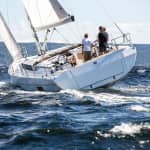
The wind is favourable for Ebeltoft, and as soon as we are out of the shelter of the island, the yacht picks up speed again. The blister is set. The course is 019, so we manage over eight knots at times with a five-degree heel and little rudder pressure. One or two sailors are overtaken and greeted in a friendly manner. Is there anything more beautiful? Helgenæs appears in the distance, with the bay of Ebeltoft behind it. The entrance to the town is calm, with only the low sun and an approaching rain cloud colouring the scenery. We spend the evening below deck, accompanied by the first heavy autumn rain. For dinner, we have pan-fried vegetables from Samsø and Tunø. A fellow sailor is Danish. This is an advantage when shopping at the small stalls. Everything is described in German, but you often pay with MobilePay. If you want to register there, you have to be Danish. Germans cannot do this, as a CPR number must be entered. All of the person's data is stored under this identification number. Our neighbours are a big step ahead of us when it comes to digitalisation.
Ebeltoft - The calm before the storm
Ebeltoft harbour is sheltered in a bay and is easy to navigate, even in windy conditions. You can be in the centre of town in just a few minutes. Cobblestones, crooked houses, small shops and cafés create a real Danish harbour town flair. The historic frigate "Jylland" from 1860 is definitely worth a visit. Early the next morning, shortly before dawn, we cast off from Ebeltoft. The harbour is quiet, with only a few lights on in the cockpits. These crews probably have the same idea as we do: take advantage of the weather window before it starts to blow. It's still just a breeze and we run under engine power while the sky changes from blue to grey. Gradually, the coast appears. First as a shadow, then with contours. Seagulls circle, the water is almost smooth. But you realise that something is brewing. Up to 30 knots of wind are forecast. We want to bide our time in Aarhus. We also have some money left on board to go out for a nice meal.
Aarhus - It's getting livelier
The closer we get to Aarhus, the more life appears on the horizon. Freighters and fast ferries emerge from the haze. We are lucky and reach the city in time before the predicted strong winds arrive. From the marina right in the city, the centre can be explored on foot: wide promenades, small alleyways, cafés by the water and impressive architecture. A walk through the open-air museum Den Gamle By feels like a little journey through time, while the ARoS art museum with its rainbow panorama offers a modern contrast. This doesn't have much in common with the last few days. Although the Danes are endeavouring to make the city as green as possible, it is and remains the second largest city in Denmark. For us, however, this also has an appeal and we enjoy the hustle and bustle. We mingle with the people and realise that a city festival is in full swing. We wondered why there were little stalls dotted around the town. The galley stays cold for the first time and we go out to eat.
One more time: Weathering the storm
When we plan our trip in the evening and take a look at the weather, it quickly becomes clear that we don't need to set off before 2 p.m. tomorrow. The forecast is for 1.50 metre waves and 28 knots of wind until midday, then decreasing sharply. We decide to set off later and then head for Hou. Under land, we cross to the east-southeast and the Rassy shows once again that ten tonnes can also sail. Hou is clearly laid out and yet surprisingly large. Lots of jetties, space for manoeuvring, a relaxed atmosphere. There is everything you need right by the harbour, short distances to the town, beaches for a stroll. Another place to take a deep breath and a really good choice after the hustle and bustle of the city. What's more, the best fish and chips in Denmark are said to be served here, at least that's what we were told at the local sailing club. Unfortunately, it was already too late for a test, but when it comes to food, our source is very reliable.
The week is coming to an end and we have to return to Kerteminde. We have 36 nautical miles ahead of us in perfect conditions: Half wind at ten knots and a 110 square metre blister. Every sailor knows how the pulse rises in such conditions. The current is on our side and the recorded sailing day has an average speed of eight knots. This means that even longer distances can be enjoyed in a relaxed manner. After four and a half hours, we enter the bay of Kerteminde. The day has been so much fun that we don't want to stop - and to be honest, we don't want the week to end. Just as we are thinking about mooring in the harbour, the regatta field of the Vegvisir Race 2025 passes under the Great Belt Bridge. Of course, we can't miss the spectacle. A crowning finale that makes this wonderful week of sailing even more special.
Precinct information
Charter
We got our Hallberg-Rassy 40 from the Danish charter company Jim Søferie. The charter base is located in Kerteminde harbour, making it the perfect starting point for cruises in Denmark and Sweden. There are a total of twelve boats to choose from. The range extends from the smaller Hallberg-Rassy 29 to our 40. The journey by car from Hamburg takes around three and a half hours. Car parking is available free of charge in a fenced-in area. Extras such as final cleaning, a dinghy, outboard motor and bed linen are also available. A week's charter costs 4,470 euros in season and 3,850 euros out of season.
Wind & Weather
In summer (June-August), the weather between Samsø and the Danish mainland is usually mild. Temperatures during the day are typically around 18-22 degrees. There are many sunny days, but the weather remains changeable with occasional showers. The wind is almost always noticeable, especially over the water. It usually blows from westerly to south-westerly directions and is often in the region of a moderate breeze. Overall, these are typical Danish summer conditions: pleasant, but rarely completely calm.
Navigation
Navigation between Samsø and the Danish mainland is generally considered easy to master. The area is clear and the fairways and harbour approaches are reliably buoyed, although there are numerous shallows and shallow areas around Samsø and close to the coast. There is also regular ferry traffic, which should be avoided in good time. A short, steep wave often builds up when the wind blows against the current.
Literature & Maps
Delius Klasing, Sport Boat Charts Set 5: "Kattegat" (€99.90) and Set 4: "Great Belt to Bornholm" (€89.90). shop.delius-klasing.de Havneguide.dk is a Danish online harbour platform. A harbour guide developed especially for sailors and boat travellers in Denmark.havneguide.dk

Jan-Ole Puls
Editor Test & Technology
