


The silhouettes of the "icebergs" and the "lighthouse" emerge from the haze in front of our bow the deeper we sail into Aarhus Bay. It sounds Nordic and nautical, but it's actually modern architecture. Jagged building cubes next to a towering skyscraper really do look like chunks of drifting ice. These and other partly futuristic-looking building ensembles now form the skyline of Aarhus - a unique sight on the Baltic Sea for sailors heading for the metropolis. The white and blue "icebergs" with their sloping edges have already won an architectural award, while the "Lighthouse", the 142 metre high skyscraper, has only just been completed. In between are ultra-modern residential neighbourhoods, directly adjacent to the container and ferry port.
Opinions are divided on the almost visionary architectural style: for fans of dreamy "hyggelig" Denmark, it is a kind of culture shock, for others it is the cool signature of a city that wants to be different in many ways. With every mile we sail towards the city centre, the skyline grows and takes on ever more imposing proportions. And yet, as the yacht passes the side of the ultra-modern district built into the sea and turns into the basin of the city harbour behind it, the classic Denmark is suddenly there again: well-preserved old building facades, the familiar tower of the cathedral, the two turrets of the school next door, the traditional boats in the museum harbour. Aarhus is diversity. The city combines past, present and future.
We chug into Lystbådehavn, one of the city's two harbours. Marselisborg on the southern edge of the city is not an alternative for most visitors, as it is a little out of the way and the nearby sewage treatment plant emits a rather foul aroma in some wind directions.

Even in summer, Aarhus is rarely overcrowded
In the city harbour, on the other hand, the smell of fresh smoked fish wafts over the jetties from time to time - much better! A box is quickly found, even in summer, because Aarhus has an advantage: unlike Copenhagen, the harbour here is rarely overcrowded. Somehow, the town is off the beaten track of many cruising plans. It's just under 20 miles deep into Aarhus Bay. This was also the case for us, who sailed over from Tunø.
The few tourists are lost in the cityscape, Aarhus still belongs to its inhabitants. The yacht is not right in the centre, but it's easy to get there on the on-board or rental bike. But first we follow the delicious smell of fish - it's been a long day of sailing, so we end up at Clausen's fishmonger in the harbour. It turns out to be a paradise for fish fans, with everything from oysters to zander. In the middle of it all is a fisherman straight out of a picture book: red rubber trousers, woolly hat, three-day beard and tattooed arms. But instead of the obligatory anchor and mum's name, there are images of filleted mackerel, a bubbling meerschaum pipe or even Captain Haddock from "Tintin".
Aarhus is a young, lively city and nowhere near as overrun by tourism as Copenhagen" (Jakob Clausen, fishmonger)
The proud tattoo bearer turns out to be Jakob Clausen, co-owner. "We are Denmark's oldest fishmonger, the fifth generation since 1888," he explains. I ask him if he has been fishing since he was a child. "I've never fished a day in my life!" he replies with a laugh. "We are traders. I wanted to be a journalist, but then my father fell ill and I had to go into the business."
We go on to ask whether the fish comes from the bay and the waters around Samsø and Anholt. The answer: "We buy a lot of it directly from the fishermen in the large landing harbours such as Esbjerg," says Clausen. The lobster comes from Anholt or Læsø. "There's not much fish here on our doorstep." He recommends mackerel in summer and cod in winter. And then he has another restaurant tip for us: "For a fish dinner, go to 'Seafood' in Marselisborg marina. It's good, even if it's not cheap."
The traffic lights in Aarhus show Vikings in red and green
For now, we make do with a selection of Clausen's salads, smoked fish and other specialities, which we enjoy in front of our boat at the tables on the pier. Afterwards, we are ready for a tour of the city. Hire bikes are the first choice for this. Like Copenhagen, Aarhus is an incredibly bike-friendly city: dedicated lanes next to the cars, dedicated traffic lights. Speaking of traffic lights: the ones for pedestrians show a Viking armed with a shield and axe, either standing or walking dutifully. Or charging off - who knows?

We cruise back and forth through the city, passing Latinerkvarteret with its student cafés and bars. A lively neighbourhood, bands play on the street, hip shops invite you to shop. In between are beautiful streets. You should definitely have a drink on Åboulevarden behind the pedestrian zone by the cathedral. A canal runs through the city there. The chic cafés on the steps leading down to the water offer picturesque views. Street food fans are recommended to visit the food market at the bus station, a culinary world tour in a very small space.
Old houses and modern art
In the museum village "Gamle By" you can dive deep into the past. The huge ensemble of dismantled and rebuilt houses from the region reflects life from three eras (1600-1900, 1900-1927 and 1956-1974). The buildings are furnished and actors dressed in original costumes re-enact market scenes, bringing the town to life. An open-air museum that is unrivalled. A day here flies by like nothing, especially in good weather.
The Aros, on the other hand, is a tip for fans of modern art. Original installations and sculptures such as the giant "The Boy" by Ron Mueck can be seen here, as well as many paintings. The museum is also famous for its rainbow walkway. We walk along it in bright sunshine at a lofty height above the rooftops of Aarhus. A circular glass walkway, the wall of which shines in all colours and bathes the city behind it in colourful hues - an experience!
Aarhus doesn't get boring even after three or four days. It's hard to leave the city, there's so much to see. Even in the immediate vicinity of the city harbour, which we had already admired from the sea on our arrival. The ultra-modern residential neighbourhood with few green spaces looks a little sterile. But the original bathing establishment, the wakeboard track and the snack stalls invite you to linger.
Aarhus is a Spækhugger stronghold
Meanwhile, the harbour is a hive of activity. A very impressive fleet of Danish design classics is moored there: 32 Spækhuggers. The regatta sailors prepare their boats and hoist the sails. We strike up a conversation with the skipper Jakob Ege Friis. We want to know why there are so many of the mostly beautifully restored boats here. He says: "Aarhus is the Spækhugger stronghold in Denmark. The boat sails great, is safe, but also offers plenty of sailing fun. And it's unbeatably cheap to buy second-hand." Many of the boats are owned by young people, who often form owners' associations, says Jakob. "So you can get keelboat and cruising sailing for the price of a dinghy!"

To ensure that the class sails actively, the sailing club has simply placed all the Spækhugger owners next to each other. This way, the owners can talk shop and encourage each other to join in. With success: every Tuesday at least 15 Spækhuggers come together at the regatta - a great concept!
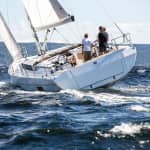
As we are planning another tour of Aarhus Bay, we ask Jakob for tips. He doesn't take long to answer: "I prefer the peace and quiet of nature, a night at anchor. Knebel Vig, Begtrup Vig or Langør on Samsø in the north-west are a good choice." Unfortunately, the first two places are out of the question for us, it's been blowing from the north-west for a day with gusts of 35 knots and the swell is right in the bays mentioned. More like weather for sailing eastwards. So Ebeltoft, the second major highlight in Aarhus Bay. Our Pogo flies off with a clear wind and reefed. In no time at all there is a 10 in front of the decimal point on the log.
The frigate "Jylland" is moored in Ebeltoft
After just an hour, we pass the Sletterhage beacon and turn into Ebeltoft Vig. The sun flashes briefly between the first dark clouds, illuminating the red and white row of houses in front of the Ebeltoft marina. Meanwhile, whitecaps dance on the water. We are glad when the boat is safely moored in the town harbour.
Ebeltoft is buzzing in summer, the 'Jylland' is our tourist magnet. But life pulsates in Aarhus!" (Josefine, confectionery shop assistant)
The actual destination of this stage lies directly outside the city in the dry dock: the frigate "Jylland". The warship, built in 1860, is an exciting relic because it is a hybrid: a full-rigged ship and at the same time propeller-driven with a steam engine. The "Jylland" was the last of its kind, after which only steel warships with engine propulsion were built. After a short period of use as a warship, she served the king as a representative travelling vehicle before being decommissioned. She then went through various stages of decay, was used as a youth hostel, among other things, and was finally renovated in the specially built museum shipyard from 1984.
For sailors, walking through the boat is an exciting journey through time, during which you learn amazing things. For example, that the "Jylland" was able to uncouple the gigantic propeller from the shaft for sailing and pull it up into the hull. If you download the highly recommended "Useeum" app beforehand, you can listen to exciting stories about battles, voyages, everyday life on the ship and the fates of individual crew members at many stations around the ship. The ideal way to spend a stormy day.
We then stroll through the beautiful old town centre of Ebeltoft. With its half-timbered houses, it is truly a pearl of Aarhus Bay. Shops and studios line the cobbled streets, which are also full of visitors. There is also a good smokehouse in the harbour and a large yacht chandlery - what more could a sailor's heart desire?
Flødeboller as sweet works of art
We get stuck in front of a queue of people outside the "Sicilia" café. As it turns out, locals wait patiently here to buy "Flødeboller", which means "cream balls" and is known here as a chocolate marshmallow. But there is more to them than that. Josefine, the shop assistant, sells them as true works of art. Covered in coloured chocolate, decorated with fruit toppings and butterflies made of marzipan, filled with all kinds of creams. The variety seems limitless. "We have fun with seasonal creations, in summer with lots of fruit, now in autumn with apples," says the saleswoman. Instead of a waffle, a tiny apple pie is baked as a base and the cream mixture is then placed on top. The creations are so crazy and popular that the patisserie has even supplied them for fashion shows in Paris and Berlin. Simply delicious!

We continue the next morning. The wind takes a short break, then it's supposed to blow at 40 knots for two days. We move on to Tunø. Gusts of 30 again, the Pogo flies again. There are only four boats left at the tiny jetty, the season is drawing to a close. The island, which is often bursting at the seams in summer, now seems quiet.
The walk ends at the supermarket, where we buy barbecue food. We ask the shop assistant if we can visit the legendary church tower, which is also a lighthouse. She sighs: "It's closed in autumn. It's getting quieter and quieter here, only 60 people live on Tunø in winter, six years ago there were twice as many," she reports. The last two families had just moved away, the ferry trips had been cancelled so much that the children couldn't go to school.
Tunø: lively in summer, otherwise very quiet
"The residents are ageing, and because they have a lot of time on their hands, more and more are shopping in Aarhus. Business is slow," she continues. Now, at the beginning of September, the Kro is only open at weekends. "I might have to close for the first time this winter, the electricity costs have exploded so much that it's no longer profitable."
Tunø comes to life in summer: Viking gatherings and island festivals attract sailors in droves on the weekends" (supermarket owner on Tunø)
That's how stories of decline begin. But she doesn't want to leave it like that. "Come back in summer, when the church tower is open, and the island festival on the second weekend in August is wonderful!" You can walk across the harbour with dry feet because of the many boats, there is live music, games and a barbecue.
It is these contrasts that make up the charm of the wide Aarhus Bay: here the metropolis with its skyrocketing rents and not ten miles away an idyll that has fallen out of time. Truly an area with many faces.
5 tips for Aarhus Bay
- Watch the regatta spectacle: From 29 May to 8 June, Aarhus will be a stopover harbour for the Ocean Race.
- Enjoy the view: There is a great bar on the roof of the Salling department stores' with a breathtaking view.
- Hiking in the national park: Mols Bjerge, a picturesque hilly landscape between Knebel Vig and Ebeltoft Vig, is ideal for long walks.
- Hot dog at the beacon: Sletterhage Fyr on the Helgenæs peninsula is well worth a visit. Also because there is a very good hot dog stand there in summer.
- E-bike tour on Samsø: You can hire bikes via app at the harbour in Ballen. Cycle from there to Nordby and Langør!
More on the topic:

Andreas Fritsch
Editor Travel
