


Read more here the first part of the report
We head southwards along the west coast of Lošinj and then into the bay of Mali Lošinj. The popular health resort of Mali Lošinj was once the bathtub of the Habsburg aristocracy. The sophisticated buildings around the town harbour and the wide promenade date back to the 19th century. Back then, Mali Lošinj was also a centre of shipbuilding and maritime trade. The mild, sunny climate still makes the town of 7,000 inhabitants the most popular holiday destination in Kvarner today. Guests arriving by boat dock right in the centre of the town. The town harbour is surrounded by numerous cafés, konobas and bars. Life here pulsates deep into the night. The bays in the south of the island of Lošinj are among the most beautiful in Kvarner. You could spend an entire charter week here alone. The most popular are Krivica and Balvanida.
Anchoring in Kvarner
During our visit in June, there were no more buoy fields. However, there are still dozens of concrete blocks connected by chains at the bottom of both bays. Anyone anchoring there should know exactly where to throw the iron. Fortunately, the water is so clear that you can recognise the rows of concrete blocks in daylight. We decide in favour of the Balvanida. Four sailing yachts are anchored here on a sandy bottom to protect the seagrass meadows in the shallows. And all the pleasure craft are moored at a safe distance from the natural bathing beach - you don't want to get into trouble for breaching the new regulations. Suddenly, a Croatian party boat enters the bay at speed to the sound of loud disco music, comes close to the beach and drops anchor in the middle of the seagrass meadow. At that moment, I wished the Croatian water police would visit Balvanida and enforce the new regulation.
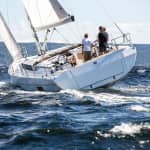
Shuttle service from the boat to dinner
The flower island of Ilovik is the southernmost point of Kvarner and the favourite destination of many charterers. One hundred mooring buoys are moored in the Ilovik channel today, giving us a flavour of how crowded it can get in high season. We are lucky that most of the buoys are still free. There are even some at the L-shaped harbour pier. We moor with a mooring ring and are in the centre of Ilovik. If you prefer to moor at the buoy, you can leave the dinghy on deck and take a shuttle (tel. 099/516 23 49, www.ilovik.hr) to take you ashore. The journey usually costs three euros. But if you stop off at one of the three restaurants, the shuttle fee will be credited to your restaurant bill.
The fish restaurant "Amigo" has been one of the best in Kvarner for decades. The owner, Elza Stojši, invites us to enjoy fresh seafood from the Ilovicka vrata, served with a chilled Zlahtina. The breathtaking silence, the clear air, the clean sea and the sensationally good cuisine are what make Ilovik so attractive. These include the Ilovik veteran Senadin Maši, who comes from Bosnia and runs the speciality restaurant "Porto" here at the beautiful end of the world. His terrace hovers over the sea. Before the start of the season, we are the only guests and enjoy the Bosnian-style stuffed peppers.
The green island of Croatia - A trip to Rab
A charter week is far too short. The wind has turned south and is with us when we sail the entire route from Ilovik back to Punat on Friday, our last charter day. We leave the wonderful harbour towns of Rovenska and Veli Lošinj on our port side. Instead, we want to moor for two hours in the island metropolis of Rab, which is about halfway to our home harbour. There was a lot of building work on the island of the same name in the winter of 2024/25. The harbour used to offer little protection from jugo and there were only a few guest berths on the town pier. In the meantime, however, the harbour pier in front of the old town island has been redesigned. There are now guest berths with moorings, electricity and water. A new pier has been built to the south of the city pier to keep the jugo at bay.
A young, friendly harbour master assigns us a spot on the new Old Town pier and takes the lines. "How long do you want to stay?" he asks. "Just two hours," I reply. "That's five euros an hour." Rab, which is more than 2,000 years old, is definitely worth a visit. You reach the "summit" of the old town via narrow alleyways. The towers of five churches are lined up along the car-free mountain road (Gornija ulica). The bell tower of St John's Church at the top is always open. You have the best view from the top: The old town centre lies before us in the shape of a ship's hull, the church towers are its masts.
Best views in Krk
As we cast off, we feel nostalgic. We would have loved to stay longer in Kvarner. On the remaining 21 nautical miles back to our home harbour, the Jugo pushes from astern and gives us a great sailing experience. We first head for the island capital of Krk to refuel the boat before returning it. As we have always had good sailing winds for a week, the fuel bill remains manageable. In the meantime, the Jugo has fallen asleep. We drop anchor one last time in the shallow water south of the harbour mole and enjoy the view of the old town of Krk, illuminated by the evening light.
There has been a lack of guest berths in the city harbour for years. In addition, the main pier, which is too short, offers insufficient protection when the Jugo swell rolls in from the south. Permits have now been granted to extend the piers to the west and east to create a closed harbour basin. Construction work is due to start after the end of the season. When the piers are finished, two new floating jetties will be installed in the eastern harbour bay, where local boats will be moored. The berths thus gained in the old town will then be available to transit guests. According to current plans, the construction work should be completed by August 2027.
There are many good reasons for travelling to Kvarner again next season. With the setting sun behind us, we motor the remaining three miles from Krk to the charter base in Marina Punat. We have arranged to check out the next morning. This gives us the opportunity to try out the new "Marina" restaurant as a farewell. The restaurant in the futuristic new building in the centre of the marina was opened in autumn 2024 and immediately made it into the top ten best restaurants in Croatia. Only agricultural products from the island of Krk and fish and seafood from Kvarner are prepared here according to traditional recipes. We are looking forward to it.
Read here: What's new on the Adriatic?
Precinct information
Journey
The charter base "In2theblue" is located in Marina Punat in the south of the island of Krk. The journey from Munich to Punat takes around seven hours, while Eurowings flies directly to Krk from Hamburg. From Rijeka Airport in the north of the island, it is 31 kilometres to the marina. Alternatively, from June to September you can take the ÖBB motorail train from Hamburg to Villach. From here it is a 3.5 hour drive to the charter base.
Charter
In addition to yacht charter, In2theblue specialises in sailing instruction, skipper and regatta training. The charter fleet consists of 37 sailing yachts from 34 to 51 feet, including five catamarans. The locations are Punat and Kremik. The Beneteau 41.1 chartered by us (12.43 x 4.20 x 2.18 m, three double cabins, two bathrooms) is easy to handle even by a small crew thanks to its furling mainsail and electric winch. Depending on the season, the boat costs 1,100 to 2,400 euros per week. Extras: Transit log (€ 290), bed linen, towels (€ 10 p. p.), outboard motor (€ 80), gennaker (€ 500), SUP (€ 130), final cleaning (€ 100), Croatian tourist tax (€ 1.33 p. p. per night). Contact: In2theblue Charter, Puntica 7, 51521 Punat, Croatia. Tel. +43/676/898 62 83 04 in2theblue.com/yachtcharter
Navigation
The crew should be proficient in basic seamanship such as anchoring or mooring with murres. This includes planning the trip according to the daily weather forecast, especially with regard to bora. The weather can easily change and the bora can arrive earlier or stronger than forecast.
Driving licences
German skippers need at least a recreational craft licence for chartering. One member of the crew must have a radio licence.
Wind, weather
The climate in Kvarner Bay is mild and sunny throughout the season. The fair weather wind Maestral blows from the north-west in the mornings to afternoons and dies down in the evenings. The Bora (from the north-east) develops its greatest strength in the Vinodolski channel, in the Senjska vrata and in the Velebit channel. It can also occur in other parts of Kvarner, but much weaker. Strong winds and swell can also be caused by the Jugo (from the south-east) or a thunderstorm (from the west). From May to October, daytime temperatures range from 21 to 30 degrees. meteo.hr / windfinder.com / windguru.cz

Bodo Müller
Freier Autor
