


A motorsailer moors next to us, and of course I go onto the jetty to help. The woman is already standing at the bow with the mooring lines in her hands. "Hochwanner!" I hear her shout. I'm a little irritated, but smile at her with a welcoming face. The boat inches closer. The woman calls back to her husband again, this time: "Leutascher Dreitorspitze!" Now I frown. What is this?
The woman continues to look intently towards the jetty. "Beaver head, beaver head!" Somehow that's strange. But the two look completely normal. Then comes one after the other: "Big dog death! Hochkalter! Eastern Karwendelspitze!" At the last exclamation, she throws me the lead.
"Thank you very much," says the woman kindly. "Gladly," I reply. Should I ask? I mean: I would be interested in Hundstod. Östliche Karwendelspitze tells me something, but I can't work out what.
The man now comes forward and also greets her politely. "You skipped the Zugspitze," he then reproaches his wife. She defends herself: "We were already practically in the box. I went straight for the Hochwanner. Or Hochvogel. Never mind." But her husband doesn't let up. "And the Watzmann Mittelspitze?" he asks. She: "Please, Gert, there's only a few metres difference. I'm making a fool of myself." But he doesn't accept that: "And I need precise information. You've also left out the Hocheisspitze."
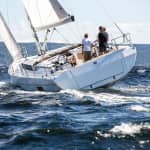
"Hello," I say, but the man pays no attention to me. He is annoyed. I'm so curious that I ask after all. I've realised by now that it's about mountains. "What do the Zugspitze and the Hundstod have to do with mooring?"
"Yes, everyone asks me that. No matter where you arrive. My husband insists on it. He claims that if you have your own terms for sailing as a couple, i.e. terms that no one else uses, you work better together during manoeuvres." I'm amazed and just say: "I see."
She continues: "I came up with the mountains with the different heights because I know them, as we also like hiking. The Zugspitze is the highest, so you still have room to climb up to the footbridge. I'm Hilda, by the way." - "I see." Then I introduce myself too.
I could never memorise all these mountains in my life. Although I have to admit that I don't like the usual commands and orders when mooring either. My husband always calls out in such a professional manner: "Right on the lead line?", and I'm then supposed to shout "Right!". And then the next command is already being barked.
I often simply don't answer because this accurate sailing language doesn't suit me. I still trip over lines regularly, I've even fallen over once, and then I'm supposed to pretend I'm Ellen MacArthur.
And some sailing terms are really strange. Once we were sailing with several boats when my husband said to someone on the phone: "I have to hang up now, we have a manoeuvre in the flotilla squadron." I thought we were being attacked by a warship.
"So why don't you just say: 'Eight metres, seven, six, five and four'?" Hilde explains: "That makes my husband nervous and he gets into a tizzy. If you dock at the same time as others, you hear numbers from all sides. We've often ended up dotting against the jetty.
"I don't think that's bad at all," says my husband, who has overheard our conversation. "You're often at the front and can't tell how many metres it is to the jetty. And when I hear other voices, I don't know what's going on any more. Especially when it comes to mooring, you regularly wet your jacket."
I don't want to put up with that. "Just because I often don't understand you, because of too much wind or whatever. I always do it wrong anyway, no matter how I do it. Besides, you wet your jacket when you put it on and that transfers to me." Well, that had to be said!
"Fine by me," he replies meekly. "But you need to learn how to use the terms correctly." I add: "And you have to learn that it's helpful if there's only one term for all the things on board and not five for each thing."
Vaporise! Also something like this. You vapourise in a steam bath or in cosmetics before cleansing the skin.
But he's right about one thing: I'm really bad at estimating distances. But I won't admit that now, it would be grist to his mill.
He then rummages somewhere in the cupboard and finally hands me a book. "Here, finally get to grips with it." My goodness! For the sake of peace on board, I take the book back to my bunk as evening reading. Good. Let's start with the casting off. I read: Clear to cast off starboard/port ahead. - Clear! - Clear on the fore line - Clear! - Clear for fender. - Clear! - Clear for aft line - Clear! How monotonous! Who's going to remember that, I think to myself.
In fact, we have often argued about this very thing. I'm supposed to let him know when the lead is in. Jesus, he can see that! But please, please, please. If he thinks everything will work better then. But under no circumstances will I use self-selected terms like these mountains when putting them on. Dear me! Suppose I were to use tree pests as a guide, then I might have to shout "woolly cup bug!" when I'm still four metres from the footbridge. I'd rather do it another way.
So I read on and try to memorise everything: Spreading the leader. - Is deployed! - Ready to place under... . - Is clear! - Vaporise in the fore spring. - Is clear! Vaporise! Also something like this. You vapourise in a steam bath or in cosmetics before cleansing the skin.
The next day, after casting off, I stumble onto the foredeck. "Watch out for the sausage!" shouts my husband, and that's exactly what I mean: sausage! "Jesus, the gennaker! You stepped on the gennaker!" I shout back: "Why didn't you say that?" He: "Because you can also say sausage." - "I see."
A little later: "Right, let's pull up the rag." Rag, bag, bladder works too. How are you supposed to manage that? Then: "Right, we're going upwind now." - "You probably mean 'Hot on the jib'!" He looks at me. "Whatever. You've really read something about it. We should always do it like this now. Just sailing terminology. I think that's good."
After a lovely day's sailing, we want to get to Lyø and lower the sails first. "Right, sails down," says my husband. "No," I say. "That means 'ready to hoist sails, ready at jib halyard, lower jib, ready at main halyard, lower mainsail'." He snorts: "Oh my goodness!" I am proud. Then we enter the harbour.
"We'll take that spot!" Good, I think to myself, there are lots of people on the jetty. How nice. "Look at the truth!" I shout, delighted, because I know he hates that kind of talk. Then I shout: "Ready to moor, aye, aye, Captain. I know: Captain next God!" The gangplank is amused. Turning to the bystanders, I say in a friendly manner: "My husband can only dock with these special terms. What can you do?" I go one better. "Better to drink rum than sit around. That's what my husband always says."
He, the man, doesn't talk to me anymore, not even after I say: "Now cheers to the skipper! Warm beer from the Smutje is enough, keelhaul the crew right away!" If looks could kill. Finally, I hand him a book that someone has forgotten here and that I read yesterday. It contains funny sailor sayings that he won't tolerate under any circumstances.
He reads: Young people sail dinghies, but that's just not for old people. And: A skipper is even slightly out of tune when the keel floats up. "Those would be my special terms that I would choose for investing," I say, and I know that now there's peace in the box once and for all. Because otherwise: If an eel comes up the companionway, the sea valve was probably open!

Steffi von Wolff
Freie Autorin
