


Before the snow came and the ice, lots of ice, this winter had already demanded a lot from him. At the beginning of January, a storm from the south-east raged for days, causing short waves even in the otherwise well-protected Maasholm Noor. The anchor slipped sometime during the night at 40 knots, gusting to over 50 knots - the wind pressure was too great.
A boat moored not far from him had already started to drift. At high tide, it was pushed to the opposite bank of the Schlei near Rabel. It has been lying there on the stones ever since, its rig angled to the north-west, the companionway open. Even when viewed from a distance, it looks like a reminder of the pitfalls associated with wintering at anchor.
The first winter storm - a difficult test
Adel Moser got off more lightly. He was on board when his Finnclipper 35 slowly began to drift away. He wasn't able to do much about it. "I do have a powerful diesel," he explains. "But it won't start because the on-board electrics would have to be repaired first." He didn't have the money or time for that in the autumn. And the outboard motor on his dinghy only has 2.5 hp - far too little to tow the seven-tonne yacht against 10 Beaufort.
So all he could do was deploy the second anchor - "and hope that it would hold". Moser was lucky: first the iron slowed down the drift and then, just before reaching the shore, it actually took hold in the soft silt.
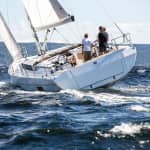
When first the wind and then the water level dropped the next day, he found himself slightly adrift. But the single-handed skipper was able to free himself in the end with the help of his outboard motor, which he mounted on the bathing ladder, and his spinnaker, which he used to heel the boat.
"That was a close call," he says. But he says it so calmly and matter-of-factly, as if it were little more than an episode in an otherwise ordinary life on board.
A home surrounded by nothing but nature
It is for Adel Moser too. The 42-year-old, who found sailing late in life and has only had his own boat for three years, exposes himself to nature like few others. He has chosen the Noor, the bulge in the Schlei that turns Maasholm into a peninsula, as his front garden. He sees the Finnclipper as his home. Not just during the season, but all year round.
In November, when the water temperature slipped into the single digits, it was no fun. In January, with a bitter easterly wind and what felt like minus 15 degrees, it became existential. In February, ice threatened to trap him. The skipper persevered, interrupted only by occasional trips ashore to fetch water in a canister or to walk to Kappeln to buy food.
His greatest luxury on board is the gas cooker and a solar panel, which struggles to keep the on-board battery charged. He uses it to charge his mobile phone and power an LED lamp when he wants to cook something or read. He also has a fan heater with a thermostat and 20 litres of diesel in the tank to run it. "But I don't want to burn any of it," he says. "I just dress warmly."
For particularly cold days, he keeps a thick wetsuit in his wardrobe, which he also uses to crawl into his sleeping bag and under several blankets at night when in doubt. "For me, it's a way of experiencing my environment completely unfiltered." He seldom bars up his downstairs. "Otherwise you don't really live." If it rains or snows, that's just the way it is. "I don't think: help, rain!"
Renunciation as gain
Unlike many bloggers who don't expose themselves in nearly the same way, Adel Moser's life is not an Instagram production. On the contrary: he withdraws. In his hermitage in a confined space, he distances himself from the constraints of a world that has become alien to him: complicated, standardised, over-commercialised. Experiencing nature in the wintery Noor helps him, as he says, "to find myself again."
In this renunciation, which he experiences as a gain, he is reminded of Thies Matzen and Kicki Ericsson, who spent two long, hard winters in South Georgia on their nine-metre wooden boat "Wanderer III". "Time was perhaps our most important asset," says Matzen, looking back.
Moser's self-imposed isolation is also reminiscent of Chris McCandless, a young American from a wealthy background who renounced all his possessions in the mid-1990s to search for meaning in the Alaskan wilderness.
The book about him, "Into the Wild", moved an entire generation at a time when there were no smartphones, no social networks and no AI. It was translated into 30 languages, reprinted more than 170 times and made into a film in 2007. It is still on the curricula of many schools and universities today because it is an expression of a search for truthfulness.
It says: "So many people live in unhappy circumstances and yet do not take the initiative to change their situation because they are accustomed to a life of security, conformity and conservatism that only seems to give them peace of mind. In reality, however, nothing damages the spirit of adventure as much as a secure future. The fundamental core of a person's living spirit is their passion for adventure. Therefore, there is no greater joy than an endlessly changing horizon."
Chris McCandless' diary entries mirror the stories of authors such as Jack London and Henry David Thoreau, who a century earlier also sought peace and fulfilment in the rugged outdoors.
His boat is the place where he can finally arrive
But Adel Moser, who follows a very similar path, is not familiar with their books. He doesn't aspire to any role models or philosophy. He simply does his thing as best he can.
When he talks, he does so calmly and deliberately. This is also how he moves on board or from the jetty to the dinghy: without any haste, carefully. When he rows ashore, four layers of clothing on his body and a large rucksack on his back, he doesn't wear a lifejacket. "I don't need one," he says. "Before I take a step, I've thought it through thoroughly. That's why I'm not afraid, even in snow and ice. I feel totally safe on the water."
His boat is called "Finally". The old name, "Aniara", is still on the bow, but the new one fits better. It expresses a sense of arrival that has long been missing in Adel Moser's life.
Born in Thuringia and raised in Berlin, he had to leave a difficult childhood in his wake. He doesn't like to talk about it, only mentioning a brutal attack that sent him to hospital. The rest lies behind the walls of dissociative amnesia, which still makes it difficult for him to find his way in the world outside his Finnclipper.
He did not complete any vocational training or study. The shadows of his early years were too long. Due to his amnesia, he is entitled to a pension: 700 euros a month. For a year, he didn't even claim it because he rejects what he calls "all this money nonsense" - that everything has a price, even a few watt hours that he needs to charge his battery when there isn't enough light for the solar cell in the grey northern German winter.
He was given his boat as a gift. It stood on land for years, the water so high in the bilge that the floorboards floated up. But he got it afloat, somehow, "finally". This is their second winter together.
"The boat, the sailing - that's something very special for me," says Adel. "I wake up! There's no one to block my door. Nothing else bad can happen on board." Maybe that's why the cold and storms lose their menace, because he experiences the Finnclipper as a safe space. In winter, perhaps even more so than usual, because nobody even comes close to him.
He does not deny that the exposure is difficult. "But it also really gives you a lot of strength." He enjoys every moment, he says: "When I grab my bike, row ashore and just go for a ride through the woods. That is pricelessly beautiful. Or when everything goes quiet in the snow. When it soon gets warm again and the flowers bloom. I get huge eyes!"
The boat, in all its simplicity and imperfection, opens up a whole new world for him. "It's like when you open a book and it just grabs you."
With the support of the community
When a strong easterly wind blocked the entrance to the Noor with a thick layer of ice at the beginning of February, which gradually threatened to encase his "Finally" as well, Adel drew up an escape plan with the dinghy, which he wanted to pull across the ice if necessary. But the village community of Maasholm beat him to it.
They had discussed the situation in the local council: offer help or hope that the young man would manage? The local representatives decided by a large majority in favour of solidarity.
Mayor Kay-Uwe Andresen immediately drummed up half a dozen fishermen, who readily agreed. One of them took his large steel cutter into the Noor to break the ice. The rescue team then set off in a smaller cutter to evacuate the hermit from his Finnclipper.
It was a deeply moving action. Adel Moser hadn't asked to be rescued, but he still climbed over gratefully. As they lay in the municipal harbour, with the dinghy in tow, the mayor, the fishermen and the anchorman from Noor, they drank a cup of grog together, as is customary in Maasholm even in summer.
Who knows, perhaps the man with the wondrous love of nature has long since found a second home without realising it. Not only on the water, but also in the village.
Sometimes I'm on board for four or five days at a time. Being exposed really gives you a lot of strength. I'm not afraid, not even in snow and ice."

Jochen Rieker
Herausgeber YACHT
