


- Harry Pidgeon becomes a sailor within a day
- River adventures become a dream of the sea
- Ideas from several boats become "Islander"
- Harry Pidgeon lays the keel of the "Islander"
- Most difficult construction work
- Piles of pieces of wood in the sand become a yacht
- A thousand dollars in materials and a year and a half of hard work
- The "Islander" ship
- The author Harry Clifford Pidgeon
- The book "Around the world one-handed"
The "Islander" was my first attempt at building a sailing boat, but I don't think any amateur boat has ever so comprehensively fulfilled its owner's dream. A land person could not have been prouder to be travelling across the sea on a flying carpet. As a teenager, I was not exactly favourably placed for a career in seafaring, but I had many qualifications for this profession. My love of the sea didn't come from an early connection, as I was born on a farm in the middle of Iowa and didn't see salt water for the first time until I was eighteen in California. As far as I know, none of my ancestors were ever sailors.
Also worth reading:
- Single-handed pioneer: Joshua Slocum is the first person to complete a single-handed circumnavigation of the globe
- Forgotten pioneers: Ann Davison was the first woman to sail single-handed across the Atlantic
- Pioneering achievement: Jazz Turner is the first wheelchair user to circumnavigate Great Britain single-handedly
After spending a few years on a ranch in California, I went to Alaska where I gained first-hand knowledge of boats. I had built a sailing canoe in California. But living thirty miles from navigable waters, I hadn't learned much about its use until I read Lieutenant Schwatka's 'Along Alaska's Great River' and decided to check out that mighty river.
A young farmer joined me on this adventure. We followed the tracks of prospectors and smugglers, climbed up the snowy Chilkoot Pass and built a boat on the shore of Marsh Lake, one of the Yukon's springs. It was a real boat made of planks that we had sawn from a spruce tree growing nearby. To propel our new boat, we had made a pair of oars and a paddle. We launched our boat from the ice into a patch of open water at the foot of the lake.
Harry Pidgeon becomes a sailor within a day
I had never held a pair of oars before, but now I was operating them and Dan took over the paddle. We left Marsh Lake early in the morning and reached Miles Canyon the same day. There we met a group of four men carrying two boats around the canyon. They offered to help us carry our boat, but after looking at the spot, I decided we would go through, which we did the next morning.
One of the group, Peter Lorentsen, stood at the bottom of the canyon to see what would happen. When we shot out of the canyon and got to the bank where Peter was standing, he said, "Well, you guys are sailors." I replied, "If you'd seen us yesterday morning, you wouldn't have said we were sailors." However, he persisted: "I'm an old sailor and I know you boys are sailors." Peter was later killed when his boat capsized while following us through the Five Finger Rapids, but we were able to rescue his partner Henry and bring him to his destination in Circle, a new mining town on the Yukon. Beyond the Five Finger Rapids, the Yukon River was an easy ride for the two farmers, who had become sailors within a day.
River adventures become a dream of the sea
Late in the autumn, we took the small cargo steamer "Bertha" from St. Michael's Island at the mouth of the river to California. After that wonderful summer on the Yukon, I had a hard time settling back in and returned to Alaska, where I had many exciting adventures on the rivers and lakes of the North. For a while I owned a small boat and sailed it between the islands of southeast Alaska, but I never went out to sea and spent most of my time hunting and photographing along the rivers and in the mountains of this great country.
The experience I had gained building small riverboats from materials found in the woods stood me in good stead when I later built the Islander that took me around the world, and living in the wilderness was a good school for developing ingenuity. On a visit to my old home in Iowa, I remembered that one of my childhood dreams had been to paddle down the Mississippi to the sea. With this idea in mind, I travelled to Minneapolis and built a small flatboat just below Saint Anthony Falls.
I had many friends and relatives who lived on the river and cheered me on my way to sea, and I learnt that I could use my photographic talent to make a profit in the end. For more than a year I travelled the river and by the time I left the small flatboat at Port Eads, I had decided to explore further afield on a boat of my own. From that point on, I became interested in sailing boats and started thinking about travelling. But it takes more than just wishes to acquire a suitable boat and go on long voyages, so I eventually returned to California and became a photographer among the big trees of the Sierra Nevada. After a few years of this work, although I enjoyed it, I longed for new impressions.
Ideas from several boats become "Islander"
It was around this time that I came across a design for a boat that seemed to be very seaworthy and not too big for one man to handle. It also didn't seem too difficult to build for my limited knowledge of shipbuilding.
Through business with lumberjacks and tourists in the great forests and the proceeds from the sale of a small farm, I came into possession of the necessary funds, so I decided to build my long-awaited ship and make a voyage to the islands of the sea. From the mountains I went down to the shore of Los Angeles harbour, which was located on an undeveloped plot of land, and began the actual construction work.
The plan I wanted to build my boat from had been designed for Captain Thomas Fleming Day, who had extensive experience of sailing small boats, and was in line with Captain Day's idea of what a small seagoing vessel should look like. It was a V-hull boat, a type that had been developed by Captain Day and yacht designers from Rudder Magazine. The reason for using the V-bottom type was that it was easier for the amateur boat builder to design and build. Three safe and manageable touring boats were presented and the plans published in "Rudder". These were the "Sea Bird", "Naiad" and "Seagoer". The "Islander" was built along the lines of the "Seagoer" and the general construction plan is the same, but I used ideas from each of these boats and added some of my own ideas based on the material available and my limited resources.
All the information I had when building the "Islander" is contained in a booklet published by the Rudder Publishing Company in New York ("How to Build a Cruising Yawl") and contains instructions for the construction of "Sea Bird", "Naiad" and "Seagoer".
Harry Pidgeon lays the keel of the "Islander"
At the beginning of 1917, the actual construction work began with the laying of the keel. The timbers for the keel were eight by twelve inches (20 x 30 cm) thick, and the largest piece was twenty-eight feet (8.5 m) long. Whenever I hear someone talk about my fragile boat, I always think of these massive keel beams. The beams were cut with a saw and crosscut, and a 1,250 pound (about 567 kg) piece of iron was cast at a nearby foundry for the lower part of the keel that would serve as ballast. When the beams and the iron ballast piece were bolted together with large iron bolts, they formed an extremely stable backbone for the frame of my ship.
With the exception of the stem and some parts of the cabin, which were made of oak, Douglas fir or Oregon pine was used for the construction. The beams for the frame were all very heavy and were additionally reinforced in the bilge area with steel plates that I had cut from tank plates. Once the frame had been screwed together as tightly as possible, the planks were fitted. The bilge strut and all the parts above it were made from a single piece.
Most difficult construction work
As I was working alone, the planking was long, hard work and the thick, heavy planks were cold bent into position without the aid of a steam box. The bilge struts were two and a half inches (6.3 cm) thick and seven and a half inches (19 cm) wide amidships, tapering to six inches (15 cm) at the ends. These parts were bent over twenty inches (51 cm) on edge and led around the curve of the sides.
After they were in place, a carpenter from a boatyard looked at them and said, "I know how we would put these planks in place in the boatyard where we have a steam box and lots of helping hands, but how you put them in place on your own I can't imagine." It really was the hardest job in the build, but when it came to hammering in wedges and fitting them, no one in the boatyard could have beaten me. These planks had to fall into place, be forced into shape or break. I feared that they would break, but they didn't break at all.
Gradually, the boat began to take shape and spectators kept coming to ask questions and give advice. There was a beachcomber living in a nearby hut who kept telling me that the keel of my boat was cut too far forwards. "She won't go upwind. She'll drift downwind of you." He told me he was building a boat fifty feet long and ten feet wide that he was going to take to Africa to hunt lions. He had invented a reefing device with which he could reef the sails without leaving the steering wheel. He also wanted to install an electric motor as an auxiliary drive and generate electricity with a windmill on deck.
Piles of pieces of wood in the sand become a yacht
I wasn't the only boat builder on the coast either. Within sight of my work, but on the other side of the canal, on the terminal side, a coloured Moses was building an ark to transport a colony of his followers to Liberia. As he was laying the keel, when asked about the size of his planned ship, he replied that it all depended on the donations he received.
The donations didn't seem to stop. For as my boat slowly took shape, his grew into a wondrous two-storey structure, with windows below and above, and a stovepipe protruding through a broken window. No doubt my boat was often mistaken for one of these freaks as it rose from the pile of timbers in the sand. But a yacht builder who was interested in my project told a friend of mine that he couldn't have done a better job himself.
Once the planking was in place, the deck was laid and covered with canvas, and then the deckhouse was added. The sides of the superstructure were each a single solid piece and extended aft to form the cockpit coamings. The cabin was twelve feet long, with a berth on each side and space for drawers and a wood-burning stove. Below deck, between the deckhouse and the cockpit, was a spacious stowage area where supplies could be stored for a long voyage. The cockpit was watertight and self-draining thanks to lead pipes that ran vertically through the hull.
A thousand dollars in materials and a year and a half of hard work
As far as caulking was concerned, I was advised to hire a professional to do it. However, remembering how successful I had been at caulking small boats, I approached this task with more confidence than almost any other on my new boat. And I can say that few boats have been as dry as mine.
The masts were made and fitted, and I painted the name "Islander", which I had given the new ship, on the transom. I dug out the floor under the boat and laid out slide rails for the boat to slide into the water. Some friends who wanted to be at the christening thought they had time to watch the christening of a ship from a nearby shipyard and then the christening of the "Islander", but my boat was launched first. They arrived too late.
From laying the keel to launching, the "Islander" was almost entirely the work of my own hands. She was rigged as a yawl, thirty-four feet long, ten feet, nine inches wide and had a draught of five feet without cargo. With her three sails, she had a sail area of about six hundred and thirty square feet (about 58 m2). She was designed to have a motor fitted, but for many reasons, mainly financial, I didn't have one. After all, the real attraction is to let the elements take you where you want to go, and besides, a motor never works properly if it's left alone with me.
I built a small, nine-foot-long rowing boat as a dinghy, which was brought on board at sea, turned against the deckhouse and lashed down. In this position, it was taken with me wherever I sailed. In total, the Islander cost me about a thousand dollars for materials and a year and a half of hard labour.
The "Islander" ship

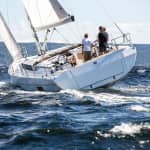
The motorless 34-foot gaff-rigged yawl was modelled on the lines of the "Seagoer", which its builder found in "The Rudder" magazine. Pidgeon used oak, Douglas fir and Oregon pine. The material cost 1,000 dollars. "Islanders" dimensions: 10 x 3.30 x 1.50 metres, displacement: 12 tonnes.
The author Harry Clifford Pidgeon

The scion of a Quaker family, he was born in Iowa in 1869, grew up on a farm and worked as a craftsman. In 1917/18, Pidgeon built the "Islander", with which he sailed single-handed around the world from 1921 to 1925, second only to Joshua Slocum. Pidgeon repeated this feat from 1932 to 1937, also with his "Islander".
The book "Around the world one-handed"

In the book "Around the World Single-Handed. The Cruise of the 'Islander'", Harry Pidgeon describes his first circumnavigation of the world between 1921 and 1925. The vivid travelogue was published in 1932 with numerous photos taken by the author. A reprint in German has now been published. More information: kontrabande.de
