


The location alone is promising. On the underground bridge between Baumwall and Rödingsmarkt, a traffic sign points the way: left towards Fischmarkt, Landungsbrücken, HafenCity and Speicherstadt. Turn right towards the city centre, the town hall and the Alster. Famous Hamburg - just round the corner. Towards the harbour, visitors only have to walk down Rödingsmarkt as far as the canal before they are met by the Elbe. The "Rickmer Rickmers" is moored there. Behind it, barges bob and freighters call at the terminals.
The address could hardly be more attractive. Here, the Hanseatic city tastes of the sea air. No wonder that a nautical shopping paradise once grew up in this neighbourhood and flourished for decades. Because that's exactly what Rödingsmarkt was: perhaps the most beautiful and lavish sailing mile in the world.
Also interesting:
Well over a dozen maritime shops lined up between Baumwall, Kajen and Großer Burstah. Yacht chandlers, boat chandlers, sailmakers. Plus various speciality shops for sailing clothing, ropes, paints, nautical charts, navigation and equipment of all kinds. Buyers came from all over Germany. Everyone's eyes lit up at Rödingsmarkt. As they left one shop, they stumbled into the next.
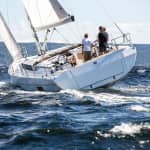
There was nothing that was not available here for the beloved passion. From anchors to Dyneema halyards, from paraffin lamps to gooseneck blades, from compasses to lifejackets, from violin blocks to Southwester. Plus sound nautical advice. If you wanted to equip your yacht or just browse - Rödingsmarkt was seventh heaven for sailing equipment.
Customers stood in the shops in person, were able to smell, look and feel the coveted goods with their own hands. Fingers brushed over shackles, ropes and marlin spits. At the end of the season, people rummaged through the boxes containing the bargains. Leftover lines, wicks, flags, radar reflectors. There was always time for a chat. With the shop owner, with other sailors. Some people just came in to talk. The shop door jingled on the way out.
Boat shops have more or less disappeared
If you go to Rödingsmarkt today, you won't find any of this. Better: almost nothing. Shops have been dying out here too for a long time. According to estimates, up to 70,000 retail shops have closed across Germany in the last ten years. Price computers and search engines now also rule the sailors' world. If you need a compass or new antifouling, you can surf through the online shops and order online. Shopping by mouse click, return key and dispatch.
On the nautical mile, the boat shops have more or less completely disappeared - apart from a single sailing shop that has survived and is holding its own. Halfway up the street, at number 39, large shop windows gleam, behind which maritime goods are piled up. Oilskins hang out there, mannequins wear woollen caps, southern waistcoats and lifejackets. Petroleum lamps, flagpoles and radio beacons stand in the display case, draped next to offshore boots and barometers.
If you press your nose against the window, you can see what a treasure trove awaits you here. Fenders, lifebuoys and boatswain's chairs hang from the ceiling. Cleats, signalling horns, winch cranks, boat batteries and clickers are stored on the shelves. At the back of the shop: Rolls of ropes and sheets, the walls full of shackles, shroud tensioners and fittings. A cornucopia of boat stuff.
The customer hardly knows this feeling any more. Wandering through the shop. Look and discover in peace. Going through the lists for the boat in your mind. Ah, I could really use that! Ah, this chain claw is just the right size! And then: Start sailing in your mind. That's exactly what happens when you step into a real sailing shop like this again. Everyday life suddenly tastes of wind and water.
Last of the Mohicans at Rödingsmarkt
Marko Metzger stands behind the sales counter in a denim shirt and blue waistcoat. The last of the Mohicans at Rödingsmarkt. The septuagenarian says: "We're a kind of fossil, the last of its kind." Above the shop is the name of the remaining one-off: Yachtausrüstung Hamburg.
Marko Metzger trained as a retail salesman when he was just seventeen. He then worked for various companies in the nautical sector and spent some time working in field sales. At the beginning of the 2000s, the opportunity arose to take over the branch of a sailing shop. Metzger stepped in, soon ran the shop on his own account and lived to see the good times. 30 years ago, the Rödingsmarkt was booming when it came to sailing.
There were at least 14 maritime shops in the neighbourhood. "The shops complemented each other," recalls Metzger. "We knew each other, everyone got on well. If something was missing, you called a colleague next door or recommended a customer."
Thanks to the many sailing shops at the port, Hamburg was not only known as a stronghold of shipping, but also as a centre for equipment. "Customers came from all over Europe," says Metzger. "Scandinavia, the Mediterranean, Poland, Russia." Some sailors even travelled from South America to buy equipment at Rödingsmarkt. Metzger: "The nautical mile here was unique, there was probably nothing like it anywhere else in the world."
Closed, disappeared, shut down
Metzger has to think about all the shops that have disappeared over the years. One well-known name was the yacht chandlery Schmeding, a real Hamburg icon not far from the jetties. The shop was part of the harbour scene, dating back to the time when there were still crooked houses, small pubs and general shops here. In 2007, they cancelled the sails.
The corner shop Canel with a view of the Speicherstadt was also an institution. After it closed, an antiques dealer took over the shop space, but that too has long since disappeared. The list goes on: Schefferling yacht equipment - gone. Steinmetz & Hehl, specialising in maritime clothing - closed. Gronau & Sohn, founder of the Jeantex brand - passé. Yachtelektrik Mörer - moved to another location. Yachtfarben Waage - also closed a long time ago.
The well-known mail order company A. W. Niemeyer, which used to operate a two-storey outlet on Rödingsmarkt, also left the harbour. The company then opened a flagship store in Bahrenfeld until it also closed in 2023.
The Hartmann business was also affected. Founded in Hamburg in 1925, the company used to supply the shipyards on the North and Baltic Seas. The shop on Rödingsmarkt became a treasure trove for skippers who worked on their ships themselves. Grinding machines, sandpaper and an inexhaustible range of screws. Hartmann's bronze and brass parts can be found in hundreds of yachts. But this paradise has also disappeared from Rödingsmarkt.
Museum-ready contemporary witnesses
Marko Metzger sits at the back of his shop's lounge. A wall clock is ticking, the coffee machine is running. On the wall is a picture of sailing ships. In the course of the conversation, he remembers even more shops that have disappeared from the scene over time.
Bade & Hornig, a specialist bookshop for nautical charts and literature, merged with another shop and moved away. The Hamburg harbour supplies store Wilhelm Kelle, founded in 1932 in the Zippelhaus, located around the corner from Bei den Mühren, is also history. "An original that has always been part of the harbour," says Metzger. "They had everything, from sack hooks to iron bollards."
Then, in 2010, the Speicherstadt also lost this shop, which had finally resembled a museum-ready witness to the times. In the end, tourists came into the shop and stood in awe between the ship's bells and cane anchors. After the death of the co-owner, the small retailer had to close. The "Hamburger Abendblatt" wrote: "The traditional shop for ship accessories was one of the last of its kind, a wistful farewell after 78 years."
Rigorous mail order business breaks the back of many
Customers come into Metzger's shop in the morning. They pick up ordered goods, look around between the shelves and chat to the boss. "The sailors have hardly changed in all these years," says Metzger. "They've always been there, whether from the Alster, Baltic, North Sea or Elbe."
Many regular customers still come today, including young people. So it can't be due to a lack of new blood or a lack of demand that so many of his colleagues have had to give up. Metzger cites other reasons that led to the extinction of the sailing shops: the market was already changing in the mid-1980s. Long before the internet, the first yacht shops began to sell yacht items by mail order. Catalogues were printed and sent to customers all over Europe.
"That's when it started," says Marko Metzger. "It was brutal competition, with some people beating each other over the head with prices." In addition to the rigorous mail order business, there were other factors. Some of the shop owners were unable to find successors when they wanted or had to retire at well over seventy. Metzger: "Retail means a lot of work, you have a six-day week and bookkeeping on Sundays. You have to want that."
Then rents and other costs exploded in Hamburg, which particularly affected retailers. The large mail-order companies had lower storage costs in comparison and were able to operate more efficiently. Metzger: "At some point, the little ones could no longer keep up."
But that was not all. DIY stores also soon set up nautical departments, where goods were once again available at rock-bottom prices. Finally, the internet and online retail hit the market. Sailors no longer had to go anywhere or even make a phone call. All it took was a few clicks of the mouse and the boxes of new boat shoes arrived at home. At super-low prices.
"It all comes together in the end"
Today, digital business is omnipresent. Any small business owner who doesn't join in is as good as lost. For some of the sailing shops, further death blows followed: Competition from abroad, customers holding their money together after countless crises. And then came corona.
"It all comes together in the end," says Marko Metzger. And today, he adds, the political and economic climate is creating a bad mood everywhere. People are still sailing, and there was even a brief boom during coronavirus. But none of this is helping the small shops. "All in all, too many factors have come together, and only a few in the retail sector are surviving," Metzger explains.
It doesn't feel good, says the boss, even though, as the last man standing at Rödingsmarkt, he can't complain. Metzger has three permanent employees, with temporary staff joining him during the season. However, he no longer has any contact with the other shops on Rödingsmarkt. "They no longer have anything to do with sailing and water sports, there are simply no points of contact."
But Metzger wants to carry on. He is attached to his shop and feels the responsibility of keeping one of the few remaining sailing shops alive. Many of his customers would be disappointed if he were to give up. However, he is slowly looking for a successor. "I could well imagine a smooth transition. You have to get to know a shop like this first."
Sailors can only hope that this will be the case. Genuine yacht shops have become absolute rarities. Not only in Hamburg at Rödingsmarkt, but also on the coasts and in the rest of the country. When the last ones go, the lights go out. No more fragrant teak, no more shackles in the showcases, no more dolls with blue troyers. What remains is the screen. But it doesn't smell of the sea.

Marc Bielefeld
Freier Autor
