


Piecework: Crane, maintenance, storage - behind the scenes at the boat service company
David Ingelfinger
· 17.12.2025


High-pressure cleaners fill the air with clouds of mist. Shipyard employees shout instructions to each other. The sound of a crane's engine roars in your ears. A yacht floats in the air, brackish water runs down its hull and collects on the pier. Daniela and Thomas, the owner couple, are standing a little to one side. They watch intently as the crane operator slowly swings their Hanse 56 over the area and places it on a storage stand at the washing area.
The scene of the action is the Yachtwerft Dick shipyard in Kiel-Wik on the banks of the Kiel Canal. From mid-September to mid-November, up to 30 boats are lifted out of the water, cleaned and put into winter storage on fixed dates - three times a week at peak times in October. For workshop manager Lasse Brandhorst and his team of around 25 people, this means working on a piecework basis. A look behind the scenes shows how the well-coordinated team manages this mammoth task.
Read more from this series:
- Harbour master up close during Kiel Week
- Non-stop work as a boatswain on a museum ship
- Why a retired captain works as a lock keeper
- Dreams come true at the Sirius shipyard
- Students at the sailing boarding school give their all for the dream of the Olympics
- From the roll of cloth to the finished sail at the sailmaker's
- How a captain of the road transports yachts
- Attention, control! On the road with the water police
As soon as the first yachts moor at the floating dock below the five metre high concrete pier early in the morning, things get underway. Like a clockwork mechanism that is set in motion and in which one cogwheel meshes with another, the ships pass through several stations. "When you moor here, several people immediately come on board and start working - like ants," says owner Thomas with a twinkle in his eye, still a little incredulous at the speed with which the mast was hoisted and his ship put ashore.
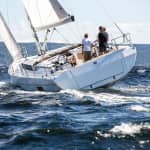
He and his wife have been bringing their Hanseatic yacht with the rather unusual name "Kurs 270" to the Yachtwerft Dick for winterising for five years now. During the season, the couple travel on the Baltic Sea. The fact that they keep coming back to Kiel in autumn is due to the exceptional service provided by the company. "They are incredibly efficient here every time, but they've never been as quick as today," says Daniela in amazement. It took less than 20 minutes to take the boat out of the water.
"The fact that everything works so smoothly is thanks to a system that was implemented 30 years ago and has been continuously improved ever since," explains Brandhorst. The owners are given fixed times at which they have to be on site. If necessary, the mast is laid first, then the ship is moved a few metres further along the jetty to under the crane.
Hand in hand with high working speed
For uncraning, employees attach two straps to the crane hook and then guide them around the bottom of the hull at the bow and stern. They use underwater cameras to optimise the positioning of the straps. As soon as they are in the right place, the boat is lifted out of the water and placed on land on a trestle that has already been prepared. The supports and supports of the trestles are customised for each boat by another team beforehand.
Work is carried out at two wash bays in parallel. While one team is cleaning the underwater hull with high-pressure cleaners, a few of their colleagues are already picking up the next boat from the crane. Finally, a special lorry-sized lift truck takes the boats from the pier across the road in front of it to the winter storage facility opposite. There, the boats are either parked in the outdoor area or in a hall. Smaller boats sometimes make a further journey to one of several halls located in various parts of Kiel.
"Given the pace of work, you always worry a bit about the boat, but so far nothing has ever really gone wrong," says owner Daniela, sighing with relief. Lasse Brandhorst confirms that there have been no incidents during his time at the shipyard over the last 15 years. "At most, there's the odd bent Windex or a faulty lamp." The many years of routine contribute significantly to the smooth workflow.
Efficiency thanks to meticulous planning
The special thing about the system at Yachtwerft Dick is that all steps take place simultaneously. While the mast is being laid on one boat, another is hanging in the crane. Meanwhile, a third boat is being carpentered and another is ready to be transported to the warehouse by the lifting vehicle. In this way, the shipyard employees can complete up to four ships at the same time.
Each team works on a stationary basis. The respective work processes are well-rehearsed, every move is perfect. "On average, we need just ten to fifteen minutes to lay the mast, crane and jack up a yacht," says Brandhorst. As if on an assembly line, there is a constant supply of new ships waiting on the canal to be brought ashore next. "A lot of planning is needed beforehand to ensure that everything works like this," says the workshop manager. This begins with the scheduling of appointments, including the exact time for the owners, and ends with the choice of location for each individual ship in one of the halls.
"Even the height of the trestles is planned down to the last centimetre so that each ship will fit in its intended place later." Brandhorst is often able to draw on experience. "As most of the owners have been with us for years, we know most of the ships and their dimensions," says Brandhorst. But sometimes not everything goes according to plan. "Last year, our equipment carrier got stuck at the top of the hall door," says Daniela, looking anxiously at her Hanse 56, which is now on its way into the hall.
Convince with quality
This time it's getting tight again. The engine of the lifting vehicle hums dully in the hall. Lasse Brandhorst, visibly focussed, indicates the direction with brief hand signals. Under the critical gaze of Daniela and Thomas, the driver manoeuvres the large yacht bit by bit through the comparatively small hall door. There is barely ten centimetres of clearance above the equipment carrier. But it fits. And after 20 minutes of manoeuvring, it's done: the ship is in its place. A load off the sailor couple's minds.
When asked how he deals with his own nervousness and that of the owners in such situations, Brandhorst responds with a smile: "We crane 800 boats a year. You get a certain routine. In the end, we can always impress with our quality."
While the exciting part is over for Daniela and Thomas and they can have a coffee, in many cases the work for Brandhorst and his team is only just beginning. After all, the yacht yard's service doesn't just include craning the boat and transporting it to winter storage.
Owners can also choose from a wide range of other services. These range from engine maintenance to a full service offer for all those who do not want to or cannot look after the boat themselves in winter.
Not even 20 minutes after the Hanse 56 has arrived at its berth, employees from the shipyard come on board again. They prepare the engine for the coming winter. In the case of the "Kurs 270", they only have to fill the cooling system with antifreeze. The pair had already done everything else beforehand.
The shipyard's comprehensive services come at a price
Lasse Brandhorst puts the cost of the service in concrete terms: "For a classic family cruiser such as a Bavaria 31, the crane-out including engine work and storage for the entire winter half-year is around 4,000 euros." Compared to other boat service companies on the Baltic Sea, this sum is definitely in the premium segment. However, the owners do not pay this surcharge solely for the work carried out, but because they can rely on the shipyard's trustworthiness and punctuality. "In smaller harbours, customers sometimes wait a few hours for their turn. If they have an appointment with us at 2 p.m., then they get their turn at 2 p.m.," emphasises Brandhorst.
Thomas and Daniela's Hanse 56 is now safely under the hall roof in Kiel. This day marks the end of the sailing season for them. They will not return to the shores of the Kiel Canal until next spring. Then, when the hall doors open and the team at Yachtwerft Dick returns one ship after another to its element.
