


Opinion: Recycling boats - between aspiration, reality and greenwashing
YACHT
· 22.11.2025

Dear readers,
Sustainability has long since become a defining leitmotif of our time. And, of course, the topic does not stop at yachting. Manufacturers are increasingly presenting innovative projects and thus portraying themselves as future-orientated and responsible. They emphasise the careful use of resources, experiment with alternative materials and point to new approaches that are intended to improve the environmental balance of their products. That's a good thing!
This trend is visible everywhere. For example at boat shows, where green innovations are prominently displayed, or in press releases that increasingly emphasise sustainability as an integral part of corporate strategy. Even in regatta sport, more and more attempts are being made to combine the pursuit of sporting excellence and performance with ecological responsibility. In short, sustainability has become an important sales and marketing argument throughout the industry - a topic that hardly anyone can ignore.
However, I increasingly see a second side to this trend. On the one hand, it is pleasing that the industry is recognising its responsibility and looking for solutions. On the other hand, there is also a growing danger that terms such as "recycling" or "sustainability" will degenerate into mere marketing tools and fade in significance without achieving any real measurable ecological success. I think the question needs to be asked more about how substantial the publicised innovations and projects actually are and remain.
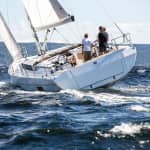
One positive aspect is the consistent use of materials that have already been recycled. If manufacturers use fibres, plastics, aluminium or wood that already have one or more life cycles behind them, this can directly and sustainably reduce the consumption of resources. Especially in a production environment such as yacht building, where a lot of new material is traditionally processed, such measures go hand in hand with tangible progress.
The use of recycled materials therefore offers a real opportunity to significantly reduce the ecological footprint of modern yacht building. And the effect of these measures is already visible today: less primary material, lower energy consumption and often also a reduction in production waste. This shows that sustainability in yacht building is not just a vision, but is already part of everyday life in many places and serves as a role model.
The situation is different with recyclable composite systems. They are now often presented as the revolutionary building block of a new circular yacht industry. Thermoplastic resins and separable matrix systems promise that a yacht could be completely recycled at the end of its life cycle.
This is where my critical view begins: a yacht may remain in service for 40, 50 or even more years. Nobody can realistically predict today whether the recycling systems currently being developed in laboratories and pilot projects will still be available and whether they will still be economically viable. Materials are being developed today for hypothetical recycling in the distant future - without any certainty as to whether the processes required for this will ever exist on an industrial scale.
This inevitably raises the question of the real benefits of these developments and naturally also fuels the controversial debate surrounding the topic of sustainability. The gap between visible impact and mere promises for the future creates fertile ground for an unwelcome topic: greenwashing!
Innovation always begins with the first steps, and many developments in the field of recyclable composites are technologically exciting, courageous and potentially forward-looking. However, it remains important to deal with the topic objectively and to categorise the facts realistically. Only when technological innovation goes hand in hand with practical feasibility can real change occur - and greenwashing is kept out of the equation.
Michael Good
YACHT editor
Recommended reading from the editorial team

New podcast episode
How the sailing boys went from the sea to the big screen

How much courage, how much youthful recklessness and how much stamina does it take to circumnavigate the world in a sailing boat as a complete beginner? Tim Hund and Vincent Goymann provide the answer in the 67th episode of YACHT - the sailing podcast
Kraken 58
Luxury tourer with passive safety as top priority

Integral keel, full skeg, Kevlar-reinforced hull laminate - this luxury tourer for long journeys is built to buck the trend. Safety is the number one priority. Does the concept work?
Ferrari Hypersail
New project manager for the record chaser

Ferrari Hypersail has completed the construction phase of its 33-metre foiling monohull. Giovanni Soldini is ending his role as project manager and Enrico Voltolini is taking over responsibility for the test phase of the record chaser, which is now beginning.
Obituary
"We will all miss him very much" - Albert Schweizer has died

Farewell to Albert Schweizer: The sailor, sailmaker, sailing promoter and North Sea Week race director has died at the age of 69.
Sailing in old age
The right equipment and conversion to extend your time on the water

After 60, the body loses a lot of strength. Technical solutions such as joystick controls and electric winches push back the age limit by years.
Globe40
Jury decision in favour of Burke and Fink, top duel continues

In the Globe40 final, changes in the lead keep sailors and fans on tenterhooks. On land, the jury has granted a request for redress from Team Next Generation.
Grand Soleil 80
First long cruise launched

Cantiere del Pardo has launched the first Grand Soleil Plus 80 Long Cruise in Fano. At 23.99 metres in length, the yacht marks the new flagship of the Italian shipyard. It was built by Matteo Polli and designed by Nauta from Milan. The telescopic keel enables draughts of between 2.80 and 4.80 metres.
Project
Unusual self-experiment - taking part in a regatta on a low budget

In a new YACHT project, two young editors dare to experiment: they want to take part in the Vegvisir race with a 54-year-old Erria 25
New podcast episode
How the RYA Yachtmaster Offshore goes - with Timm Kruse

In the 66th episode of YACHT - the sailing podcast, Timm Kruse talks about the Royal Yachting Association's (RYA) offshore certificate, the Yachtmaster Offshore.
Swan 51
Elegant eye candy with remarkable build quality in the test

At 17 metres in length, she is the smallest model from the Nautor shipyard. But thanks to its luxurious fittings and outstanding performance, it is a real eye-catcher.
Newsletter: YACHT-Woche
Der Yacht Newsletter fasst die wichtigsten Themen der Woche zusammen, alle Top-Themen kompakt und direkt in deiner Mail-Box. Einfach anmelden:
