


Interview: How the sailing rebels help cancer patients find new courage to face life
Fabian Boerger
· 02.12.2025


Marc Naumann, 43, is about to take his state exams when he finds out about his brain tumour. The cancer throws him off course. Especially as it returns after an initial recovery. During this time, Naumann finds support in sailing. After being discharged from hospital, he made a decision: he gave up his career as a lawyer and founded the non-profit organisation Segelrebellen (Sailing Rebels) in 2014. Since then, he has been taking young cancer patients out on the water. The aim of the cruise is to give them new courage to face life, regain confidence in themselves and their own bodies and get off the merry-go-round that constantly revolves around the disease. The motto of the sailing rebels: "F*ck Cancer. Go Sailing!"
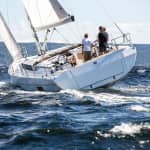
We meet Marc Naumann on board his "Magic" and accompany him and his crew out of the Flensburg Fjord towards the Danish South Sea. In this interview, the sailing rebel founder talks about losing control, how people complement each other at sea - and why sailing helps young cancer patients deal with the challenges of the disease.
YACHT: Mr Naumann, the sailing rebels recently received the German Foundation for Young Adults with Cancer's Volunteer Award. However, when you set off on your first sailing trip ten years ago, instead of being recognised, you faced strong headwinds. Why was that?
Marc Naumann: Back then, we sailed from Marseille to Mallorca. We got a real shitstorm on social media about this trip. It was said that we were deliberately putting young people in danger. Some wrote: "They're sick and have no idea what they're getting themselves into", or: "This has to be stopped if something happens and there's no doctor there." Many people don't want to deal with the subject of cancer. It is uncomfortable, arouses their own fears and worries.
What did that do to you?
That unsettled me at first - but then encouraged me all the more to continue. Because there was also support. It came from a few people, but it was all the more intense. I still receive messages today that show me that what we are doing is right.
What is behind the sailing rebels?
We organise trips for young adults who have been diagnosed with cancer. It is an offer for those who realise that they are currently struggling with the disease or its consequences - and who therefore want to change something.
What's rebellious about that?
A rebel wants to improve conditions. Even back then, when I was still on the infusion machines, I described myself as a rebel. I didn't want to take it easy, I wanted to experience something. Rebels go down new paths, try out new things. Many of those who are on board now have never been sailing before. They embark on an adventure and say: I dare to do this.
Who is going on board?
The sailors are between 18 and 40 years old and have already recovered from cancer. They are young people who want to try something new. At the same time, it's not always about sailing per se - after all, we don't do traditional sailing training here. What makes the trip special are the conversations and activities on board.
What motivated you to set up the sailing rebels?
After chemotherapy, I caught up on my state exams. On the last day of my exams, I received the news that a friend had died of cancer. At that moment, I knew that I didn't want to tie myself down to a job, I wanted to sail instead. I had learnt this shortly before the diagnosis and it had become an anchor for me ever since. But going on a big trip, seeing the world alone? That wasn't the right thing. I didn't want to work as a charter skipper either, because holidaymakers don't want to travel with sick people. As an outsider, you might think: What heartless people! But to be honest, I think that's completely legitimate. Conversely, as a sick person, I didn't want to sail with healthy people either. The way we interact with each other is simply different.
What do you mean?
When we're sailing and someone says they're tired or can't tighten the sheet, no one looks askance. Nobody wears rose-tinted holiday glasses and assumes that everything will go perfectly. Instead, we have an approximate route in mind and everyone tries to contribute to making it work.
What does sailing achieve that therapies and other programmes do not?
When I was in therapy back then, there were batik painting courses and discussion groups. When you're in your thirties, that doesn't correspond to the reality of life. Young people do sport, want to experience adventure, want to travel. That's exactly what sailing offers. It gives you a great sense of freedom. You determine your own path, you are independent, responsible for yourself. At the same time, the wind decides where you sail. You have to work with what you have and make the most of it. That strikes a chord with many people - especially once they have overcome the illness. If we went hiking, for example, and someone couldn't go because their feet hurt or they didn't have the strength, we would have to stop or even turn back. Here we are all in the same boat and reach the destination together. Everyone does their bit, even if it means supplying the crew with bananas.
What moves young people, what do they talk about on board?
We're not doing therapy bingo here. It's not about who had the worst therapy or the worst illness, but about practical solutions. Anyone who has been in therapy for two or three years is in a kind of forced break, while the lives of others around them simply go on. Your own education, studies or job, on the other hand, don't continue, relationships break down, you have no income, perhaps you move back in with your parents. The whole life you have built up collapses and you are no longer in control. But there are also other issues, such as family planning. Have you taken precautions and had sperm frozen? Then there are expensive therapies that are not covered by health insurance. How do you get them? Questions arise about pensions, rehab and other things.
These are sometimes very profound topics. How do you manage to get even reticent participants to open up?
Some take longer. They are not used to talking about it, perhaps out of shame. But as soon as one person starts, everyone starts talking. Then sometimes it doesn't stop. And if no one starts, I start.
It sounds as if the trip had a therapeutic effect.
Yes, but it's neither therapy nor coaching. I point out possibilities. Everyone then takes away what they need. I don't want to impose anything on anyone. The aim is to enable a different view of life.
On your last trip, you sent a message in a bottle - in memory of Daniel Jox, a former fellow sailor. What is his story?
Daniel was there many times. He became ill at 14 and died at 28. He spent half his life in therapy, he had a brain tumour. He came on board for the first time when he was 19 and we sailed from Lanzarote to Ibiza. I remember one situation in particular: because the tumour interfered with his sense of balance, he always had to sit on deck secured with a safety line. Once Daniel said that the anchor had come loose. The others were cooking below deck. So I asked him if he could go forward and check it. He was taken aback and said he couldn't leave his seat. I wanted him to dare anyway, even though everyone said he couldn't do it. In the end, he managed it. Daniel was a kind-hearted person. It is sad that he has now passed away. At the same time, it's also nice to see how much he still experienced and how much self-confidence sailing gave him.
Do you have much contact with former participants of your cruises?
I was still on the phone to Daniel when he was already in the hospice. Another example is the father of a participant who was there in 2017 and died soon afterwards. It was his birthday recently and he was collecting donations. We generally put out a paper boat for everyone who has passed away. It is folded from the nautical chart of the area where we sailed. It is a quiet, moving moment.
Ten years ago, the sailing rebels were one of the first projects of this kind. How has that changed?
In the beginning, there were hardly any alternatives. It's different now. I know two other clubs. One charters traditional sailing boats twice a year and takes large groups out on the water. The other project was founded by former participants. They sail with charter ships on the Baltic Sea and occasionally in the Mediterranean in winter.
How did the sailing rebels change?
In the beginning, we also chartered boats. There are some pretty wild stories. (Laughs) Sometimes we sailed 400 nautical miles in ten days. Over time, we became calmer.
And now the "Magic", a Hylas 51 from 1992, is also one of the sailing rebels.
Yes, since 2017. We set off with her again in spring: In three stages, we will sail via Denmark to Hamburg. The ship will be taken to the shipyard there, after which we will sail back across the North Sea around Skagen.
Are you planning to change anything about the current concept?
People often ask me if I would like to have a second boat. Absolutely not! What I can imagine doing instead is bringing the sailing rebels ashore. I launch the beetroot rebels on my farm in Denmark. The farm is somewhat secluded. It's spacious, there are goats, chickens, cats and lots to do. The offer is aimed at those who don't dare to go on a sailing boat. It is a good addition.
- More information: sailingrebels.com

Fabian Boerger
Editor News & Panorama
