


Interview: How Guillaume Plisson photographs superyachts from a helicopter
Sören Gehlhaus
· 14.02.2026


Sometimes it takes an impulse from outside, a lateral entrant who puts things in perspective. In the case of Guillaume Plisson, it's very big things. Born in Breton, he got the biggest and most extravagant yachts in front of his lens and established a new visual language. His approach seems to be free of the awe that strikes you when a monstrous ship, finely crafted in every detail, appears before your eyes. The appearance often seems so unreal that selective perception is suspended and enormous fascination prevails.
But Plisson throws himself into it, playing with his models made of steel and aluminium. As if they were objects to be examined with childlike curiosity. Twisting, turning and touching, enjoying the form through the viewfinder. At the edges, curves and crevices. Each yacht is a new toy, the fun is always great, the result individual. Eyes and camera replace hands. Plisson goes on a voyage of discovery, places people like figures on model boats and sets the sheer size in proportion so that it can be grasped by everyone. Simple and sophisticated.
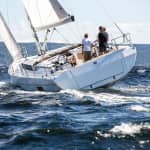
The result: photos of surfaces that go into depth, details that say more about the object than the big picture. Guillaume Plisson's success cannot be pinned down to one perspective. The "Tribute to Yachting" exhibition during the Monaco Yacht Show 2025 provided a comprehensive overview of his work, which extended across the entire harbour area and into the pavilions. A three-sided prism was also located next to the BOOTE EXCLUSIV stand. The photographer came there with a Leica around his neck, in the best of moods and accompanied by his professional and private partner Marta. The Monaco native answered our questions on the
J Craft "Amazon Queen".
How did the exhibition at the Monaco Yacht Show come about?
The idea had been around for a long time. I was convinced that we needed emotions at the trade fair. It's not just shots of superyachts. We also wanted to convey something else, to honour life at sea, in the shipyards or the work of the designers. There are 143 pictures in total.
It was certainly difficult to make the final selection.
A nightmare! (Laughs) It was very political. I also wanted to include as many yards as possible, which are all here. The result took me a lot of time.
Can you remember the first picture you took?
Phew, that's difficult. But the first one must have been with my grandfather. He wasn't a photographer, he was president of the French Sailing Federation (FFV). I grew up by the sea and on boats, my family is closely connected to photographs of lighthouses. I spent years with my father [Philip] travelling all over the world to be in the right place with the right swell. Often we were in the middle of hell, in a helicopter of course.
Was your first published photo of a lighthouse?
No, I remember it exactly, it was taken during the 1985 Fastnet Race. Shortly after the start, "Drum" by Duran Duran singer Simon Le Bon lost its keel and capsized. I was twelve and standing on the Needles lighthouse, at exactly the right moment and with the longest lens in the world at the time. We were there in a motorhome and my father was taking photos from an accompanying boat. So I grabbed the 1200, mounted it on a tripod and held it up. Our fridge was full of film canisters, which we immediately took to the lab. We only photographed with slides that had been developed using the E6 process. My photos of "Drum" ended up in "Paris Match".
Sounds like a good school for the photographer's life.
My only one. I continued to work with "Paris Match" as a freelancer and still do. After leaving school, I did my military service as a photographer in Tahiti. My job initially consisted of photographing all the military bases in French Polynesia. After one mission, I spent about ten days in the darkroom. At the time, the relationship between the people of Tahiti and the French was very complicated. There were struggles for independence, which I documented photographically. I had to be incredibly flexible and flew in Falcon jets to ships that were in distress. Sometimes I was in the air for six hours with my camera. It was hard work and very good training.
And then you came straight to yachts?
I was often booked for regattas. These included five America's Cups and several editions of the Route du Rhum, where I was the official photographer for the Orma multihull class. Sailing was my passion. A call from Philippe Starck, who needed photos of "Motor Yacht A", brought me into the superyacht industry. We didn't know each other, but the photographer Yann Arthus-Bertrand had recommended me. When Espen Øino saw my pictures, he wanted to work with me.
We usually only know the work you have done for shipyards. How many owners would like to have their yacht presented in the best light, but don't want to know about it in public?
In my job, I spend most of my time in contact with owners, designers and shipyards. It's bizarre. Before I established myself in this industry, my pictures were seen all over the world. Now a lot of it is confidential. And sometimes it's really frustrating. That's why I'm so happy about this exhibition, which doesn't show any gossip or private shots.
They celebrate the beauty of yacht lines, but also the hard shipyard work behind the scenes, as with "REV Ocean".
I love these pictures from Romania. Incredible people, incredible shipyard. It's not like a shipyard in northern Europe. I felt like I was in Charlie Chaplin's film "Modern Times". Everything was loud and super-graphic. And on an unbelievable scale. The workers were very proud and happy to be recognised. But it wasn't easy, some of them didn't like being photographed. And I set myself apart by not being able to wear a helmet. Otherwise I wouldn't have been able to look through the viewfinder.
You went from zero motor yacht orders to the biggest. Was it difficult to adapt?
No, because I had already taken a lot of photos from helicopters. I looked at the yachts with different eyes. I didn't hold the camera at a 45-degree angle to the stern or the bow. I didn't want boring pictures and played with my camera. I wanted the design to be presented differently, to shine. I focussed on this new approach. I was probably in the right place at the right time. (Laughs)
How many photos have you taken so far?
That's huge. You can't imagine how many hard drives are stored in my office. We had a fire in Brittany in 2010, it hit our 10,000 square metre laboratory. I had been working on an article for "Paris Match" and heard about a major fire on the radio on the way home. 150 firefighters were battling flames 50 metres high. I arrived a little too late, but I said to them: Concentrate on the archive, and they unloaded 50 lorry loads of water there. We lost about 600,000 pictures. That was traumatising. I decided to leave Brittany and started again in Monaco in 2013.
Do you work exclusively with helicopters for superyacht shoots?
We try to cover everything. It depends on the location, the boat and also the crew - their co-operation is particularly important. Without the crew's involvement in the process, our shoots are impossible. My partner Marta is just as important, she was a chef on a superyacht herself and knows the code on board. She is always on the bridge or with the crew members and organises everything. I'm usually in the helicopter. It's real teamwork.
The photographer announces that he will now put the DSLR camera aside and capture some interview situations with the iPhone. Guillaume Plisson points out that it is the latest model. "I really like it! It's so comfortable."
Do you take private pictures with your mobile phone?
Never.
And what about drones?
I use them for jobs, but then only for very special settings: from above, vertically at an angle of 90 degrees or when I have to get super close to the fuselage. For everything else, I rely on helicopters. I can use lenses from 11 to 800 millimetres focal length. Changing lenses is certainly hectic.
Is equipment also being sacrificed to the sea?
At the beginning, when I was still sitting alone in the helicopter, I lost a lot of equipment. Now I have an assistant with me who hands me the right one from a set of cameras.
How important is the pilot in your photo jobs?
Its share of the photos is 50 or even 60 per cent. The most important thing is that the pilots have a lot of experience. I often fly with Michel de Rohozinski, who is an artist and the founder of Green Bees Helico. He now offers flights around Cannes and Monaco and also works as an instructor. When we are travelling in his Robinson R44, we laugh a lot. We've been flying together for 20 years. And every time we finish a shoot, he switches off the engine and spins down using autorotation, only to switch on the engine at the last moment and touch down softly. My assistants don't like that at all. (Laughs)
How much time do you spend on a gigayacht?
This can take up to a week, depending on what is required. When we go to great lengths with filmers, models and make-up artists, we can be up to 14 people. We take between 2,000 and 6,000 pictures in one day. For photo shoots, we get up at four o'clock and finish at midnight. It's very exhausting.
Do you prefer interior or exterior shots?
Indoors, we work according to architectural standards. Then the preparation time for a room can be three hours, and we need up to 65 shots for the one shot. We have a special lens that captures a large area, but without distortion. To bring the room to life, we place light sources everywhere. It's a different world. I love exteriors, so I can play with natural light and put the actual size in proportion. I always try to incorporate that. Even if it's just a small spot.
We leave Port Hercule and head out to sea. Plisson takes the helm and routinely manoeuvres the runabout through considerable swell. He doesn't own a boat in Monaco, but often charters one with his partner.
Do you return to Brittany from time to time to the storms and lighthouses?
Yes, of course, my family lives there. Almost 40 years ago, my father founded the publishing house Pêcheurs d'Images [Fishermen of Images], and from 1995 we also sold our posters and art prints in our own gallery in La Trinité-sur-Mer. Unfortunately, he had to close it a few weeks ago. My eyes have changed with the experience, I see the landscape there differently now. I've become much more minimalist in my paintings.
Do you have a favourite weather for photography?
I love storms. And I love calm, the real calm when the sea is as smooth as glass. Like at the photo shoot last week, there were waves, but the sea was like a mirror. The atmosphere is incredible. I love clouds. I mean, blue skies and sunshine are so ...
Plisson does not elaborate. Leafing through the exhibition catalogue, he points to a photo of "Ahpo" in which the strong marbling of the sea almost overshadows the yacht. With shining eyes and gesticulating, the photographer talks about the photo shoot and how he and his team were welcomed by the owner's family in Jamaica.
When you talk about your work, this euphoria still resonates.
I'm still excited because the next picture is the one I really want to make. That's why I maintain this pressure and passion. I spend a lot of time preparing with 3D renderings. That way I already get a perfect view of the boat, without distortions. Before a shoot, I lie down in bed, sit in a helicopter and dream my images in 3D. Then I know in advance from which angle the pictures will look good.

Sören Gehlhaus
Stellvertretender Chefredakteur BOOTE EXCLUSIV
