


Interview: European champions without realising it – with Freya Olbrich and Paul Piendl
Antonia von Lamezan
· 20.10.2026


Timm Kruse: Why didn’t you realise you’d won when you were running onto the pitch?
Freya Olbrich: We had problems with the internet and don’t have Starlink on board. That means we’re only online when we’re near land, and only then can we follow the tracker. And we were so busy sailing that, from the second half of the regatta onwards, we hardly checked where the others were.
Paul Piendl: Navigation and weather routing are handled via our laptop and mobile phone. It keeps you pretty busy switching back and forth between Navionics, weather routing and the tracker, whilst trying to make out anything at all on the salt-encrusted screen. After a while, it gets a bit annoying. You’d rather just concentrate on sailing.
Tell us how the race went for you.
Freya: We set off from La Maddalena in northern Sardinia, heading for Genoa on the Italian mainland. Winds of around 30 knots were forecast, downwind. The boat copes well with this; it’s built for downwind conditions. We hoisted the spinnaker and had a very action-packed first few hours. This spread the fleet out, as not everyone had hoisted the spinnaker.
Paul: Boats at the front sometimes catch a gust of wind that the others miss out on. On the other hand, the leaders might already be heading into a lull, allowing those behind to catch up. A number of factors worked in our favour there. We tried to use the weather forecasts to make smart decisions and position ourselves so that we could either avoid wind shifts or make the most of them.
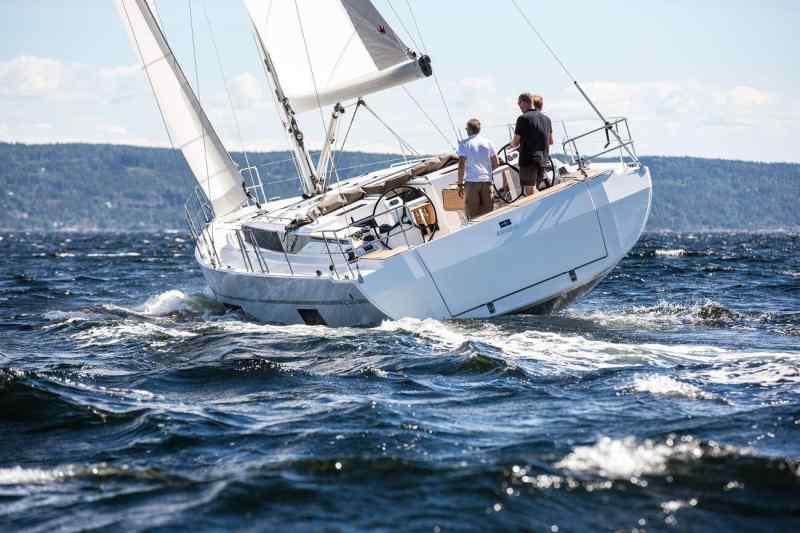
Freya: Two months earlier, we’d already taken part in a regatta in Italy, where we learnt a fair bit about the sailing area. In particular, how to position ourselves at night to make the most of thermals and onshore winds. That really paid off.
You spent 55 hours at sea on a Figaro 3 that you were hardly familiar with. How did you get to grips with the boat so quickly?
Paul: The European Championships form part of the Nastro Rosa Tour, organised by the Club Marina Militare. Two months earlier, there had already been Il Giro, a stage regatta around Italy, during which we sailed 22 daily stages on the Figaro. That’s where we got to know the boat. Fifteen teams applied, but there were only ten boats. So there was a qualifying series just before the European Championships. Some teams had never sailed a Figaro before, whilst others had considerably more experience. Everyone had to find their own way. What perhaps helped us was that we’d gained varied experience on different boats and developed a feel for which lines to pull.
Freya: When I saw the Figaro for the first time, I had a great deal of respect for the boat. Taking it out for the first time was exciting. In the end, it was nice to realise: it’s just a boat, really. Same physics, same lines – perhaps a few more. You have to get to grips with the foil, but you get the hang of it relatively easily.
Who has taken on which role on board?
Freya: We’re completely on an equal footing – in virtually every role. During the qualifiers, we were both out on the boat the whole time; nobody was taking a nap. Most of the time, I’d be at the helm and Paul would handle the bow. Offshore, it’s completely different: whoever’s on watch takes on all the tasks and calls on the other when a hand is needed.
Paul: It’s also fair to say that Freya is a better helmswoman than I am. In the short qualifying races – which lasted two to three hours – it makes no sense to put the less confident of the two at the helm. During the long shifts, when the other is asleep, it’s like single-handed sailing anyway.
You told me that you’re not a couple. How does that work on board?
Freya: We’ve never really had a proper row and I’d say we’re honest with each other. If we have a difference of opinion, we talk it through. It actually works really well.
Paul: It’s perhaps a good thing that we don’t have to hold back. If I don’t like something Freya does, or vice versa, we can bring it up straight away without it having a negative impact on our relationship. We don’t take comments too personally and just talk it through. It works well.
Paul, how did it come about that, in your early 20s, you sailed round the world on a nine-metre yacht?
Paul: It all started with a book I read as a child, when I was perhaps ten years old: Rollo Gebhardt’s *A Man and His Boat: Round the World in Four Years*. The stories about sailing, but also the encounters with people and cultures on remote islands, fascinated me so much that the dream has stayed with me ever since. For a while I’d lost touch with that dream, but then, at the end of my apprenticeship, I remembered it. I searched eBay Classifieds for something affordable, found the boat and completely underestimated the amount of work involved in getting it ready. Fortunately, this coincided with the Covid-19 pandemic. I was at a boatyard in Portugal, where there were few distractions. That’s how it all began.
Four years away, then back into society: Was it difficult to return?
Paul: I’ve perhaps managed to avoid that a bit so far, because I’ve just carried on sailing straight away. I’d thought about going to university, but didn’t get anywhere with it. I found it hard to commit to staying in one place for four years. So I applied for various jobs, including as an event manager at the World Cruising Club, the organiser of the ARC. Then, more or less straight after my sailing trip, I travelled on as an event assistant for another year, all the way to Australia. So my return has been delayed a bit. Perhaps I’m just telling myself that I want to lead a settled life. So far, it hasn’t really worked out.
Freya, how did you get into sail-making?
Freya: I’ve always loved sailing, especially as a child, and I’ve always enjoyed sewing. During the pandemic, I initially started a degree course, but quickly realised I needed something more practical. At one point, I was sitting in an online lecture with my sewing machine and ended up going sailing instead. That’s when I decided to do an internship, and it was absolutely brilliant. There are now more women in the training programme, but in most companies it’s still very male-dominated.
You’re studying geography now. How do you manage to fit in the regattas?
Freya: I took a break from my teacher training course, then spent a while sailing and travelling, and have now found a pretty good compromise: finishing my degree – which will take just under a year – whilst working as a sailmaker and sailing on the side. Fortunately, the regattas fell during the semester break.
How did you meet in French Polynesia?
Paul: The meeting took place on Bora Bora, near Papeete. I was working there for the World Cruising Club at the time.
Freya: Straight after my apprenticeship, I spent a few months working in a sail-making workshop in Tahiti. After that, I had the opportunity to sail a few legs of the World ARC on a German boat, and that’s where I met Paul.
Paul: We’ve stayed in touch. I heard that Freya had sailed the Silverrudder, and we had a chat about it. When I then heard about the Griffin project, I needed a sailing partner. The only person who immediately sprang to mind was Freya: because of her personality, and because of her motivation and enthusiasm for offshore sailing. I simply gave her a call and asked.
Freya: I didn’t think twice. I was absolutely delighted to receive the call and knew straight away that this was a good thing.
Paul comes from a background in offshore sailing, whilst Freya is more from a regatta sailing background. What have you learnt from each other?
Freya: At Wednesday regattas and club races, you practise a lot: starts, sailing close-hauled, tactical steering. That’s what I bring to the table. With Paul, it’s above all his composure in crisis situations. In offshore sailing, things always go wrong from time to time, and that’s worth its weight in gold. On top of that, he brings a wealth of experience to the table.
Paul: Freya summed it up perfectly. Before this project, I’d sailed in very few regattas; I never really got into dinghy racing when I was younger. Freya has far more experience in that regard. I agree with that one hundred per cent.
How do you join the Griffin Youth Project?
Freya: You apply. The application deadline for next year is still open. You send in your sailing CV and some details about yourself, and you may then be invited to take part in the qualifying regattas.
Paul: Griffin has two branches: one in England, which introduces young people to offshore sailing, and the international double-handed project, which is run by the Club Marina Militare. Among other things, Griffin covers the entry fees. And simply being introduced to these events is valuable in itself. In sailing, it’s often not entirely clear what opportunities are available and what’s actually possible. We’ve sailed alongside beginners, but also alongside Olympic sailors and people who do offshore racing full-time. It’s really cool to be part of that.
Is there anything similar in Germany?
Freya: I’d say so, yes. In Germany, a lot of things depend on connections. You need to know someone who owns a boat, or be recommended by someone. There isn’t really a scheme where you can apply from scratch. This will open doors for a lot of people.
Paul: The hurdle of the boat has been cleared. The DSV runs academy programmes, but these usually require you to turn up with your own boat. That’s incredibly difficult for young people. There’s definitely room for improvement there.
How is Griffin funded?
Paul: Through donations from RORC members and donations in general. The international division is funded by the Club Marina Militare and other sponsors.
In Germany, we have Boris Herrmann, and there’s no one else to speak of after him. How can we change that?
Paul: What sets us apart from the British: they are a seafaring nation; England is surrounded by water. In Germany, we have the North Sea and the Baltic Sea, but access to offshore sailing from our own country is simply much more difficult. That means fewer people actually get the chance to do it. Boris Herrmann is a brilliant sailor and, as a businessman, must be doing a lot of things right to be so successful. But most people who want to sail in professional campaigns end up in a huge debt trap. For many, that’s too big a hurdle.
Freya: Due to the limited access to water, offshore sailing has a different status in Germany than it does in France or England. This also affects the interest shown by large companies in sponsorship, as visibility is lower.
Paul: I think it was with Boris Herrmann that sailing really featured on *Tagesthemen* for the first time. In other countries, it’s an everyday occurrence.
What are your plans for the future?
Freya: I’ll be finishing my degree next year and will be writing my Bachelor’s thesis by the summer. After that, I’d like to focus more on sailing. I’ve got some initial, vague plans, but nothing’s been finalised yet. I’m currently taking part in the Magenta Project, a nine-month mentoring programme for women in sailing. I’m open to whatever opportunities come my way.
Paul: We both had our own plans for next year before we set sail together. Now they’re getting in the way a bit. Lots of people ask what our next joint project is. I’ve got my eye on a few other projects that I’d like to pursue. Perhaps we’ll take a year’s break for now, with each of us working on our own projects. We’d both like to get back together afterwards and set off again together, enriched by our new experiences.
The interview was conducted by Timm Kruse.
You can listen to the YACHT sailing podcast with Freya Olbrich and Paul Piendl here
At this point, you will find external content that complements the article. You can display and hide it with a click.
Spotify
Apple Podcasts
Amazon Music
Audible
Deezer
Don’t forget to subscribe and leave us some feedback.
If you have any questions, suggestions or requests for topics, please write to us at podcast@yacht.de!
Antonia von Lamezan
Volontärin