


Book extract: Solo in the high latitudes - Veronica Skotne's dream spot in the Arctic Ocean
YACHT
· 07.04.2026


The sea did not belong to us, just as we did not own the wind or the air or the rock. We didn't own the earth beneath our feet or the starry sky above our heads. The people around us did not belong to us, nor did the birds or the seaweed or the cod in the sea. Not even life belonged to us, because it was fleeting and never ours. My story begins and ends in the sea, just like all other life, like a drop in the bottomless deep. Let my remains become oil, and in a million years they may be called a raw material.
My name is Veronica, and I live at sea in an old sailing boat, a boat that is older than I am and has seen more of the world than I have. It was built in 1982, the same year that the Falklands War broke out, when the Alta conflict ended, and 16 years before I was born. I can only mention the historical events of that year, 1982, because I wasn't there and can't report on them myself. But today I can tell you.
More reading tips:
Before I moved on board, the sailing boat had already crossed the oceans, had sailed past the point where one horizon disappears and a new one begins, had already seen distant coasts and sun-warmed beaches on the other side of winter. It's a long way from cotton grass to palm trees. Now the boat is sailing in the icy waters off Finnmark with me as captain.
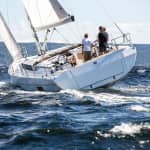
The boat is my home
We could sail anywhere. Between the atolls in the Pacific, in the trade winds at the equator or through the mangroves in the tropics. We could sip fruity cocktails without a scrap of clothing on our bodies and wave to the sun every day. We could live a life without even a hint of a country somewhere far north, where the winter is so dark that people don't see the sun for many months and the air is so cold that no trees grow.
We would never have to live with polar lows, the violent sudden storms that occur when the air from sea ice meets warmer, ice-free seawater, or be travelling in tumbled Vadmal clothing or woollen socks. I say "we", but it's all about me and the boat, which takes on a soul in my solitude, making it long for cocktails and sun cream too.
But something vague drew me to Finnmark, something I can't explain exactly, and the boat followed my course faithfully. So we are both partly to blame for our cold situation, even if only one of us recognises this guilt. The northernmost part of Europe, where even the sun leaves the land - for a while, a long while. The boat is my home, the hull my four walls and the sea my view. This is how I lived for three winters, with the sea, the boat and the coast of Finnmark.
On the black, cold, unpredictable Arctic Ocean
Now I'm going to get to know the extremes. I want to visit the parts of this barren land that catch the most wind and are the first to be hit by the waves of the open sea. Let the rest of Europe sit quietly with its longing and paint a picture of the sea as if it were graceful and merciful. Many words come to mind when I think of the sea, but "mercy" is not one of them.
People live on the outermost coast. Not many, but some. On small islands, they cling to a piece of rock while the waves crash steadily over them. They live their lives out there, as I mean it, by the sea, but not the kind of sea you find depicted on postcards with red sunsets, parasols and lush beaches, postcards with greasy sun cream fingerprints hanging on stands next to handmade shell jewellery, no, not that kind of sea, but the Arctic Ocean. On the black, cold and unpredictable Arctic Ocean, that's where they live their lives. What grows in salted earth? My journey has no destination, I'm just looking for people who might be able to give me an answer as to why I myself am out here, on the coast of the Arctic Ocean.
The boat has two masts, a steel hull and an anchor that I want to trust blindly. It has four large sails that I can operate with winches and that, with the help of the wind and the ropes alone, can take me across any sea imaginable. Inside, the boat is clad in dark wood, the kind of interior that was popular in the 1980s, brimming with nostalgia and warmth.
I can make food inside, I can relax there, I can live my life. I've replaced the typical navy blue upholstery with creamy white linen, because I've never liked the combination of deep blue and dark brown. I thought the lighter-coloured fabric made the saloon more inviting. The galley is small enough for me to lean against the wall when I'm cooking a meal in heavy seas. The heaters are fuelled by spirit, which was also widely used on boats forty years ago. I sleep in the aft cabin. It's spacious, and when I'm lying on my back in bed, I can see the sky through a wide hatch in the deck.
The sea and I exist as one
The sea knows no one. Without obligations, the ocean currents flow on like time, indifferent and free, carefree and unsuspecting, and without obligations I ride on them in the false assumption that our friendship is mutual.
I look into the distance, out into the endless blue, and feel no loneliness, not the way I feel loneliness among people. Those who have come to know the sea feel no loneliness, because the sea will always speak the language you have given it. The sea nods in understanding because its soul is my own soul. This is how everyone finds themselves in the face of the deep. The sea is frantic when I am frantic, peaceful when I am calm, threatening when I feel threatened. We exist as one, because when I see myself reflected on the surface of the sea, I only see myself.
Today I'm on the Loppmeer, off Loppa, which is never smooth, which always makes me restless. A restless sea, as people know it. I'm on the Loppmeer, sailing with a strong wind from the west towards Finnmark. How many sailors have stared into these depths and longed to return home to their green-clad fjords? Perhaps the sea finally brought them there. Here, the Arctic Ocean thunders against the land, washing over exposed ground and creating turmoil, chaos, unrest, life. It smells of life, as if life itself had been created out here, and this life is chaotic and as destructive as it is beautiful and graceful.
I was in Troms. The boat was in the shipyard there for an overhaul, because in western Finnmark there are no suitable facilities for bringing sailing boats - or "pinnebåter", as they are also called here - ashore. This is the realm of the sjarks, and sjarks have neither a fin keel nor masts. Once a year I have to go to Troms to heave the boat ashore, because the salt water fights against everything man-made, and I can only try to delay the destruction.
A new winter in the Arctic Ocean is on its way
I escaped Finnmark, sailed away, but now I'm heading north-east, on my way back, because I'm not giving up on the idea of the north yet. I sailed north three years ago, because life is hard in the north, but not like in the south. In the south, yes, life is easy there, but it's also difficult, because I'm still struggling with the world and I prefer to work my way through tangible difficulties, frost, snow or the weather. I can cope with wind or storms, but the struggle also finds those who don't fight, and then comes the real darkness.
I haven't yet turned the bow towards the Southern Cross, not yet, although winter is approaching again and I dream of chasing the sun, the light that is constantly moving away from us here in the north and disappearing somewhere in the sea. Then it gets dark and a new winter is on its way. Soon the sun sinks into the sea and doesn't return until the new year. Soon I have to find a harbour where I can spend the winter, very soon, because the storms have already lined up and I have to find a harbour before they catch me.
The sails have become my lungs, because I can only breathe at sea. Maybe one day I will rust in the salt water like my boat, one day, but not yet. At this moment, I feel the wind in my hair and sail across the Loppmeer towards Finnmark once again, driven by the same longing that drew me here three years ago.
Finnmark is the most sparsely populated part of Norway, one of the least populated areas in the whole of Europe. Perhaps it was precisely this desolation that attracted me, the promise of an almost deserted country. I have to talk to them, to those who live out there, on the coast, in harmony with the sea and the wind. Those who live isolated and alone on the islands, in the part of Norway that is most exposed to the weather. I need to talk to them to understand why; perhaps in an attempt to understand myself, because I know that we suffer from the same cursed longing for the sea.
Company of a fulmar
The outermost coastline of Finnmark consists of seven islands, from west to east: Loppa, Sørøya, Rolvsøya, Ingøy, Hjelmsøya, Magerøya and Vardø. Of these, only the last two have a connection to the mainland, while all the others are dependent on boats, as they have always been. These seven were once large and important settlements in the north, back in the time of the Norns, when the sea was the real thread of fate for all people. What do they look like today, these seven? Are they still alive?
Out here on the Loppmeer, the fulmar keeps me company. It often flies in when I have a good wind in my sails. Then I spot the bird as it overtakes the boat, like a little white flash. It comes from the port side, flies in front of the bow and flings itself around with momentum, then sails towards me again. Then it overtakes me again, this time on starboard, flies behind the boat and disappears somewhere aft, and when I think it has left me, it returns, flings its body into an arc again and repeats the trick. He goes on and on like this, circling playfully and effortlessly, often for hours, and at some point he disappears again, almost silently, flies out to sea and is gone.
The fulmar doesn't care much about storms. While I struggle to keep the lines and sails under control, it plays with the wind without a care in the world, as if to remind me that the wind is harmless as long as I play along with it. So I reef the sails, the boat rights itself and the world becomes calmer. When the fulmar accompanies me, it's like meeting an old friend. But I know that if I were to disembark, lie in the cold water for too long and come close to the end, the fulmar would come and peck my eyes out before I had even taken my last breath. Our friendship only exists because I created it, but I still feel the joy of reunion every time we meet.
Separate and yet connected
With the bow facing north, I have the Kvænangshöhen astern. There, the mountains crowd together in the small space available to them, pushing each other higher and higher, as if they couldn't breathe properly and had to stretch upwards, up to the sky for air. There is snow on the highest mountain peaks, but the water is bare, as it usually is now in autumn.
In front of my bow lies Brynnilen, the Holm, which marks the border between the districts of Troms and Finnmark. Just opposite Brynnilen on the mainland are two villages, one in Troms, the other in Finnmark. One has the sea to the north, the other to the south. There is only a short road between the two, and this road has no connection to the rest of the mainland. Only one person lives in each of these places, one in Troms and one in Finnmark. So they are separate and yet connected, each on their own side of the county border, but disconnected from the rest of the world. Seglvik is in Troms and Andsnes is in Finnmark.
I should have anchored in Andsnes, as many did before me. People used to anchor in Andsnes to trade, to barter, to wait for favourable winds. I should have gone ashore and talked to the two people who live so separately and I should have listened to the stories they have to tell, stories from the time when Brynnilen was a trading centre and an important hub for transport and fishing. When there was still a post office there, a fish reception centre, a school and a quay, and when people lived in the houses.
At that time, families along the coast were trilingual and the coastal inhabitants were citizens of the world. Without a connection inland, they were tied to the sea. Andsnes was important because the main traffic artery ran by sea and Andsnes was centrally located - right between Troms and Finnmark - but today the ships pass far out to sea.
Maren on the spar
I'm not anchoring there today. Today the Lopp Sea is churning as usual and there is a strong wind. The only harbour was destroyed by a winter storm almost ten years ago and never rebuilt. When the coastal people turned their attention to the land, the decentralisation of the coast followed. So I sail past Brynnilen, Andsnes, Seglvik and the two people who won't be getting any visitors tonight, and as I sail on, I see a light in a house ashore and think that it must be lovely in there, in the cosy warmth, perhaps with a fire in the fireplace and food on the table. I'd love to be there, but I'm here on the Loppmeer, riding my boat through the gusts.
The Bergsfjord is sheltered from the wind, it's quiet there and there are good anchorages with protection from the westerly wind, so I sail there. I'm tired and cold. I can see Loppa, the island of Loppa. One day I'll go there to talk to the people who live there, but not now, because the wind is too strong out there now and I'm looking for a sheltered anchorage for the evening. There isn't one off Loppa. I lower the sails as I pass Marholmen, because now I'm between the skerries and there's no wind here. Marholmen is where Maren lived, according to one of the many stories that wander from boat to boat, among the boats that are sporadically found in the harbours of the half-abandoned fishing villages.
Maren on the spar beckoned to shipwrecked people, fishermen seeking help, whom she had beguiled with her charm on the quay in Øksfjord. Then she took their lives out there on the pier, stole everything they had and then threw them into the sea. It is said that one day Maren was caught, tried and beheaded. Some say that her head was impaled on a pole on the Holm as a kind of warning to passers-by that the arm of the law reaches all the way to Finnmark.
There is indeed a pole on Marholmen today, but only the cormorant is resting on it. I've heard that Maren sometimes appears to sailors, on evenings like this, when the sea is churning and the fog hangs heavy in the air, then you can see her. Her feet don't touch the ground, she floats above the landscape. She waves to the sea, waves at you and comes towards you, towards the shore of the pier, towards the water, and then she comes closer, over the water, now she is very close, almost at the railing. On evenings like this, she comes for sailors at dusk.
I won't be seeing Maren tonight. Maybe she's showing solidarity when women are at the helm. I only see the cormorant colony that has conquered the spar and start the engine to manoeuvre into the mountain fjord. It's quiet in the fog, and I'm ashamed that it's me who's destroying the silence that evening.
The Arctic Ocean is overwhelmingly wide
Anchoring takes an hour. I'm exhausted, hungry and drained of energy. I do things I shouldn't do, so it's slow going and I have to start all over again, but I take a deep breath, a light breeze blows in my face, and soon I can light up inside, drink warm cocoa and feel the warmth spreading through my body until I get even more tired, and then I can sleep in my bed, soon.
My bed isn't warm, it's damp, but it's mine and I can rest in it, and my body is now so exhausted that I could just as easily sleep on the shore. The boat is sheltered from the wind. It's not grey and hard and cold like it is outside, there's the warm hue of forty-year-old mahogany and smooth surfaces that you can run your hands over and feel the cracks in the wood. It's cramped in a way that feels spacious, because inside it's not overwhelmingly wide like outside, but clear and cosy.
I can make myself a hot meal in there. I can chop up the onions I bought in Tromsø, heat them up in the pan with some garlic, a few mushrooms and some dried reindeer meat that I got last time I was in Alta, and then the whole room smells of fried onions and I no longer have the strong smell of diesel in my nose. When the engine stops, it goes quiet, and as I take off my salt-soaked clothes to wrap my body in warm wool, all I can hear is a soft gurgle of shallow waves on the hull.
Freedom at sea
I believed that freedom lay in sailing; to let the wind and weather determine the course, that would be freedom. Open sea, free sea. I thought that sailing and life on the sea were the great freedom, but I had forgotten that the boat, the wind and the weather limit all opportunities to make your own decisions. Is it really freedom to always sail where the wind takes you, to always sail the predetermined course without being able to choose where you go and where you stay?
Today the strong wind decided that I shouldn't sail to Andsnes, but rather to Bergsfjord. Nevertheless, I felt a sense of freedom in leaving myself to the decisions of the weather. The freedom of not having to choose, the freedom of not having to make any decisions. The freedom of being at the mercy of something greater that tells me what to do. The freedom from having to exercise control. Perhaps it is just as absurd to defy the weather as it is to defy freedom itself. Freedom as punishment - Sartre said that we are condemned to freedom because man cannot actually be completely free.
Nevertheless, we have to deal with the consequences of our actions as if they were entirely our own. Being subject to the weather can be a kind of acquittal from this judgement. Perhaps. The last freedom. But now the warmth has penetrated the wood panelling and it smells of good food. It is quiet. I'm tired and let myself be lulled to sleep at the anchorage off Bergsfjord.
Three years have passed. Three years since I thought my fate would not follow me across the water. Three years since I assumed I would be safe if I just kept moving across the sea, because it is a popular belief that you have to cross water to prevent evil from following you. I moved onto a sailing boat because I had nothing left to lose, as I was already threatened with ruin and desperately needed something to carry me. Now I'm about to face my third winter on board.
About the book "Beyond the Winter Sun"

In her very personal story about impulsiveness and the loneliness of the Arctic Ocean, Norwegian Veronica Sotnes, 28, provides insights into the adventure of her self-discovery at the edge of the world with her text and 18 illustrations. Her thirst for adventure and introspective insights are thought-provoking. Delius Klasing, 26.90 euros.
