


In the "Sailors confess" series, we confess our stupidest sailing mistakes. But we are also looking forward to your confession. Send us your text, if possible with pictures, to mail@yacht.dekeyword "sailor's confession". If desired, publication will be anonymised.
First of all: what happened to me - or rather my crew - in the mid-noughties would hardly be conceivable today. Fortunately. This is due to the technical progress on board. And I'm not talking about plotters, autopilots and weather apps, but the good old telephone. Many people will remember: of course there were mobile phones back then too. But they weren't yet a defining part of everyday life - and that's why people didn't always have them with them.
It gets dark early in autumn. And?
The charter trip had started in Heiligenhafen, heading for the Danish South Sea. It was late in the year, at the beginning of October. The advantage of this time of year: empty harbours. The disadvantage: short days. Apart from that, it was the only date that suited the three of us anyway.
After a long trip to the Schlei, we headed to Sønderborg in Denmark the next day, where we moored in the almost deserted town harbour. But only for a few hours, because for some reason we had decided to anchor overnight, even though the weather was supposed to get worse and rain was forecast. Our destination was Hørup Hav, just round the corner. The next day we were to cross the Little Belt to Ærø.
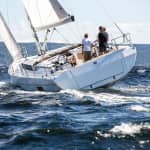
As the wind would shift to the south-west in the late evening and pick up a little, we looked for a sheltered spot far inside the harbour off the northern shore of the Kegnæs peninsula. We were completely alone, the only other yacht had passed us on the way out, and we were delighted to have this beautiful spot all to ourselves.
Get ready for shore leave!
As soon as the anchor was down, the dinghy was made ready to go ashore: my crew of two wanted to use the rest of the day to pay a visit to the Kegnæs lighthouse. I can't remember exactly where we were moored at the time, but looking at the distances on Google Maps, the distance from the anchorage to the lighthouse must have been at least a nautical mile - with the same way back. Quite ambitious even in good conditions - but we were still young.
The two of them rowed off. I stayed in the cockpit for a while until it got too chilly and then went downstairs. I made myself comfortable in the seating area with a book and finally fell asleep. When I woke up, I was still alone on board. It was now dark outside - and it was pouring with rain. My fellow sailors had been out for hours and I assumed that they were sitting somewhere warm with a beer, waiting for the rain to stop.
Then the rain stopped. From the companionway, I briefly stuck my head outside: it was pitch black and visibility was zero. Another hour passed with no sign of the dinghy. I kept looking outside. The absolute darkness should have helped me. But that evening it took a while before the penny finally dropped - by chance.
A light goes on
Suddenly a new thought occurred to me: maybe the south-west had driven the rest of the crew off while rowing? My eyes reflexively went up to the clicker - and I saw nothing. The anchor light! I hadn't switched it on when I went below! How could I have forgotten that? Now I hurried downstairs and flicked the switch. Less than ten minutes later, I heard rudder strokes in the darkness.
Soaking wet and frozen through, my crew climbed on deck, while I would have loved to sink into the ground. The pub, my arse. They had made their way back early. However, it had taken them a while to realise in disbelief that our yacht's anchor light was obviously not on: No, that would never happen to Christian! Or would it? Then the rain had started.
Eventually they had rowed to the shore and climbed ashore to seek shelter under a tree. And to wait. During this time, by the way, they had decided to be merciful with me. And when they had already resigned themselves to having to hold out until morning, a light had come on over the water outside.
Christian Tiedt
Editor Travel
