


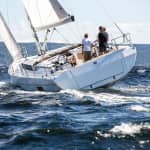
The Atlantic crossing is already several days behind her and her two companions, but Marlene Brudek's enthusiasm is still clear to see. During a phone call shortly before Christmas, she waxes lyrical as if she had just arrived on the Caribbean island of Saint Lucia. "That was amazing! The way we surfed down the waves from astern with crazy thrust at times - indescribable!" she gushes. "And the waves were impressively high. At least from our boat's perspective. Not only is it small and the stern open, but you also sit really close to the water in the cockpit. On one occasion, the log showed 16.5 knots on a surf like this. Wow, yay, yay, I just thought, if that goes well!"
More on the topic:
It went well. Very well indeed for the passionate skipper, who was one of only ten boats in the Racing Division to complete the Atlantic Rally for Cruisers (ARC), which ended in mid-December, with her JPK 1030 "Heartbeat 2". The calculated time was good enough for fourth place. Ahead of her were three yachts, all of which were over ten metres longer and crewed by large regatta sailors, some of whom were hired. Leading the way was the "NextGen by Jajo", a former Volvo ocean racer with a large crew. It completed the route from Gran Canaria to the Caribbean in little more than ten days. The Brudek trio took a good five days longer. And thus still faster than the majority of the ARC fleet.
Some of the other 140 or so crews wanted to take things at a more leisurely pace; they had started in different cruising groups from the outset, depending on the type of boat. For many of them, it was just about being there and arriving safely. That alone was enough of a challenge for many. For those who had dreamed of two and a half weeks of cosy trade wind sailing were taught otherwise. Firstly, there was no wind right after the start, so many crews had to use the engine. This enabled them to get out of the worst wind holes. And then it came with a vengeance, the longed-for north-easterly trade wind. Although not as strong as in previous years. As a result, the ARC speed record was not jeopardised. But it did blow strongly at times and at times unsteadily enough to turn the 2,700 nautical miles into a kind of never-ending mogul slope.
ARC helps fulfil a long sailing dream
At least north of the Rhumb Line, which marks the direct route to the Caribbean. More wind was forecast there, which the more ambitious sailors wanted to take advantage of. Among them were two friends from North Rhine-Westphalia. "On our worst night, we had to deal with no fewer than seven squalls!" reports Henrik Teichmann, 58. "You're busy changing sails for hours on end. Sleep is out of the question!"
He and his sailing friend Karl-Heinz Henzel, 65, have been sailing together regularly for 22 years. However, a transatlantic passage had never been in their logbook before. "Doing this was a long-cherished dream of ours. However, our wives only gave us the go-ahead on the condition that we sail on the ARC," Henzel reported shortly before the start in Las Palmas. "They thought we were in good hands with all the other crews."
Once they reached their destination - they needed just under 18 days with their eleven-metre single-tonner from 1976 "45 South II" - they talk about the impressive team spirit among the participants and the willingness to help each other. "Back in Las Palmas, all you had to do was post in the WhatsApp group that you were missing this or that tool and a few minutes later someone would be standing in front of your boat with the part you needed," says Teichmann. It continued in the same way at sea. "Almost everyone has Starlink on board. There was a lot of chatting, even videos were posted, but people also asked for advice and offered help to crews who had got into difficulties. There were a few of those.
One ship reported water ingress, another had problems with the steering. In both cases, other yachts in the vicinity reacted within minutes and set course for the distressed vessels, reports Teichmann. "In the end, the crews got to grips with their problems themselves. Nevertheless, it was good to realise that you're not alone out there in an emergency."
Medical assistance
Although not an acute emergency, the incident on board the "Atlantic" was extremely painful for the skipper. An unusually high wave caused her 18-tonne steel yacht to heave so much that Julia Merkel was thrown through the air below deck. "I was sitting at the navigation table," says the 43-year-old Berliner, "when I was suddenly thrown off the bench. I hit my head hard against a handrail mounted under the ceiling." There was an open wound on her forehead and it was initially unclear whether she had also suffered a severe concussion.
"I treated her wound and then contacted the medical service in Cuxhaven. A doctor working for the ARC also got in touch via radio after I reported the incident to the race organisers," reports Denis Merkel. "Fortunately, the situation was not dangerous for Julia. But it was good to be able to check with a doctor whether everything had been thought of when treating the wound. And what signs to look out for in the event of a concussion or worse."
Bad luck on several occasions
Julia Merkel suffered her injury about halfway between Gran Canaria and Saint Lucia. The family - with parents and daughter Paulina on board - had already been unlucky several times before. Immediately after take-off, a faulty network cable forced them to return to harbour. It later transpired that their sail configuration was causing the boat to roll excessively. They decided to make a stopover in Cape Verde, where they revised the setting.
When the journey finally continued, one of the two foresail booms broke first. Later, water leaked in through a cabin window. And finally, the rudder blade of the wind steering system broke. "Julia's head injury was really the low point of our Atlantic crossing," says Denis Merkel. "But after that it got better every day," adds Julia Merkel, who can laugh about all the mishaps again. Above all, daughter Paulina loved the days at sea. "We baked and made things for Christmas, Paulina painted, listened to audio books and looked at books. And we had fishing success too!"
When the "Atlantic" finally moors as one of the last yachts in Rodney Bay Marina in the late evening of 21 December, the award ceremony is just over - and the ARC 2025 is officially over. "But the reception was all the more warm. Lots of people who had come from the closing party spontaneously popped round to congratulate us," says the skipper. "A goosebump moment!"
Spirit of the ARC
Tanja Bräuer and Thomas Volnhofer's "Adrienne" was much more relaxed than the "Atlantic". Both are sailing instructors and can look back on over 140,000 nautical miles in the wake. They have already taken part in the ARC 14 times, this time they started with six berth charter guests.
"The days on board were characterised by the waking rhythm. We also teach everyone who wants to learn a little astronavigation along the way. And of course we also fished," says Tanja Bräuer after arriving in Saint Lucia. Thomas Volnhofer adds a little proudly that although they were not among the fastest ships, "we took the shortest route of all: 2,670 nautical miles were on the log at the finish line."
It is different stories like these that characterise the spirit of the ARC. If you want to take part in the next edition, you should hurry: The registration list on the World Cruising Club website is already filling up.
ARC facts: Impressive balance sheet

It's not just the sheer mass of people and boats that makes the ARC so unique. The variety of crew constellations and boat types is also unrivalled in this form.
The sailors
In the beginning, there were not only a few single-handed sailors, but generally many smaller crews, from couples to a trio or quartet of friends. As the size of the boats increased over the past decades, so did the crews.
Track records
- Monohull: 8 days, 6 hours, 29 minutes, 15 seconds. Set by the maxi-racer "Rambler 88" (USA) skippered by George David in 2016.
- Multihull: 11 days, 12 hours, 12 minutes, 26 seconds. Set by the Marsaudon ORC50 catamaran "Malolo" in 2022 under skipper Duncan Gladwell.
40 years of ARC in figures
Since 1986, far more than
- 30,000 sailors
- on more than 7,000 yachts and from
- over 60 nations
set course for the Caribbean.
The route

The crews sail non-stop from Las Palmas to Saint Lucia. The shortest distance is 2,700 nautical miles, marked by the red Rhumb Line. However, there is usually better wind to the north or south.
The yachts
Wooden and steel yachts were not a rarity in the first editions of the ARC, but the norm. Today, both types of boat are almost non-existent. GRP has long dominated and many Explorer yachts have aluminium hulls. And there has been a further development: There are more and more catamarans. In 2025, there were over 30. The fact that the total number of ARC participant boats is lower today than in 1986 is due to the addition of the ARC-plus 13 years ago. This time, 86 boats took part in this variant, which takes the crews to the Caribbean with a stopover in Cape Verde.
YACHT report from the first ARC 1986


Jimmy Cornell organised the very first ARC in 1986. He hit the nerve of the times: the flotilla across the Atlantic attracted over 200 crews at the time.
YACHT editors Klaus Bartels and Michael Bohmann were there at the time. They signed on to the Bianca 107 "Wann-O-Zeven" owned by a Danish sailing friend. Bartels' report, parts of which make hair-raising reading today, appeared in YACHT 4/1987, in which Bartels reports on eerie encounters with supposed pirates, never-ending night watches, torn sails, collisions and a nerve-wracking rolling of the ship. Nothing works for days without clinging on, strapping in, wedging in. An ordeal. But there are also fascinating experiences that make you forget the suffering. First and foremost the arrival: indescribable!

Pascal Schürmann
Editor YACHT
