


The challenge: from Brest in Brittany across the Bay of Biscay to Nazaré near Lisbon without the use of satellites. As if they had all been switched off by hackers, just like in a cinema thriller. Although the fiction is now close to reality: on 18 July 2025, Moscow announced that interference with European satellite signals was legitimate and justified such measures.
Can we still do that?
Since then, the fleets of many countries have been upgrading - with sextants, which not only the navy wants to use more again. Many precautionary sailors are also contributing to the comeback of astronavigation so that they are not left without a secure location one day. During this ocean training cruise organised by the RYA (Royal Yachting Association), only terrestrial aids for navigation, communication and weather forecasts will be available for training purposes. In other words: sailing like in the old days.
Can we still do that? Without satellite support over six hundred nautical miles with no land in sight? As this is a qualifying race for the RYA Yachtmaster Ocean and therefore commercial, safety is particularly important, so a Garmin inReach via Iridium satellite transmits the position in the background every ten minutes, which is displayed online.
What is not used
The Sailor Iridium telephone and Starlink permanently installed on board are not used for navigation. Instead, the tried-and-tested weather fax provides synoptic weather charts via long and short wave, which the crew has to interpret. The SSB radio is used for daily shortwave transmissions with the Ocean Sailing Club (OSK) in Sweden, but without taking advice or weather forecasts, but rather for training purposes. And for the fun of communicating over thousands of miles at 150 watts.
However, radar and AIS, both terrestrial systems, remain in use for training purposes and safety. Advection fog often forms off the Portuguese coast, for example. Another confession: the plotter also runs in the background for the skipper and instructor. Also for safety. So much for the prerequisites.
The human factor
The human factor is less predictable because, unlike in the past, these are unfamiliar circumstances. Even if the four prospective Yachtmaster Ocean candidates from Switzerland, Northern Ireland and Germany who come on board in Brest already have experience.
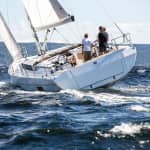
A Hallberg-Rassy 46, skippered by RYA instructor and examiner Leon Schulz, serves as the training vessel for this practical trip, which is intended to prepare the candidates for the later exam. All four had already successfully completed the corresponding theory course on Malta with Reginasailing and were therefore at least theoretically well prepared for blue water sailing with astronavigation. Now the practical part is on the agenda.
The requirements of the RYA
The RYA stipulates that the qualification voyage must be 600 nautical miles, 200 of which must be at least 50 nautical miles from any fixed installation, be it an offshore platform, a lighthouse at sea or the land itself. The minimum duration is four days and nights or 96 hours.
In addition, the route must be the shortest sailable distance from one harbour to another. Detours or zigzag courses are not recognised and so the distance sailed in this race will ultimately be more, namely 666 nautical miles, in order to achieve the required 600. And that's with the required astronavigation including astronomical compass check.
Analysing the weather situation
During the crew briefing, the anticipation of the great adventure of sailing first across the Bay of Biscay and then west of Portugal to Nazaré, which is not only known among surfers for its spectacular surf waves, is palpable. In conversation, we decide that we want to set off as soon as a weather window promises not only favourable winds, but also sunny days and starry nights for astronavigation.
After the safety briefing and analysing the weather situation one last time with the help of synoptic charts from the Internet, the following day is already suitable for setting off. Predict Wind predicts good conditions, no pitching, just some rolling forecast. We don't let the opportunity pass us by.
Perhaps this is the biggest difference between the blue water sailing of today and that of the past, when electronics on board played no role, or at least a much smaller one. You needed more time - and you took it. You had to take more time. For example, to get used to the waves and the boat first - and astronavigation would have been learnt long beforehand close to shore.
The Bay of Biscay awaits
But enthusiasm is not a problem. The watches are organised together with great commitment and the boat is checked for the upcoming 600 miles or more. Even the location of the orcas from Brittany to Gibraltar is included in the planning. We can happily do without the marine mammals nibbling at our rudder.
The on-board chronometer from Wempe is checked one last time with the time signal from an atomic clock on the Internet, then we calibrate our quartz wristwatches according to the chronometer. Accurate time on board is at least as important for astronavigation as the sextant itself.
Seasickness runs rampant
Despite the moderate waves, the first people get seasick after the Raz de Sein, the "Cape Horn of Europe". Not everyone is hit equally hard. One crew member had taken the precaution of applying a Scopoderm plaster behind his ear. But even he has no great desire to measure the altitude of the sun on the first day, let alone carry out the preparatory calculations necessary for star and planet observation in the evening twilight.
The disappointment that we didn't even get the sextant out on the first day with clear skies is written all over our faces, and so we continue sailing on an approximate compass course of around 200° towards Cape Finisterre in north-west Spain. The crew member scribbles the course on the chart with a plaster. Dead reckoning, as the English say, "dead estimate". Fits well here.
The next morning doesn't feel any better. Now the wind is gone and the predicted rolling sets in under engine power, robbing the crew of the sleep they had longed for. Luckily we have time, the nearest land is a long way off and so we continue to make rough connections on the nautical chart.
Far out into the Atlantic
The weather fax now also shows a tiny little depression a little to the west of Finisterre, which means that we can expect a headwind from the south near the Spanish coast. Not exactly ideal. The best solution therefore seems to be not only to round the cape itself, but also the low lying in front of it. And so the course is set even further west, out into the Atlantic, with the feeling that the Azores could be our next stop.
The course change is again roughly entered on the nautical chart. At this point, some crew members have probably already put the planned astronavigation on the back burner and secretly just want to get there. But this reaction is completely normal, as many sailors experience the start of a longer trip in this way: After the first few enthusiastic hours, you suddenly realise that you will not be calling at a port for the evening as usual, but that you will be sailing all night long.
Seasickness, perhaps triggered by this very thought, often sets in late in the afternoon of the first day. Through the night, sailors who have not taken seasickness medication lie in their bunk with a bucket and the next morning many realise just how far a 600-mile trip actually is. On the nautical chart, it looks as if you have barely left land and there is still what feels like an infinite amount of water in front of the bow.
Unfortunately, day two is characterised by a lack of sleep and rusks. And the doubt as to why you are doing all this to yourself - and paying money for it! Some take medication after all, but often too late for the hoped-for effect.
The sextant in use
But on the third day, everything changes. And this is precisely the educational quintessence of an ocean training cruise: the first thing that happens is something that has long since ceased to come as a surprise to experienced blue water sailors: Seasickness suddenly disappears as if by magic and is replaced by appetite and a good night's sleep. The crew feel alert again and finally want to use the sextants - but unfortunately the sky is cloudy right now. Nevertheless, the instruments are taken out to at least get a feel for them.
And now the next surprise awaits: despite the cloud cover, the sun can still be spotted thanks to the good optics of the high-quality sextants. Not continuously, but often enough it penetrates the thin grey. The horizon is clearly visible in the clear north-westerly wind anyway.
Shadow of the compass needle
Each crew member quickly takes five measurements in succession, as best they can for beginners in the overcast sky, and their colleague notes down the time to the second. Then they take turns. When the sun does peek out briefly, the shadow can also be read off the compass needle, which falls from 220° to 295° with the course set.
The contra course of the shadow on the compass (i.e. 295°-180°=115°) can then be compared with the azimuth. If the deviation from the chart is taken into account, the deflection can be calculated and the compass can be checked. This is also part of the RYA test and must be known, because after a lightning strike, for example, it must be ensured that the compass still displays correctly.
A beautiful result
The third surprise is the astonishingly straight lines that result from the connection of the respective solar observations. A straight line is evidence of correct measurement, so no sun shot was really out of line. The recording of five consecutive solar observations is also part of the test.
With such a beautiful straight line, the shaky measurements might even become applicable - despite the clouds and unfamiliar handling of the sextant. Expectations of astronavigation rise just as quickly as the general mood on board after the seasickness disappears. Should we perhaps be able to find Portugal with the sextant after all?
The second measurement
However, two measurements are needed to determine the position and so the ship's noon is eagerly awaited. The patience is rewarded, as a bright blue sky opens up at around 14:40 French shipboard time, the time for the noon latitude (due to a longitude of about 10° west, about 40 minutes after passing the noon altitude at the Greenwich meridian, i.e. at 12:40 UTC).
Just 20 minutes before noon, the crew, now completely free of seasickness, sits on deck with the sextants and can observe an ever-increasing elevation angle of the sun until the star finally stops rising and then slowly falls again. The exact time to the second is irrelevant. Instead, the maximum angle on the sextant is important and then leads to the noon latitude with a simple calculation.
After the usual corrections on the sextant, simply subtract the measured angle from 90° and then add the latitude of the sun (the declination) and you have your latitude. What a feeling of success! But is it correct? The crew are not allowed to compare their measurements with the GPS.
Wanted: a ghosted place
Next challenge: A ghosted location is required to calculate the bearing line in the morning. This is never a problem in theory lessons as it is always given in the text task. But where do you get it from if you have already sailed for several days and the docking point can only be estimated extremely imprecisely?
Quite simply: you take what you have. The coupling point in the nautical chart will hopefully not be more than 30 nautical miles or about half a degree off and is then used as a ghosted location to derive the calculation location for astronavigation.
Where is the error?
According to the initial calculations, we are very far away from our chosen calculation location. Can that really be the case? The skipper is asked, who gives the tip that a calculation error is usually to blame if the deviation is 30 nautical miles or more. On the other hand, however, it is of course quite possible that the place we have been given is actually so far off the mark.
All steps are therefore recalculated, as there is usually a simple addition or subtraction error somewhere between the numbers. This is precisely why the calculations to be carried out should always be kept as simple as possible, preferably with the help of an astro template, a celestial template.
The number range from 1 to 10 for addition and subtraction can seem complicated enough on a rocking boat, especially when after 59 minutes there is not 60 minutes but a whole degree. The Reginasailing templates provide a good guide to getting to the stat line step by step.
A misunderstanding
This time, however, the error was not in the calculation. It was simply a lack of understanding: Table 5 was used incorrectly. It is important for correcting the calculated vertical angle by the minutes of declination. Everything clear? Not straight away, which is why table 5 is just as incomprehensible at the beginning as it sounds above. A good opportunity, therefore, to discuss it again in detail so that the crew understands what exactly is being corrected or added and why.
This is followed by an aha moment, and suddenly the morning's stateline makes sense after all! It is now plotted and then "sailed" by the 220° course sailed and the distance travelled between the morning and midday latitude, i.e. shifted parallel. The noon latitude is then drawn as a horizontal line and the fix, i.e. our true position, can be read off. It is located where the offset line intersects with the noon width. Voilà!
Precision landing in Portugal
The final pleasant surprise awaits the crew later on arrival at the final briefing in Nazaré: namely that the position determined in this way is no more than three nautical miles away from the GPS position recorded by the plotter in the background. And this despite uncertain coupling during the first two days and the fact that the sun shots were taken by beginners in astronavigation under cloudy skies. Chapeau!
But we are still underway and the evening positioning with the help of the planets and stars during the twilight of the third day is rather sobering. The preparatory calculations with the help of the Reginasailing template mean that we know which planets and stars should be visible in which direction and at what altitude so that we can easily find them in the preset sextant.
After all: Mars is sighted
However, the sky is too cloudy to make out any stars, even in the gaps in the clouds that keep appearing. By the end, the horizon is already too dark to take any measurements. Only the planet Mars can be observed. At least a little.
The fourth and final day before arriving in Portugal consists of continuous exercises, sun shots and the associated calculations. And shortly before the end of the trip, fog even appears, so that sailing with radar assistance can still be practised.
There is something to celebrate
On 26 June at 16:15 local time, we finally dock in Nazaré - and reward ourselves with a visit to a Michelin-starred restaurant. After all, there is something very special to celebrate: not only that we have actually found our destination using a sextant instead of a satellite - but also that the astronavigation is so precise.
Also interesting:
- Astronavigation: From the notch in the wood to the computer app
- GPS waypoint navigation: Tips, tricks and common mistakes
- Terrestrial navigation: How to determine the course without technology

Leon Schulz
Freier Mitarbeiter
