


Mediterranean: Monster waves off the Balearic Islands again

Storms in the Mediterranean have been unusually frequent and violent in recent months. These storms repeatedly produce terrifyingly high waves. At almost 13 metres, the third documented extreme wave in the Mediterranean within a few months was measured off Menorca on Sunday, 15 March 2026.
The 16-metre wall: Cyclone Harry devastates Sicily and Malta in January
Only six weeks earlier, from 19 to 22 January 2026, Cyclone "Harry" raged over the southern Mediterranean.
A buoy from the Italian Rete Ondametrica Nazionale registered a maximum wave of 16.6 metres between Portopalo di Capo Passero and Malta. The Mediterranean cyclone developed wind speeds of up to 130 kilometres per hour.
The result was devastating: in Palermo, local reports speak of at least 20 boats destroyed, plus pontoons torn from their moorings. In Siracusa, floating pontoons were destroyed and several reports mention boats that sank despite reinforced mooring lines. On Malta, badly damaged yachts were washed ashore in Birżebbuġa, while Marsaxlokk reported that smaller boats were pushed onto the road.
Particularly frightening for sailors: supposedly safe harbours then repeatedly become danger zones. When the swell pushes over the piers, it causes yachts to swing as if on a spring. Lines are jolted, cleats and bollards are hit, fenders slide up or are squeezed out.
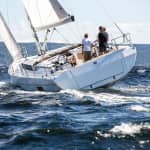
In addition, yachts offer enormous surfaces for the wind to attack. This is hardly noticeable in moderate conditions, as the wind pressure on the freeboard, mast and superstructure is rather low in light winds. However, the pressure on the hull and rig increases in proportion to the square of the wind speed. For example, the difference between three wind forces and nine wind forces does not mean a tripling of the wind pressure, but almost a 21-fold increase.
How monster waves arise - and why they are becoming more frequent
The extreme wave heights during Cyclone Harry were no coincidence, but the result of a combination of meteorological factors. Three conditions have to come together for monster waves to build up: high wind speed, long duration and sufficient "fetch" - the uninterrupted distance over which the wind blows over water from one direction. In Harry's case, another amplifier was added: jet effects between islands and in straits such as the Strait of Sicily, where the wind is additionally accelerated.
However, the real problem lies deeper. The depression tapped into humid air masses over the unusually warm Mediterranean and established itself almost stationary over several days because stable areas of high pressure in the north prevented a rapid withdrawal. "The mild water temperatures are a source of energy and lead to higher evaporation," explains Italian meteorologist Mattia Gussoni from the weather service ilMeteo.it. "For this reason, Harry became an extreme event, the likes of which we have rarely seen in the past."
The forecast is sobering: there have always been winter storms over the Mediterranean, but they will occur "more frequently and more violently" as a result of climate change, says Gussoni. He cites the increased water temperatures in the Mediterranean as the main cause, which provide the storms with additional energy. The warmer the water, the more moisture evaporates into the atmosphere - and the more energy is available for heavy rain, squalls and the build-up of extreme waves.
It becomes particularly dangerous when such systems are disconnected from the main current band as so-called "cut-off lows" and remain over the same region for days. The waves then continue to build up until they overwhelm even robust harbour facilities. The 16.6 metre wave between Sicily and Malta was the result of precisely this constellation - and it is unlikely to be the last of its kind.
Record from space: 19.7 metres in the North Pacific
The highest wave ever measured by satellite was recorded on 21 December 2024 - not in the Mediterranean, however, but in the open North Pacific during the height of storm "Eddie". The SWOT satellite (Surface Water and Ocean Topography), a joint mission by NASA and the French space agency CNES, recorded ocean waves with an average height of 19.7 metres - as high as a six-storey residential building.
What makes this measurement special is not just the sheer height, but the way in which it was recorded. For the first time, SWOT can create large-scale, two-dimensional maps of the ocean surface and not only measure wave heights, but also track the formation, propagation and energy of monster waves over thousands of kilometres.
The researchers were able to track the storm dune over 24,000 kilometres across the ocean, from the North Pacific through the Drake Passage to the tropical Atlantic, between 21 December 2024 and 6 January 2025. This means that a storm raging off Alaska can cause dangerous conditions in the Caribbean two weeks later.
Even higher waves measured - but not by satellite
There were even higher measured waves: On 8 September 2019, a single wave height of 30.2 metres was measured by a measuring buoy off Newfoundland. In the southern hemisphere, 23.8 metres were recorded on 8 May 2018 near Campbell Island south of New Zealand.
In February 2024, a new record of 28.57 metres was measured off Nazaré with the help of a drone. These monster waves are created by the "Nazaré Canyon", a sea gorge up to 5,000 metres deep that ends directly off the coast and concentrates the energy of the Atlantic in a very confined space.
Significance for cruise planning
As frightening as the recurring extremes are, the forecasts are getting much better - at least for larger-scale weather systems. The combination of satellite-based remote sensing and buoy measurements provides a more complete picture of ocean dynamics. In future, weather routing systems could therefore not only take into account current storms, but also their far-reaching "wave echoes", thus enabling more reliable forecasts for water sports enthusiasts.
Small-scale weather extremes, such as those that have repeatedly occurred in the Mediterranean in recent years and caused considerable damage in some cases, remain much more difficult to predict. The most prominent example is probably the sinking of the Bayesian.
Meteorologist Dr Michael Sachweh therefore advises: "Pay attention to the air flow at an altitude of three to five kilometres on weather portals such as "Windy". If it is blowing at hurricane force, you can expect heavy gales or even gale-force winds near showers and thunderstorms, even on the water. The wind at altitudes of around 3,000 to 5,500 metres (pressure levels of 700 to 500 hPa) is considered to be the leading current for the probable displacement of showers, thunderstorms and storms. If there is relatively low pressure up there and it is storming from the south-west, alarm bells should ring. A shore excursion instead of a cruise would then be the right decision."
