


Vendée Globe: The equator has been passed, but will Herrmann reach the Rio Express?
Tatjana Pokorny
· 22.11.2024


While a good third of the Vendée Globe fleet is still enduring the agony of the Kalmen Belt, the others have already crossed the equator. However, the pressure has not eased among the leading soloists in the southern hemisphere. On the contrary, for some skippers it has increased even more. Like Boris Herrmann, they are fighting in the trade winds to reach a low that could catch them north of Rio de Janeiro.
Thrilling Vendée Globe decision ahead
With this train, the best could possibly even catapult themselves from the equator to the Cape of Good Hope in record times. Those who don't make it are in danger of - as the Vendée Globe organisers put it - "being left behind on the platform at St Helena station".
This refers to the notorious St Helena High, which has slowed down many a circumnavigator. With the latest 3 p.m. update, the current pecking order in the race south came first on the afternoon of 22 November: Charlie Dalin, who had taken over the fleet leadership from Thomas Ruyant shortly after the equator passage, set the pace at the fifth parallel south.
Just under 17 nautical miles behind, "Vulnerable" skipper Thomas Ruyant was close on his heels a little to the west of "Macif Santé Prévoyance". Dalin, however, was able to log the faster speeds last. A little to the east of Dalin, the other "Vulnerable" skipper Sam Goodchild put the pressure on, having recently reduced the gap to the top boat to 22 nautical miles. Sebastien Simon ("Groupe Dubreuil"), Yoann Richomme ("Paprec Arkéa") and Nico Lunven ("Holcim - PRB") followed 42, 49 and 51 nautical miles behind.
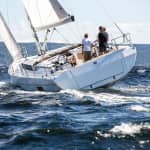
Ruyant had two problems at once
Thomas Ruyant, previously the fastest on the equator, explained his conspicuously slow progress in the morning as follows: "The fact that I came out of the 'Pot-au-Noir' very far to the west compared to the rest of the fleet gave me a slightly less favourable angle to make progress. I knew from the start that this edge would be complicated for me, especially because some, like Charlie Dalin, are very fast at this slightly narrower angle."
The boss of his own racing team TR Racing, under whose umbrella he has brought in a 2023 second strong skipper in Sam Goodchild, continued: "I'm trying to hold my position and reduce the gap to the side a little." Alongside his unfavourable sail angle, Ruyant had to solve a problem with the hydraulic cylinder of his J3 headsail.
Ruyant said: "I lost two or three hours in the fight, but I'm fine now. I'm happy with my position and my place at the moment. The aim was to be in the right packet in the southern hemisphere and that's the case," emphasised the sailor, who, like most, had not expected the jostling for position to be so close after twelve days at sea.
After 3200 nautical miles: only 60 separate the top ten
It is fascinating to see how close the boats in front are sailing after more than 3,200 nautical miles. The other current top ten sailors Jérémie Beyou, Yannick Bestaven, Justine Mettraux and Paul Meilhat are also no more than a nautical mile apart in some cases. On Friday afternoon, there were just over 60 nautical miles between Charlie Dalin in the lead and "Biotherm" skipper Paul Meilhat in tenth place, who has made the biggest leaps forward in recent days.
Boris Herrmann is fighting a great battle behind him. He was in 14th place on the afternoon of the 13th day at sea, 145 nautical miles behind Dalin, with Pip Hare powering her "Medallia" just two miles ahead of him. Boris Herrmann already knew on Thursday evening that he would have to get the maximum out of "Malizia - Seaexplorer" in order not to miss the Rio Express to the Cape of Good Hope.
Preliminary decision in the coming week?
The 43-year-old said: "We have a nice low coming from South America, on which we can sail across the South Atlantic in record time." However, he says he can only achieve this if he sails his boat close to 100 per cent. "If I'm at 90 per cent, then I'll miss the low." That will be clearer in five or six days, probably in the middle of the third week of racing. "If I miss the low," Boris Herrmann clarified, "I would lose 1200 nautical miles to those who reach the low."
If I miss the low, fate will tell us what happens to the rest of the race." Boris Herrmann
In the afternoon, Boris said on the Vendée Globe TV programme: "I'm staying calm. In the end, it will perhaps be a question of 50 nautical miles whether I make it or not. I've actually enjoyed today, trimmed my boat to the best of my ability. We have beautiful conditions: blue seas, trade wind conditions. My boat is foiling here at an average of 20 knots. It's a pleasure. If I miss the low, then that's how it will be."
Here, Boris Herrmann gives an overview of his challenging current position and major task in the race to the Rio low:

Tatjana Pokorny
Sports reporter
