


Vendée Globe: "Because I love the sea" - Interview with purist Paul Meilhat
Tatjana Pokorny
· 30.11.2024


When 42-year-old Paul Meilhat is not competing in the Vendée Globe or another Imoca race, he lives with his family in the centre of Lorient. His wife Stéphanie is an ophthalmologist. The couple have two children: Antoine, 5, and Thomas, 8. The choice of home is deliberate: Everyone can get to the sea quickly from here. The Imoca skipper can reach the workplace of his Biotherm team in Lorient's sailing cradle La Base in five minutes by bike.
Growing up in the north-west of Paris in La Garenne-Colombes, Paul Meilhat initially sailed in Olympic boat classes such as the Laser and 49er, studied sport and worked as a coach before switching to sea sailing - and embracing all ocean challenges from then on. Influenced by the tough Figaro school, he won the Tour de Bretagne and celebrated his first major victory in the Figaro-Transat AG2R in 2014. In 2015, he switched to the Imoca class, won major transats such as the Route du Rhum and continues to be recognised as one of the greatest talents in French offshore racing.
Paul Meilhat's second Vendée Globe is underway
His worst "Christmas present" brutally halted the rising star's high-flying career on Christmas Eve 2016: his Vendée Globe premiere in the penultimate edition of the solo race around the world came to an end. In third position, the Frenchman had to officially retire for Christmas after his "SMA" suffered severe keel problems. Eight years with many battles, exciting collaborations with greats such as Charlie Dalin and Samantha Davies and the resurgence with his own team Biotherm followed.
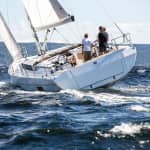
Now the 2021 Imoca season champion wants to give it another go at his second Vendée Globe with the 2022 Verdier design "Biotherm". He was not one of the top favourites before the start of the race, but has the potential for a strong top ten finish, perhaps even more. After his Vendée Globe exit eight years ago and a series of technical problems with the then brand new Verdier "Biotherm" from 2022, Paul Meilhat is focussing more than ever on the reliability of his boat in the last Ocean Race. And his own love of the sea
We conducted and updated this interview shortly before the start of the 10th Vendée Globe. It reflects the current state of the race remarkably well. The fleet was led by Yoann Richomme on the morning of 30 November ("Paprec Arkéa") ahead of Charlie Dalin ("Macif Santé Prévoyance") and Sebastien Simon ("Groupe Debreuil").
While Boris Herrmann picked up speed again on the morning of 30 November after a bad doldrums phase in 13th place, 1087 nautical miles behind Yoann Richomme, Paul Meilhat achieved the fastest speed in the fleet on Saturday morning at around 23 knots.
Paul, you had to announce your retirement on Christmas Eve 2016 at your premiere in the penultimate Vendée Globe edition after suffering serious keel damage on the "SMA". What are your goals now with "Biotherm"?
I always say that I'm a sportsman. I want to win the race because I want to win all the races I take part in. But sometimes others win too (laughs). The good thing is that I wasn't on the list of top favourites before the race started. I don't have as much money for my project as some others, but I believe that I can achieve a very good result. That's the most important thing: you have to start a race with the hope that it's possible. The Vendée Globe is also different to Transats.
What do you mean?
The more days you spend on the water, the more things can happen. That's good for me. I don't have the burden of being the top favourite on my shoulders. I believe that I started the race in a very good position.
Who do you think are the top favourites?
For me, there are four projects. Not because I know they're really good, but because they're only competing to win. They are Charlie Dalin on "Macif", Thomas Ruyant on "Vulnerable", Jérémie Beyou on "Charal" and Yoann Richomme on "Paprec Arkéa". These four did not compete to come second.
But only one can win...
Yes, but from my point of view there were more skippers than these four who could win the race before the start. Like Boris, like Samantha Davies, like Sam Goodchild - or even like me. And maybe up to five more sailors. But we don't say it like that. We're not just competing to win. That is a difference. It means that we are perhaps a little more focussed on preservation when managing the boat and rig in order to achieve a good result.
I believe that I am mentally very stable." Paul Meilhat
In other words, an approach that relies less on putting the pedal to the metal and more on good average performance so that the boat stays intact for a good result in the end. What would you describe as your particular strength?
I believe that I am mentally very stable. That's an important point for this race. Because you never know what it will bring you. If we look at the story from 2016: People were very fast at the start of the race and got way ahead of the fleet. That's where you need to be when you reach the Southern Ocean. Of course, you can still wreck the boat afterwards. But if you have ten boats in a strong system in the south, then one of these boats will probably win the race.
What chance do subsequent boats such as Boris Herrmann's "Malizia - Seaexplorer" have?
I think Boris' boat is faster in the south. I believe in a winning boat that is fast in many different conditions. Boris has a really good boat. Boris can definitely win the race. But he has also taken some risks. He needs certain conditions to win. That's not quite the case with the other boats.
"How do you see the strengths and weaknesses of "Malizia - Seaexplorer"?
I think it's probably the best boat in the south, the best boat downwind. With all the experience and all the nautical miles they have accumulated in the Ocean Race and other races, the boat is also fast upwind and not too bad in light winds.
But the problem is that the latest boats like "Macif" or "Charal" are probably the lightest boats, while "Malizia" is perhaps a little heavier. Which is why she is perhaps a little slower downwind in medium conditions. But not by much.
I now have exactly the same foils as Boris." Paul Meilhat
Where do you fit in with "Biotherm"?
"Biotherm" is really fast in light and medium winds. The weak point is the downwind performance in heavy seas. That's why we swapped foils this summer after we broke a foil in the Transat. I now have exactly the same foils as Boris. That's good, but it doesn't completely eliminate the difficulties downwind. "Malizia" is not only so fast downwind because of her foils. It also has to do with her more curved hull shape. I don't have a 'rocker'...
You are referring to the curvature of the hull bottom of "Malizia - Seaexplorer" in the longitudinal direction from bow to stern...
My boat is straighter. Boris' boat is getting closer to a bend. Which means it goes through the waves more easily. Which is not the case for me. I'm travelling a bit more like a submarine (laughs).
Did you consciously take this risk into account when building your boat in 2022?
I see the risk the other way round. Boris has taken the risk. But I still think it's a good idea! His boat is not that slow in the other conditions. He was the first to take the risk of building a boat primarily for tougher downwind conditions. We know that the tough downwind conditions during the Vendée Globe may only last ten days or even a month.
So it means a lot of risk. The race lasts two and a half months. And it's not just downwind that's required. My boat is perhaps less compromised, more polyvalent. So when comparing "Malizia" and "Biotherm" in terms of hull design, we are rather opposites. My boat looks more like the others on the dock. We have a lot of Verdier designs, maybe ten, 15 boats. "Malizia" is the only boat with this curved hull shape. I find that really, really interesting!
"Malizia - Seaexplorer" shone at the beginning of the year with two podium places in the most recent Transats. Were you surprised by these top results?
No, not me. The conditions were good for it. And the foils are really efficient. Sam Davies also came third in the Transat. She has the same foil shape. I think the Manuard foils are really good.
For example, when we broke the foil in the Transat, I went to the bank and had to ask for money." Paul Meilhat
What is the budget like for you in the team - where can Team Biotherm be categorised?
It's not a very small budget, because I have a new boat. But we don't have the budget of the top projects. Which means we have to make decisions and can't always change all the equipment. Not all of our sails are new, although many are.
A set of new foils costs around half a million euros?
Yes, about. And then you also have to pay for the studies, the systems, the composite work and more. You're more likely to end up with more than 700,000 euros.
Which teams have the biggest budgets?
Jérémie Beyou probably has the biggest budget with "Charal". Then perhaps Yoann Richomme, Boris, Charlie Dalin and Thomas Ruyant will follow.
Boris once told us that Thomas Ruyant likes to sail 'triple-headed'. The J2 is so small that it functions as a staysail between the J3 and another sail. How do you look after your sailing wardrobe, especially as your financial scope is limited?
Thomas' set-up doesn't change that much. Only the timing of the sail changes. In his set-up you have to change the sails really often. That doesn't seem very helpful to me. I prefer my own timing.
A Vendée Globe is the culmination of a long journey." Paul Meilhat
You've worked and raced with sailing greats like Vendée Globe favourite Charlie Dalin and Samantha Davies. What were you able to learn from them?
I think I've learnt a lot from all the sailors I've worked with. When you sail with Charlie Dalin or Sam Davies for a year, you learn a lot. But in the six months of the Ocean Race, in which I worked with a total of eight nine sailors, I learnt so, so, so much. That was incredible!
Above all, I learnt a lot about my boat there. When you sail single-handed, you have so much to do and can't spend every second on the boat. But in the Ocean Race, you're on deck for twelve hours out of 24 during the watches. In those twelve hours, you're only focussed on the speed of the boat. You really learn a lot about autopilots, the trim of the sails and the systems. That was so interesting!
For me, the Ocean Race is the DNA of sailing." Paul Meilhat
Boris has always said that the Ocean Race participation was very valuable for him and his team on the Vendée Globe course in optimising the boat...
Yes, that was good, even if it wasn't the main drive. I was there to take part in the Ocean Race. It's important for us to discover the world, spend time in different countries and show off our boats. That's important to say because it was a big project in itself. It was just as important to me during the time as the Vendée Globe. And of course it also helped to improve the boat.
And in much more intensive co-operation with the Shore teams than is possible with the non-stop circumnavigation of the Vendée Globe...
For me, it was the best adventure and race to explain the role of the Shore team. Because the Shore team is really involved due to the many stages. They have to overtake the boat in every harbour. Whereas a race like the Vendée Globe is really focussed on the skipper. Especially in France with its history around Eric Tabarly and these kinds of stories. We don't talk about the team behind it. So for me, the Ocean Race was a great gift for the team. The spotlight was on them and the fact that their work has an active influence on the success of the race.
Do you think that Armel Le Cléac'h's Vendée Globe record from the penultimate edition will be beaten this time - can the 74 days, 3 hours, 35 minutes and 46 seconds be beaten?
Firstly, I would like to say that this is not important for us. Because if I finish one second ahead of someone else, that's enough for me. In any case, the weather will decide the record. If the weather is similar to 2016/2017, the 70-day mark could be beaten. It might even go down to 65 days. But if the weather is more like 2020/2021, then it could be 80 days.
How fast can "Biotherm" be?
I probably won't be the fastest at top speed, but the new foils make the boat much more of a powerful all-wheel-drive vehicle. We only got our new foils on 20 September. We sailed so, so much. I spent six nights offshore at the end of September, beginning of October. Then we arrived in Les Sables-d'Olonne a bit tired, but very happy and also a bit proud of the achievement that we had made it. I think I'm the skipper in the field with the most miles in the last three years. So I feel ready. That's the most important area in my opinion.
When you think back to your Vendée Globe premiere in 2016, where you had to retire in a top-three position, how do you think about your second start?
It was a very different life for me back then. I was still very young, my first child was just a few months old. My experience was close to zero. I had only done my first Transat a few months earlier. I simply had a very, very good opportunity to compete in this first Vendée Globe. But I neither owned nor managed the project at the time.
Like in Formula 1, I was simply the driver. Now I've competed in many transats, sailed around the world and with many top people in the Imoca class. Maybe I have a bit more pressure now, but it's also very interesting to build a project from scratch, to build a boat. It's a lot of work, but it gives you more energy. I'm racing for everyone in the team, for the partners, for all the men and women who have helped me build the project!
The Ocean Race and the Vendée Globe are two very different worlds." Paul Meilhat
How big is your team?
We are eight people.
You studied sport and used to sail in Olympic boat classes such as the Laser and 49er, were once national champion and also trained skiff sailors. Is there anything from your Olympic time that helps you today as an offshore sailor?
These are two very different worlds. It would be like comparing an Olympic 100 metre sprint with the marathon. But I think the experience from the Olympic classes helps me to manage my project. It helps with the mental challenge of working hard and precisely. When analysing data. And to make the boat faster every day. That's what Olympic sailing gives you: the key tools and the ability to adapt to big tasks.
Just as the Olympic sailors had to adapt to the heat and lack of wind in Marseille this summer?
That's the task then: if there's no or little wind, then your mental state is important. I think the French might have been ready with their skills, but mentally they weren't quite ready for it. They won two medals, but had hopes of four or five.
I never feel alone at sea. I love the sea!"
Keyword "mental state": do you get on well with yourself when you sail alone for two and a half months?
Absolutely! That's for sure! That's perhaps my favourite aspect. In the Ocean Race we were always crews of four. I chose really nice people for it. That's why the atmosphere on board was particularly nice. But even so, at the end of the Ocean Race I thought that maybe I'm more suited to single-handed sailing after all.
How else is that expressed?
Enjoyment is at the centre of the race for me, because that's important to me. I have kept my open cockpit with a view of the sea. That's key for me to stay in contact with the sea. I don't want to be in a closed cockpit. I've kept it simple: I have a small seat, which is better when the boat is heeling. I also spend a lot of time in my seat cushion. When it gets down to business, I prefer to lie on the bean bag close to the ground.
We know from some circumnavigators, such as Ultim skipper Charles Caudrelier, that nutrition on board is a very important issue. What is it like for you?
Food is important to me. I'm not a snacker. I need full meals in the morning, at lunchtime and in the evening. But I almost only take freeze-dried food with me because I want to keep my boat light. A light boat is very important to me. Of course, I also have a few goodies with me. But I'm more on the savoury side than the sweet side. So I have cheese with me.
How do you distract, entertain or relax on board?
I have an e-book because it's easy. But that's more for times when I might have a technical problem. A Vendée Globe can end differently than you hope. If you're not fighting for victory, it's perhaps a good idea to have a few books with you.
What I really like are podcasts. It's hard with music because the boat is so loud. But I listen to a lot of podcasts. I love adventure podcasts, for example about the discovery of the New World in the 1500s, or about pirates. But I also like socially critical podcasts and podcasts about sustainability issues.
You also have a small ocean laboratory on "Biotherm" in co-operation with the Tara Ocean Foundation, as we know it from "Malizia - Seaexplorer"...
Yes, it's quite similar. It's a bit heavier, weighs 35 kilograms. It sits directly under the mast. We've changed a lot since the Ocean Race. The lab was originally made for the research vessel "Tara". This is a 40-metre ship that weighs 150 tonnes and is therefore much more stable. The enormous forces on the Imocas had taken their toll on the lab. So we installed eight shock absorbers. Now it works better.
What can your lab do?
The centrepiece is a state-of-the-art automated microscope. The laboratory combines flow cytometry and video technology to capture high-resolution images of microscopic particles such as phytoplankton in aquatic environments. A total of four million images have already been collected to date. The goal for the Vendée Globe is to collect another million photos.
These time-stamped and geographically located images are available to researchers via the EcoTaxa database and make it possible to study marine ecosystems...
We pump salt water through it every hour. We have a filter for the bubbles because they are no good for the microscope. Every 20 minutes we take 5000 pictures of five millilitres of water. With AI, we are able to recognise what kind of phytoplankton we find in different areas.
We collect the data - just like Boris. There are specific applications afterwards because it is open data. For example, colour satellite images are compared with our plankton information. All activities serve to better understand the health of the oceans and support science in research and in finding solutions for the future. It is important that we as offshore sailors participate in this.
The latest video clip of Paul Meilhat before diving into the Indian Ocean:
Tatjana Pokorny
Sports reporter
