


RORC Transatlantic Race: Supersailer, scow and semi-foiler ready for the crossing
Sören Gehlhaus
· 09.01.2026


On Sunday, 11 January 2026, the 12th RORC Transatlantic Race will be launched off Lanzarote. Since its premiere in 2014, the Royal Ocean Racing Club's offshore race has always been a stage for the fastest in the 100-foot category. The chase across the pond has been dominated by the likes of "Commanche", "Lucky" and "Leopard 3". This time, all eyes are on "Raven" which will be sailing for the IMA Transatlantic Trophy for the first Maxi in Antiugua. The 34-metre-long carbon construction with its laterally lowerable T-foils left the halls of the Finnish Baltic shipyard in 2023, has already sailed across the Atlantic twice and has more than 18,000 nautical miles in her wake.
Endurance test for semi-foiler "Raven"
The RORC Transatlantic Race will be the first transatlantic regatta for the team, which has trained extensively off Lanzarote. Project Manager Klabbe Nylof has been longing for this moment: "This is really the first time we are taking 'Raven' into a proper offshore racing environment. We've done long passages, we've pushed the boat hard, but a race like this presents us with different challenges. It's about consistency, resilience and learning how the whole system works under pressure over many days."
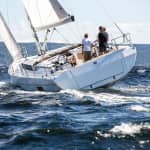
The price calculated by Botin Partners and Jarkko Jämsén The "Raven" was designed to use the lee wing to increase buoyancy and skim across the sea. Complete lift-off was never planned, as this would require a foil on the rudder, among other measures. Combined with around ten tonnes of water ballast, the concept is designed to place more emphasis on average speed than maximum top speed.
"Raven" with a mileage of 600 nautical miles
"Raven" has already exceeded 30 knots and can consistently make miles over long periods of time at speeds between 25 and 27 knots, which allows for distances of 600 nautical miles under the right conditions. Nylof emphasises that the project was never about breaking records at any price. "The owner's original idea was not to build a pure racing boat," he explains. "The idea was to create a fast, modern superyacht that would push the boundaries but still remain robust and usable. What surprised us was how efficient the platform became as soon as we started using it properly."
Two starters around 40 metres in length
In terms of length, "Raven" is topped by "Be Cool" by five metres. The Swan 128, which was first launched in 2025, shares its length with "Linnea Aurora"Truly Classic 128, won the title of largest participant in the RORC Transatlantic Race. With a displacement of around 136 tonnes, "Be Cool" is primarily geared towards cruising and achieves around 17 to 18 knots, but logs average speeds of around 12 knots on the high seas. According to IRC, "Raven" has to compensate the Swan 128 for more than 700 seconds per hour.
For "Be Cool" captain Luca Serra, the transatlantic race is a natural next step: "We've already sailed more than 5,000 nautical miles, including from Finland to the Mediterranean. Now it's time to really test the boat in a serious offshore race." Serra previously held the same role on the eponymous Swan 98, and makes it clear that the 128 represents a fundamental evolution. The aim was to make the yacht easier, safer and more enjoyable to sail, also for the owner.
"We want to preserve the friendly spirit. There will be four or five top professional sailors, but we are not building a superstar team. This boat is about cohesion, experience and respect for how we want to sail it," says Serra. The crew will sail in three watches of five people each, with clear watch leaders and a strong focus on routine. "Good watches, good communication and good habits count for more than raw aggression over 3,000 miles. That's where races like this are really won or lost."
"Walrus 4" on a major Atlantic mission
Walross 4" has a similar philosophy for the Akademischer Segler-Verein (ASV) from Berlin. Skipper Matthias Kahnt is responsible for the 56-foot single-deck boat designed by Georg Nissen and his crew: "Crossing the Atlantic was a dream come true for all the young crew members on board the club boat. Nine out of ten people on board are students at Berlin universities, and we all know how important time for adventure is. That's why we're delighted to be able to enjoy the journey a little longer than the faster boats!"
The participation in Transat 2026 is part of a larger project called Atlantic Connections, which aims to celebrate the 250th anniversary of the United States and participate with "Walrus 4" in the celebrations in New York Harbour on 4 July 2026 (Sail4th 250). "This is our way of honouring the special, long-standing relationship between our city and the United States. This sailing project is under the patronage of Kai Wegner, the Governing Mayor of Berlin," says Kahnt.
The strengths of the "Walross 4": "We have a robust boat that was built for long ocean sailing trips and has already survived very difficult conditions. The dimensions of the rig, the keel construction and the 35 mm thick, 7-ply hull made of Khaya wood will withstand any weather during the race. Of course, this also has a small disadvantage: we weigh around 18 tonnes and will start planing much later than some racers made of carbon fibre. But we will cook full meals in our galley and sleep very well and dry in our bunks."
IRC field with two "flat noses"
A number of teams are targeting the IRC ranking based on calculated time with exciting new builds, first and foremost "Palanad 4". The brand-new 50-foot design by Sam Manuard crosses the Atlantic with a scow bug. "Palanad 3" won the 2021 race and set the IRC record for the route from Lanzarote to Antigua. "We want to sail as fast as possible," says skipper Antoine Magre. "A highly focussed crew, a strong weather strategy and exploiting the boat's strengths - that's what it's all about."
Maxitude" by father and son team Xavier and Alexandre Bellouard is fresh from the shipyard. Marc Lombard's designers have given the Lift 45 a similarly full foredeck and modern lines. Xavier Bellouard on their chances: "We realise that we are being watched closely, as the boat surprised many during the Rolex Fastnet." With their bow, the Bellouards hope to show that a wide foredeck is not just a trick of the Class40. "It's a direction that the offshore world as a whole will take at some point. 'Maxitude' is an evolution of the previous model, a Pogo 12.50," continues Xavier. "My wife will be joining us in the Caribbean, which is one of the advantages of having a large forward cabin. The Maxitude is really a boat for two purposes, for racing and for cruising."
"Ino Noir": Sailing fast and slow
On "Ino Noir", James Neville returns with the boat that finished third last time. The Carkeek 45 has been further developed after a season characterised by reliability problems. "We want to do better than last time," says Neville before the start. "The slowest speed is actually more important than the fastest. It's about steering the boat, controlling chafe and maintaining the sails. It's about consistency." Ino Noir will be competing with almost the same British crew from last year, supplemented by Spanish navigator Juan Vila "If the boat is faster than the waves, we can sail into the wave ahead, causing huge wear and tear on the sails and equipment."
Outlook of the crews
"Ravens" project manager Klabbe Nylof is confident about the race: "The boat is strong and controllable even without foil support. That's very important on the high seas. You need the confidence that the yacht can take care of you if something gets damaged or the conditions change." With Damien Duchon as skipper, Will Oxley as navigator, the "Raven" team comes with confidence but remains realistic: "This race is all about learning, proving reliability and unlocking the next phase of what 'Raven' can do. This race boils everything down to the essentials. It's about how well you manage the boat, the systems and the people. That's the real test."
"Be Cool" captain Luca Serra agrees: "Crossing the Atlantic in company, as part of a real race, makes sense. It's safer, more interesting and much more meaningful than doing it alone. This is where you really get to know a boat." Matthias Kahnt predicts for "Walross 4": "As we have quite a heavy boat with a symmetrical spinnaker setup, our VMG angles are quite low in rough winds. The wind and wave conditions of the classic trade wind zone therefore suit us. We estimate our potential to be similar to that of the 'Spirit of Helsinki'." The Swan 651 sailed to third place in its group last year.
Transat start and tracking
The RORC Transatlantic Race starts on 11 January 2026 off Marina Lanzarote, for multihulls at 12:30 UTC and monohulls at 12:40 UTC.
As the fleet is very diverse, the fastest multihulls are expected to take between 5 and 6 days, depending on weather conditions. The majority will arrive in 12 to 14 days, while stragglers will be at sea for around 17 days.
The monohull record was set by "Lucky" (ex-"Rambler 88") in 2025 with 7 days 20 hours, 34 minutes and 41 seconds.
Go to the tracking here (please click).
