


At the start of the RORC Transatlantic Race, there was a colourful hustle and bustle in front of the Marina Lanzarote in Arrecife. The majority of the 21 yachts sprinted away with flying sails in rough north-easterly winds of initially twelve and later 15 knots. The collective departure of the monohulls once again emphasised the Diversity of this year's fleet - and in sailing in general.
Colourful monohull fleet
The 50-foot scow "Palanad 4" with its flat bow and round outline looked like a playful beluga, while the 34-metre-long "Raven" sped off like a gigantic water strider. Then the Swan 128 "Be Cool" pushed past with the elegance of a swan, followed by the Truly Classic 128 "Linnea Aurora" with traditional lines and teak superstructure.
Olivier Magre's Mach 50 "Palanad 4" was the first boat to cross the start line. The Swan 128 "Be Cool" skippered by Luca Serra got off to a good start and secured the pin position. James Neville's Carkeek 45 "Ino Noir" found a good position four boats away from the starting buoy. The Baltic 111 "Raven" skippered by Damien Durchon quickly gained ground, crossed the fleet on port tack and headed seaward at 14 knots or more.
Trimarans forge ahead
The MOD70 tris "Argo" and "Zoulou" and two 50-foot catamarans started in the second group. Alister Richardson led Jason Carroll's "Argo" across the line: "The plan was not to get caught out or taken by surprise by Zoulou. We decided to approach the line on starboard so that Zoulou wouldn't have the opportunity to catch us. We did a very good job with the time and distance to the starting buoy so that we could jibe there and head out to sea."
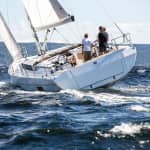
Before setting course for the Caribbean, we had to round the waymark off Puerto Calero Marina. "Argo" reached the mark even before "Raven", which had started ten minutes earlier and had additional bulwarks aft. One hour after the race, Brian Thompson reported from the chart table of "Argo": "We are down near Fuerteventura and are quickly reaching the African coast." Three hours after the start, the MOD70s "Zoulou" and "Argo" were racing at 25 knots almost side by side towards the African coast, with "Raven" leading the monohull fleet and making a big gybe to the west towards Rumbline. The rest of the international fleet behind the leaders were close together on a fast deep reach along the east coast of Fuerteventura.
"Ino Noir" in front after IRC
Shortly after the start, "Ino Noir" took the lead in the IRC classification. Tactician Jack Trigger commented: "We weren't planning on taking any big risks at the start with a whole transatlantic ahead of us, but it went well and we managed to avoid getting tangled up with the big boats. We sailed a nice VMG run to the Calero mark and played with the wind shifters towards the beach, which gave us a good little advantage. Then we switched to our A3 around the mark to get south into areas with more pressure as quickly as possible."
Finnish two-handed crew
The RORC Transatlantic Race 2026 will not only feature high-tech machines packed with professionals. The crew of the smallest boat comes from Finland. "Stimmy", a Sun Fast 3300, is crewed by Vendée Globe finisher Ari Huusela and owner Annika Paasikivi sailed double-handed. For Huusela, who has almost 100,000 nautical miles under his belt, this campaign is about rediscovering joy. For Paasikivi, it is a leap into the unknown - her first real ocean crossing. "For me, this is a relaxed, happy project," says Huusela. "Our goal is simple: to enjoy sailing and arrive safely."
Tactics of the "Walrus 4" crew
At the other end of the experience spectrum is "Walross 4" from ASV. Many of the ten crew members are crossing an ocean for the first time. The regatta participation of the training yacht of the Akademischer Segler-Verein zu Berlin is part of the sailing project "Atlantic Connections"which the ASV is organising between August 2025 and September 2026. Skipper Matthias Kahnt takes a relaxed approach: "We don't have the financial means to ship equipment for the regatta to make the boat lighter. That's why we're taking everything with us. We have also decided to cook normal food on board and not resort to dry catering like many other participants. We want to use this as a psychological weapon against the other teams via social media."
The first three days could be crucial for the "Walross 4" crew: "We will concentrate on doing very well during the difficult conditions around the Canary Islands. After that, we will simply try to find our groove in our everyday watch between rowing - we don't have an autopilot - trimming sails, cooking, sleeping and, of course, social media activity," says Matthias Kahnt.
The fleet always in view
RORC Race Director Chris Jackson confirmed that both starts went off without a hitch: "From the moment the fleet leaves Lanzarote, the race is monitored around the clock. We look out for anything unusual. If a tracker indicates anything unexpected, we are immediately alerted and ready to react." For the RORC, safety is an absolute priority, regardless of whether it is a 60-mile race or a 3,000-mile ride.
All boats in the RORC Transatlantic Race have been fully inspected and meet the requirements of World Sailing Category 1 for ocean racing. In many cases the crews are carrying safety equipment that goes far beyond the minimum. All relevant coastguards along the route have been briefed in advance and have full details of each boat, crew member and contact procedures so that any issue can be dealt with as quickly and safely as possible.
Go to the tracking here (please click).
