


Warnemünde Week: Four winners and plenty of sailing at the finale - "Great week!"
Tatjana Pokorny
· 13.07.2025


- A raging "Red Devil" and a power player
- Warnemünde Week: British dominance in the Musto skiff
- When a race win is the string...
- Decision in the last race
- Warnemünde Week: satisfied conclusion
- After the Warnemünde Week: "almost ready for the Olympics"
- Two German sailing area candidates for the Olympics
At the end of the 87th Warnemünde Week, after stormy and rough days with some cancellations, but also courageously acting race officers and active participants, there was once again plenty of sailing in the beautiful Baltic Sea area. All classes that were still active were able to complete an intensive final programme and celebrate their winners from four countries and the runners-up.
A raging "Red Devil" and a power player
By the "Super Sunday" of Warnemünde Week, the storm had turned into more favour. Despite a few showers, an impressive field of sails still active on the second weekend unfolded off the Mecklenburg coast. Race organisers and athletes used the conditions for plenty of races. The award ceremonies for the Zoom8 World Championships, the European Musto Skiff Championships, the RS Aero German Open and the Finn ranking regatta were all festive afterwards.
The best sailors of Warnemünde Week 2025 received their medals in the engine shed in Warnemünde. The sailing nations Finland, Great Britain, Ukraine and Germany each won gold once. One of the youngest challengers this year was one of the greatest, and one that we could be hearing a lot more about in the future: Finland's Sisu Seliö was crowned the new Zoom8 world champion after an impressive series.
Although the 14-year-old helmsman from the Brändö Seglare sailing club in Helsinki is still sailing in a junior class, he clearly dominated his competitors. Whether in light winds or stormy gusts: The winner in all seven races was Sisu Seliö. His streak? One race win. On land, the super talent was presented with a shirt labelled "Red Devil" by his father Sami. Although the young sailor showed himself in a winning pose, he was reserved in his comments on his title and performance: "It feels good," said the Finn.
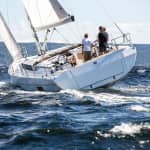
Warnemünde Week: British dominance in the Musto skiff
His father was proud, however, because his son's World Championship gold is part of an impressive series of victories. Sami Seliö said of his son: "Sisu is Finnish champion in the powerboat, the Opti and the Zoom8. And now also world champion." The two other world championship medals in the junior class went to Estonian Leon Zolotarjov and Dane Johan Gundborg. There were no German sailors at the start in the class dominated by Scandinavians and Balts.
The victories in the other championship classes on the second weekend were characterised by similar dominance. In the agile Musto skiffs, the British turned their European Championship into a national title fight with international participation. At the end, there was no doubt about the best: Eddie Bridle is Europe's new Musto skiff champion.
A year ago, the man from the south-east of England had to settle for sixth place behind his compatriot Jono Shelley at the World Championships. Now Bridle set the tone in the competition for the European Championship crown. With six wins and two second places in nine races, the helmsman from Brightlingsea Sailing Club on Great Britain's east coast relegated Jono Shelley (Largs SC) and Jamie Hilton (Dalgety Bay Sailing Club), who compete for Scottish sailing clubs, to the other places on the podium.
European champion! That sounds good, really good. I just tried not to make any mistakes." Eddie Bridle
At the German Open of the RS Aero Aero fleet, the Ukrainian Sofia was the woman who didn't waver: she also took a race win from her unblemished record of five first places. The experienced helmswoman is also active in the Olympic Ilca6 class. She showed off her broad sailing horizon at the Warnemünde Week.
When a race win is the string...
After a flawless series of five first places in the five races, she stood on the top step of the podium between silver medallist Marcus Walther (Langen) and bronze medallist Juliane Barthel from Dümmer-See. The power player had not only hoped for her success, but expected it.
"It went as it should," she said after returning to land and laughed. "We had four nice races today - first with very stable winds, then later with gusts and showers." She answered the question about her favourite boat class without hesitation: "RS Aero! It's simply more fun. The boat is lighter, reacts to every movement and gets planing faster downwind. Now I'm looking forward to the RS Aero World Championships in France. I want to sail for a medal there."
The finals of the Finn sailors, on the other hand, turned into a thriller. After the fleet had provided epic images on the Baltic Sea the day before, one of the closest decisions of this Warnemünde Week was made in Sunday's final. André Budzien from Schwerin lost out for the second time in a very short space of time. At the European Championships for OK dinghies, Budzien had just missed out on a medal in fourth place, tied on points with third place. In the Finn on Sunday, the Warnemünde Week victory slipped away from him on equal points with Fabian Lemmel. Budzien's overall all-round performance nevertheless remains outstanding.
Decision in the last race
His Berlin Finn opponent Fabian Lemmel, like André Budzien, each took two wins and a second place in the classification. The deciding factor was the final race, in which Lemmel crossed the finish line ahead of Budzien. "It wasn't a pure match race, but we kept an eye on each other and didn't let each other out of our sight," said winner Lemmel. He continued: "André was super fast on the downwinder. But on the last cross, I suddenly had a speed that I didn't even know where it came from."
Budzien was unable to catch up with Lemmel's lead by the finish. Fabian Lemmel's assessment of the Wanremünder Week was correspondingly happy, saying: "The conditions were good again today, with some slight twists. And the race committee did a great job." This final word was confirmed all round. All results of the Baltic Sea series can be found here.
From 5 to 13 July, the 87th Warnemünde Week proved to be a sailing series with many faces. The sunny and light windy start was followed by champagne conditions in the middle of the week, before heavy showers, high waves and stormy gusts took over. At the end of the week, the weather switched to reconciliation. The final day once again offered a full racing programme. Accordingly, a great deal of flexibility and a hands-on mentality were required throughout the entire series. The organisation team led by sports director Peter Ramcke also had to cope with some tense days.
Warnemünde Week: satisfied conclusion
The interaction between the regatta management, the individual teams on the courses and the classes was successful with a worthy programme for everyone. In total, Peter Ramcke and his crews were able to send 580 boats and around 800 athletes across the course for 85 races in eleven competitions. In the end, 13 of the 38 participating nations entered their names on the list of those taking home medals from the Warnemünde Week.
The sports director was completely satisfied with the outcome: "We started the week with the Ilca European Cup and the European Championships for OK dinghies at the same time. That was a real challenge, but it went fantastically well. The Warnemünde week ended very well with four classes on four courses. In between, we had some unusual stormy days for the summer. But that's part of sailing."
Looking back, Ramcke says it was "a great week with high-calibre participants". "And we mastered the weather conditions," said the regatta director. This also included switching to alternative courses to those originally planned. Ramcke: "We had to switch to the eastern courses because the wave conditions there were better for the sailors. That's what makes Warnemünde Week so special, that we have the flexibility to respond to the requirements of the sailors and the weather conditions."
After the Warnemünde Week: "almost ready for the Olympics"
The feedback from the participants confirmed the high calibre of the Warnemünde Week and the potential for major events. Peter Ramcke said: "The infrastructure is now so good that we are almost ready for the Olympics with a cruiser next door - to put it simply." With the International German Championships for the Olympic disciplines Ilca 7 and Ilca 6 as well as the IDM of the 29er with the European Cup, the host and the area are looking forward to further major events in October.
DSV President Mona Küppers experienced and observed the Warnemünde Week on site. Her summary: "It was fascinating to see the activity at the slipway in the morning. You wondered how you were going to get out of all the hustle and bustle. But it always worked out."
With the completion of the new state sports school, conditions have been created that the German Sailing Association is happy to use for its national base for junior competitive sailing. Mona Küppers said: "The conditions with the entire infrastructure play into our hands - with direct access to the fitness room and the large sports hall. The very short distances from the car park to get the boats into the water: That's a great thing. Plus the facilities to work through the training or regattas afterwards. That's perfect."
Two German sailing area candidates for the Olympics
From the point of view of the DSV President, who has just been at the Kieler Woche in the north of Schleswig-Holstein, Germany has two strong sailing areas to offer for a possible Olympic bid alongside one of the four national candidates Hamburg, Munich. Berlin and Rhine/Ruhr have two strong sailing areas to offer. Mona Küppers said: "We are convinced that it is possible to organise wonderful Olympic sailing competitions both here and in Kiel, which will satisfy everyone and after which everyone will go back to their home country and say: 'Oh, that was great in Germany'."

Tatjana Pokorny
Sports reporter
