


Rolex Sydney Hobart Race: A race like no other - "100 per cent worth striving for!"
Tatjana Pokorny
· 01.01.2026


The 80th Rolex Sydney Hobart Yacht Race once again proved that taking part in this 628 nautical mile Christmas classic is a gamble and the results are hard-won. Once again, the resilience and determination of the crews and the intensity of their preparations were put to the test. Not all of them passed. To finish first, you first have to cross the finish line - this well-known sailing adage was as true 80 years after the premiere as it was on day one. For 35 of the 128 crews that started, the dream of crossing the finish line in the Australian-Tasmanian regatta hit was shattered.
Rolex Sydney Hobart Race: brutal conditions at the start
The conditions were brutal, especially in the first 36 to 48 hours. Every weak point in the technical equipment or within the crews was attacked by the merciless sea. Metre-high wave crests caused the bow tips to shoot out of the water, only to be hurled back into their valleys shortly afterwards. More than a quarter of the fleet did not make it to the finish line. With this in mind, the winners of the race's two top prizes deserve as much applause as their many persistent pursuers. 93 teams made it to the finish line.
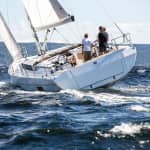
The Tattersall Cup for the victory in the IRC overall ranking after a strong performance and a protest hearing on land Jiang Lin and Alexis Loison with the JPK 10.30 "Min River". The Line Honours and the J. H. Illingworth Challenge Cup for the first boat to finish had previously secured the crew on the powerful 100-foot maxi "Master Lock Comanche". The Rolex Sydney Hobart Race has been organised by the Cruising Yacht Club of Australia (CYCA) in collaboration with the Royal Yacht Club of Tasmania since 1945. The Australian sailing event of the year has been supported by title sponsor Rolex since 2002.
Long-time participants know: No two editions of this down-under race are ever the same. The most recent edition at the end of 2025 could be described as a challenge in two acts: The tough start upwind, where crews had to cope with turbulent waves of three metres or more and survival was more important than speed, was followed by phases of often magnificent downwind sections along the east coast of Tasmania under blue skies.
The race of the two-handed crews
The fact that many crews would describe their race in far more detail and with far more variety than two sections also had to do with the respective positions in the field. Once again, the notorious Storm Bay and the Derwent River played their familiar games with the sailors, testing their skills and nerves in a variety of ways, while the wind blew stronger and weaker, frustrating and rewarding the participants regardless of the size of their yachts and their level of experience.
Only eligible to compete in the Rolex Sydney Hobart Yacht Race since 2020 and the IRC battle for the Tattersall Cup since 2022, this year it was the Doublehanded crews who sailed into the limelight in historic fashion: A total of 20 crews strong, the Doublehand fleet drew attention to their challenging discipline with outstanding performances. They did this especially in the second half of the race, when the conditions changed hour by hour in favour of the smaller yachts. In the end, seven sailing duos finished in the top ten of the overall IRC rankings.
In the final phase, this 80th Rolex Sydney Hobart Race came down to a duel between two duos and their rather small boats in the big race: the 10.30 metre (33 foot) long Australian "Min River" with owner and skipper Jiang Lin and co-pilot Alexis Loison, and the slightly larger JPK 10.80 "BNC - my::Net / Leon" from New Caledonia, on which former windsurfing world champion Michel Quintin and Yann Rigal were on the attack.
First woman lifts Tattersall Cup into the sky above Sydney
Both crews had sailed an almost perfect race and were not far apart with their corrected times after crossing the finish line. In the end, a sail setup on "BCN" that did not comply with the rules proved to be a stumbling block for Quintin/Rigalwho had to be satisfied with silver after the jury gave them a time penalty of 1 hour and 5 minutes.
Jiang Lin became the first female skipper to win a Rolex Sydney Hobart Race. In addition, "Min River" made history as the first overall winner sailed by a double-handed crew. Jiang Lin and her co-skipper Alexis Loison also formed the first two-handed mixed team to win the Christmas Classic Down Under.
We didn't think much in the first 48 hours, we were in survival mode until today, when the weather became friendlier as we sailed up the river." Jiang Lin
The opposite of the very rough conditions then presented Jiang Lin's team and many others with new challenges, as the winner reported: "The lack of wind was torture. Don't ask me how many sails we changed, how many spinnakers I packed."
Up and away in the finale: "Master Lock Comanche"
The five 30.5 metre (100 foot) maxis that made such a spectacular start to the Rolex Sydney Hobart Race on 26 December and raced down Sydney Harbour with their sails towering high above the water were also exciting. "LawConnect" was the first to reach the Sydney Heads before she plunged into the Tasman Sea. She was followed close astern by "Master Lock Comanche" and the smaller 27 metre (88 foot) "Lucky" in a remarkable third position. As a "reward", they were confronted with the stormy seas earlier than the rest of the fleet.
The 100-foot quintet had quickly become a quartet when a series of rigging problems forced the crew on "Wild Thing 100" to retire. While "Palm Beach XI" (ex-"Wild Oats XI", nine-time winner) was unable to repeat her earlier dominance and gradually fell behind the leaders, "SHK Scallywag" also had to contend with the harsh conditions, initially finishing fourth behind "Lucky".
A difficult transition zone awaited the race's gallopers as they crossed the Bass Strait on the night of 27/28 December. It marked the end of the strong southerly wind and the beginning of a more stable northerly wind. The leading maxis slowed almost to a standstill and were even briefly overtaken by the boats behind them.
Winning once is not enough for the Line Honours
For Matt Allen, co-skipper of Master Lock Comanche, the change of scenery felt like his team had to win the race twice this year. He was convinced that the most important decision was to stay close to the east coast of Tasmania. Eventually, the hoped-for wind came up from land. Then the experienced crew had left their pursuers behind and crossed the finish line as "first ship home" at 6 p.m. on Sunday, 28 December.
Jost Stollmann's Solaris 80rs "Alithia" crossed the finish line in 18th place. That was worth seventh place in the PHS (Performance Handicap System) division. PHS is a rating system that adjusts a boat's handicap over time based on its performance in regattas. The system is often used in club regattas. In the Rolex Sydney Hobart Race, yachts that do not have an IRC certificate will find a suitable racing group in this division. PHS does not require detailed measurements of a boat, but is based on the race results. The handicap is adjusted after each race based on the boat's performance.
At times, the "Alithia", developed for a circumnavigation, with which Jost Stollmann and his crew took part in a regatta for the first time, even had the bow lead in the PHS division. After ups and downs in the race, after 45 knots of wind in Storm Bay, in which the boat did not even run out of control, and after magical rides along the Tasmanian coast, a wind community caused a stumbling block, as crew boss and helmsman Arno Böhnert from Hamburg reported.
We could see the finish line, but we couldn't reach it." Arno Böhnert
It took "Alithia" an agonising two hours to cover the last quarter of a nautical mile. "Before that, we were still celebrating because we sailed up the Derwant River so cool. Then nothing worked. And it takes time for 55 tonnes to set off...", said Arno Böhnert after the race. He is certain: "Without the parking, we would have won our group."
Rolex Sydney Hobart Race: "super organised"
Despite a few hurdles, the A3 being blown up right at the start of the race and many other tests for the blue water yacht, Böhnert's assessment is positive: "The race offered everything that a great Rolex Sydney Hobart Race needs. It is a superbly organised race with an impressive number of volunteers. There is an incredible appreciation for this race."
When asked how worthwhile it might be for other European owners and their crews to take part in the Rolex Sydney Hobart Race, Arno Böhnert, who this time sailed the long distance on "Alithia" and for the second time in a team with his father Freddy Böhnert, said: "This race is 100 per cent worthwhile! These are once-in-a-lifetime experiences. It was a great experience for me to be able to compete in the race as crew boss and helmsman. There was a great atmosphere on board. Everyone pulled together. It was great fun."
Some have competed in the Rolex Sydney Hobart Race more than 30 times, others were taking part for the first time. Those who reached the finish line were among the winners, with or without a podium finish:

Tatjana Pokorny
Sports reporter
