


Project: Unusual self-experiment - taking part in a regatta on a low budget


One hundred or two hundred miles, 30 to 60 hours under sail, at night through shallow, current-rich water. The Vegvisir Race promises adventure - a special kind of shorthanded race. It leads across the Danish archipelago and demands endurance, strategic navigation and teamwork from the skippers. The regatta is organised by Morten Brandt, a pioneer of the shorthanded scene. He founded the Lyø Escape - and the Silverrudder, the most famous and largest single-handed race in the Baltic Sea. He is an institution for most German regatta sailors.
Also interesting:
It's the ideal offshore project for beginners - and that's exactly what the two YACHT editors Ole Puls and Fabian Boerger are preparing for. Their goal: to prove that offshore regattas are not just for big spenders and high-end racers. But that it is also possible with a small budget and an old boat. To this end, they want to get the best out of their "Slimöv", an Erria 25 built in 1972, during the upcoming season.
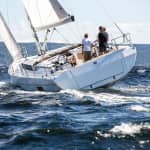
Both have been sailing since childhood. Both have experience on domestic regatta courses. But offshore regatta sailing? That's new territory in many respects. Until now, it was mainly dinghies, skiffs and catamarans that carried them across the courses. Fabian Boerger then moved on to the folk boat, while Ole has recently been sailing an X-41 or X-362. Now they are taking the reins themselves. The Vegvisir offers the ideal setting for this.
Vegvisir: Offshore adventure for beginners

The race, which takes place every year in late summer, is sailed alone or in pairs. It is modern, challenging - and beginner-friendly. Strategy, teamwork, endurance: the perfect learning and adventure project. The race starts in Nyborg, Denmark, in September.
Erria 25 is the complete opposite of a racing goat
In recent years, many performance cruisers have competed on the Vegvisir course: the Dehler 30 OD, the Seascapes 27 or older models such as the Scampi 30. The "Slimöv", the project boat, stands out in this field - but as the complete opposite of a racing goat. Built in 1972 by Bandholm Yachts in Ærøskøbing, the long-keeler is particularly impressive for its seaworthiness. The particularly thick laminate ensures rigidity - but also three tonnes of weight over a length of 7.95 metres. This is anything but conducive to speed.
Nevertheless, the Erria is the ideal choice for the project for both of them. An honest boat, accessible to many in terms of price. And, let's be honest: the best boat is the one that is available. That's the appeal. It's about the experience - and the ambition to get the best out of the boat and the crew. Because winning is not the goal. It's about being there - and the scoring reflects that: it's simply about sailing. Whoever crosses the finish line first wins. No ORC measurement for the price of a set of sails, no yardstick values. Arrive and experience an adventure - that's what counts.
Puls and Boerger document their preparations over several episodes. The aim: to optimise the Erria as effectively as possible and keep costs as low as possible. Together with YACHT experts, professionals and companies from the industry, they look for answers to the question: Where can a lot be achieved with little effort?
Details that deliver performance without costing much
The start begins in winter storage. There, the structure and equipment are put to the test. It quickly becomes clear that a different view of the hardware is needed for the regatta than for a cosy cruise across the Schlei or in the Danish South Sea.
Then it's into the water. The focus shifts to the moving and standing goods. The advantage here is that even small changes have a big effect. A splice in the sheet, a trimmed mast and the right markings on the spreaders and hollow points. These are small details that bring performance without costing a lot.
However, the sails have an even greater influence. They are often the Achilles heel of a regatta project. Buying new ones? Too expensive. Use old, profile-less cloths? A damper on fun and efficiency. So they end up on the table of a sailmaker who checks them out: What else can be done? What alternatives are there? How big and how cut should the spinnaker be?
The further the season progresses, the more often they take the "Slimöv" out on the regatta course. The two get help directly on board. Together, they learn how to get off to the right start with a sluggish long keeler and how to minimise supposed weaknesses.
Regatta sailing does not have to be a luxury or elite sport
Then there are the special features of the Vegvisir. What distinguishes a middle-distance race from the Wednesday regatta? How do you work on your endurance? How do you prepare for night sailing? What do you need to consider in the Danish coastal area?
The aim is to show in a practical way how to get started with little money. The project provides concrete tips and encourages people to follow suit. Puls and Boerger want to prove it: Regatta sailing doesn't have to be a luxury or elite sport. For them, it is an adventure that works with passion, courage and a small budget.
Do you have any questions, suggestions or tips? The team is happy to receive messages at mail@yacht.de

Jan-Ole Puls
Editor Test & Technology
