


Jules Verne Trophy: Eight proud women - Cape Horn has never been passed like this before
Tatjana Pokorny
· 06.01.2026


- Jules Verne Trophy: the third cape is done
- Cape Horn Passage: First performance by a crew of several women on a maxi trimaran
- Successful summit conquests: Everest, space, Cape Horn
- Non-stop circumnavigation: tough Atlantic voyage home ahead
- Wise at Cape Horn: six-time circumnavigator Dee Caffari
- Alexia Barries and Dee Caffari in a double pass
The Jules Verne Trophy can be won by Alexia Barrier, Dee Caffari and the women from The Famous Project CIC could no longer win in her current record attempt. The chance to do so was with the major problems early after the start on 29 November in the old year. Nevertheless, the eight sailors on board the "Idec Sport" decided to continue their non-stop round-the-world voyage, which had never before been completed by a multi-person women's sailing team on a huge multihull. This is their newly defined goal.
Jules Verne Trophy: the third cape is done
The Famous Project took an important step towards their goal on 6 January when their trimaran left the port side of Cape Horn. On Tuesday afternoon, Alexia Barrier, Dee Caffari, Annemieke Bes, Rebecca "Bex" Gmür Hornell, Deborah Blair, Molly LaPointe, Támara Echegoyen and Stacey Jackson passed the third and most famous of the three great capes on their non-stop round the world voyage.
It was a historic moment in the history of circumnavigations, as never before had an all-female crew sailed past the infamous Chilean rock in a non-stop race around the world in a multihull. Alexia Barrier's crew achieved this on the 38th day of sailing with almost 16,000 nautical miles in the stern water. This marked the start of the final Atlantic leg of her extraordinary journey. Even without the Jules Verne record (40 days, 23 hours, 30 minutes and 30 seconds, set in 2017 by Francis Joyon and his crew on the same "Idec Sport"), she can still experience her happy ending.
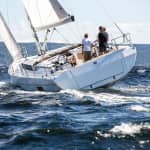
The women's dream of sailing around the world on a maxi multihull without stopping is taking shape. The last major Atlantic section towards the finish line at Ouessant is underway. In the generally calm Pacific, the women also had to overcome a period of heavy weather lasting around 48 hours with raging seas and wave crests eight metres high. With consistency and prudence, they achieved an impressive daily total of 550 nautical miles with an often unruly mainsail.
Cape Horn Passage: First performance by a crew of several women on a maxi trimaran
The last major milestone, Cape Horn, has now been reached. This alone is an outstanding achievement in the history of female circumnavigations. The Famous Project CIC represents the first crew consisting of 100 per cent female sailors to have passed Cape Horn without a stopover from Ouessant.
Only a few other women have achieved the Cape Horn feat in other constellations in the past. In the Vendée Globe, 13 women sailed solo, in the Barcelona World Race two, in the Golden Globe Race and in the Global Solo Challenge one each. Ellen MacArthur also showed her skills solo on large multihulls. Dona Bertarelli did the same with a mixed crew.
The sailors in The Famous Project-CIC team are proud of their achievement. Annemieke "Bessie" Bes from the Netherlands can now boast of being the first female sailor from her country to pass the famous Cape in the conditions described above. This is significant in her home country, as the Cape owes its name to the Dutch explorer Jacob Le Maire and his birthplace Hoorn.
Successful summit conquests: Everest, space, Cape Horn
A few more exciting figures about the Cape Horn achievements of the women from The Famous Project: 870 women have climbed to the summit of Mount Everest. 75 women have been to space. 25 women have passed Cape Horn on their courses. It remains an exceptional achievement. Skipper Alexia Barrier said on this special day at sea: "The emotion of passing Cape Horn is not the same as in 2021 during the Vendée Globe. It's just as strong, but different."
The Frenchwoman described the difference between her Vendée Globe experience and the present moment: "During the Vendée Globe, Cape Horn was a very intimate, almost lonely moment, characterised by fatigue, tension and individual responsibility. I had very bad weather and great fear. I cried a lot. Today, the feeling is deeply collective. It is shared. It shows in the looks, in the silence, in the gestures."
It is a shared Cape experience, with a close-knit crew, on a boat of extraordinary power. Loneliness has given way to an awareness of what we are experiencing." Alexia Barrier
Alexia Barrie also categorised the significance of the passage: "Passing Cape Horn means being accepted into a very exclusive circle. Few crews, even fewer female crews and absolutely no female crew on board a huge multihull travelling around the world at high speed have achieved this. This passage is a huge challenge. It requires extreme preparation, constant vigilance and absolute trust between the boat, the crew and the elements."
When you pass Cape Horn, you know that the hardest part is behind you. The South Seas, their isolation, their cold, their constant intensity mould the sailors and the community. That doesn't mean the rest is easy." Alexia Barrier
Alexia Barrier completed her Vendée Globe in 2020/2021 with the oldest Imoca in the fleet after 111 days, 17 hours, 3 minutes and 44 seconds, experiencing all the hardships of solo sailing. Now the crewed circumnavigation seems completely different, even if the team has to put up with a few low blows and still has one last tough Atlantic ride ahead of them, which can be tracked here.
Non-stop circumnavigation: tough Atlantic voyage home ahead
Alexia Barrier knows: "The North Atlantic in winter can be just as tough, unpredictable and challenging. But this cape marks a turning point. A stage where you feel that the crew has persevered, that the project is solid and that the adventure has entered a new phase. It is both a liberation and a transition. You can feel that something is opening up, that the horizon is changing. For The Famous Project CIC, this transition is both a symbol and an affirmation."
Alexia Barrier describes the Cape Horn passage as confirmation of "the total commitment of a dedicated international team and a unique project realised by women at the highest level in one of the most extreme environments in the world". According to Barrier, her crew has become calmer, more relaxed and more self-confident in the 38 or so days so far. The processes have been automated. Decisions are made more fluidly. Everyone knows their place, their strengths, their limits and those of others.
Her co-sailor Rebecca "Bex" Gmür Hornell said: "I was really excited about rounding Cape Horn. It's like the Everest of sailing, an experience that few people get to do, and I'm glad I can now tick it off my bucket list." Co-skipper Dee Caffari had already done this long before. The six-time circumnavigator was the first woman to circumnavigate the globe solo and non-stop in both directions in 2006 and 2009.
Wise at Cape Horn: six-time circumnavigator Dee Caffari
Caffari's reaction after the successful Cape Horn passage with The Famous Project sounded correspondingly wise. The Brit said: "Every crossing is unique and a blessing. I know that not all sailors who set off make it. When you do make it, it's special. I am lucky that every crossing has been very different for me. Alone, in a team, as a team leader, in the 'right' direction and in the opposite direction. This time I was travelling with a team of remarkable female sailors on a very special boat, and it took very little time."
"The south," said Dee Caffari on this Tuesday about the latest Pacific experience, "was very different from my previous experiences. It wasn't as hostile, but the sea conditions weren't always easy. On a maxi trimaran, the sea state is crucial. This machine just wants to go fast. So it was crucial to control it in difficult sea conditions. The other big difference is that this boat gives you the feeling of being far away from the sea when the freeboard is high. So it was less damp and cold than I remember."
In typical Dee Caffari fashion, she was particularly pleased for her younger team-mates, saying: "I am very happy for the newcomers on board, they are thrilled to have made this important step, and rightly so, because it is a remarkable achievement. The difficulty is that there are still 7,000 nautical miles to go to the finish line and the Atlantic can be cruel. It's important to stay focussed and diligent in the final miles, even if we want to complete the leg with more confidence and speed."
Alexia Barries and Dee Caffari in a double pass
On the double pass between Alexia Barrier and herself, Dee Caffari said: "I think Alexia and I work well together and have the boat well under control. We are also more confident about the configuration and steering. As is often the case, now that we've travelled all these miles, we're better prepared to go full throttle!"
Info for fans of the Jules Verne Trophy: Behind the women from The Famous Project, the French Ultim team on "Sodebo" is actively fighting for the record. Compared to the "Idec Sport" best time from 2017, Thomas Coville and his team were again around 130 nautical miles ahead of the record holder on 6 January on the Point Nemo course. Click here for the Team Sodebo live tracker.
Women at work for The Famous Project! On board with the female sailors - the direct transmission from the "Idec Sport" on 6 January:

Tatjana Pokorny
Sports reporter
