


Jens Kuphal knows how to deal with setbacks. As manager of Offshore Team Germany, he had to cope with breakages at the start of the last leg of The Ocean Race two years ago. Now he has to show his resilience again.
As the owner of the XR 41 "Exciter", the 62-year-old is characterised by a time penalty decided by the Offshore Racing Congress (ORC) at its General Assembly in early November. It would foreseeably deprive Kuphal's crew of any chance of a podium place in high-ranking regattas in the coming season.
Read more background here:
At the ORC World Championship held in Tallinn in August, the team came fourth at the first attempt; with the malus now introduced, 5th place would have been possible at best. He considers the correction of his race value and its justification to be questionable. "If it stays like this, we won't be able to beat even older designs on the cross in light winds."
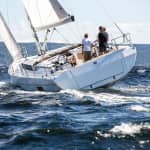
For the extremely experienced skipper, who won the title of ORC European Champion in 2022 on his Landmark 43 "Intermezzo", this is not the first time he has been penalised in the rating. When switching to the current ORC calculation method in 2023, he already lost up to 12.5 seconds per mile with his old boat compared to a ClubSwan 42 that was practically as fast on the water. At the time, the International Technical Committee of the ORC, or ITC for short, simply brushed aside any doubts about the accuracy of the race rating and did not respond to well-founded criticism.
Error in the rating or in the system?

Spiral of escalation set in motion
This could now backfire on those responsible in the association. At the end of November, a storm of indignation broke out on social media that could damage the reputation of the measurement system as a whole. The reason: all of the XR 41s that started at the World Championships in Estonia, although they were measured according to ORC without any complaints, were assigned correction factors for the 2026 season - especially the world champion boat that started for X-Yachts under skipper Jesper Radich and dominated the event with a near-perfect series.
The Technical Committee took the results in autumn as an opportunity to re-evaluate the rating and the parameters that flow into the ORC-specific velocity prediction programme (VPP for short). The assumption was that X-Yachts might have found a loophole. So far, so usual. What followed, however, was an escalation spiral on several levels that is likely to continue to have an impact for a long time to come.
I. The X-factor
With the XR 41, the ITC did not hit just any Class B yacht and not just any shipyard. The time penalty was imposed on what has long been the most ambitious regatta project of the Danes, who are among the most renowned boat builders in the world. From the announcement in 2023 to the World Championship triumph last August, the team around CEO Kræn Brinck Nielsen never left any doubt that the motto "From Vision to Victory" was meant literally: full commitment, maximum focus, no compromises.
X-Yachts spent around 2.5 million euros on the ambitious mission - several times the usual development budget. In order to be able to use the boat for more than just regattas, the shipyard designed a modular interior that can be quickly dismantled. The hull shape, with its full foredeck, strongly tapered waterline and almost V-shaped transom aft, has an ultra-modern, even radical look. A design that conveys surgical precision on the wind, but at the same time has full planing ability.
The Danes also set standards in other areas, such as crew triage. Even the development and optimisation of the sails, which North Sails took on, was carried out at Grand Prix level.
The result was impressive: the 2025 shipyard team competed five times in prestigious ocean races, including Kieler Woche. It won silver five times. In the end, the World Championship victory seemed almost inevitable - even if the XR 41 had not yet sailed as superiorly in the spring as it did in Tallinn. She proved to be particularly challenging in light winds.
However, this did nothing to change the "Formula X's" impeccable record, which is also reflected in its commercial success: The shipyard sold two dozen boats in its first year despite an otherwise sluggish economy. A fairy tale, really - until the ORC's general meeting at the beginning of November.
II The ORC dilemma
The watchdogs of ambitious ocean sports found themselves in a tricky situation. Should they let the success of the XR 41 rest on its laurels and leave the rating unchanged? Or should they contain its superiority in order to maintain a level playing field?
There would have been enough good reasons for both options. In previous years, for example, the ORC did not consider it necessary to impose a handicap on the Grand Soleil 44, even though it had won four consecutive world championships. But why then the XR 41? Just because its design is more innovative? That is one, the most fundamental form of the dilemma facing the members of the ITC. The technicians decided in favour of capping the dominance, although there was not even a formal application for this.
The other dimension is political - and not very sporting. It can be described as a North-South conflict in the dispute, largely fuelled by the Danish sailing media. The media have raised the suspicion that Matteo Polli, designer of the Grand Soleil 44 and other highly successful ORC yachts, exerted his influence in the decision-making process.
Polli has a seat on the Technical Committee and is said to have campaigned vehemently for the re-evaluation of the XR 41. It would be a veritable conflict of interest. Several sources confirmed to YACHT that there is evidence of the alleged lobbying. However, the Italian designer flatly denied such speculation to YACHT. "I am rumoured to be an opponent of the XR 41, but that is simply wrong. My only interest is to ensure fair regattas, because that makes the sport attractive to more sailors."
The minutes of the ITC meeting show no evidence of Polli exerting any influence. And yet the introduction to "Annex XR 41" is surprising. It states, as if in a kind of early justification: "Any irregularity detected during the season may trigger an investigation to determine whether a boat is performing better or worse than its polar data. The aim of the ORC, through the work of the ITC, is to ensure fair assessments for the fleet without favouring any boat or design feature."
III The curse of complexity
However, the association got really tangled up when it came to determining and justifying the time penalties. The ITC used a comparison with the older X 41 One Design, which also had several boats at the start of the World Championship. Seven of them ended up in the top 20 of the overall standings; the best one in 6th place.
"The XR 41," it says in summary, "is around 30 centimetres longer, has around 12 square metres more sail area on the wind and a 20 to 25 percent higher righting moment at a heel of 20 degrees. Despite these values, she should sail slower than the X 41 at a wind speed of 10 knots on the cross according to the ORC rating." As plausible as it may sound, such a demonstration by example does not necessarily have any evidence.
The ITC nevertheless concluded that something could be wrong with the calculation process. In other words, X-Yachts had found and exploited a blind spot in the ORC measurement algorithm during the development of the XR 41. This is not inadmissible; all designers have always looked for loopholes. However, it does justify corrections under certain circumstances.
"When we literally left everyone else standing on the last leg of the course downwind at 16 or 18 knots, I thought there would be repercussions!" Jens Kuphal, XR-41 owner
In this specific case, the technical committee identified the method for calculating the residual resistance as the cause of the rating, which it considered to be too favourable. The ORC uses artificial intelligence for this and employs three neural networks that were previously calibrated with training data for no fewer than 14 relevant parameters. A highly complex process. Until 2022, the association had calculated the race value from just three parameters.
The new system should enable greater precision, an even better recording of the performance potential of all yachts. However, there was a lack of reference values for a boat like the XR, which is quite heavy on the one hand, very fast on the other and whose design differs considerably from the majority of the market.
The fullness in the bow in particular increases her waterline area. The so-called Coefficient of Water Plane Area (CWPA) is significantly higher than usual. As a result, the neural networks cannot provide reliable projections for the residual resistance, which falsifies the speed predictions. Jason Ker, himself a renowned designer and ITC member, speaks of "unknown territory" for AI. Because the neural networks cannot work properly without reference points, they rely on estimates. Instead of valid resistance values, they produce "hallucinations", says Ker.
This seems logical - but also surprising. After all, Max Gurgel, himself a physicist and yacht optimiser, had already pointed out this flaw to the ORC in 2023 when the advanced AI calculation method was introduced. At the time, his well-founded analysis received little attention.
And even now, the Technical Committee only partially agrees with his reasoning. The Kieler had used several examples to demonstrate that the aberrations of the neural networks by no means only affect boats that are clearly outside the norm. Even for more conservative designs such as the Grand Soleil 44 or the ClubSwan 42, there are sometimes considerable variations between the different neural networks.
"On a typical ORC short course with two up-and-downs, the correction factor selected by the ITC adds up to at least 40 seconds per race. That's a lot!" Max Gurgel, optimiser
If you follow Gurgel's reasoning, the ORC wanted to do the right thing by expanding the calculation parameters, but chose too simple a way to master the complexity it had chosen. The Kiel native, who was also involved in the development of the XR 41, is an ORC fan at heart. He is impressed by the science-based formula and the general approach. He was all the more irritated by the ITC's simple "fix".
According to this, strongly deviating values such as the fullness index should be adjusted more or less arbitrarily instead of fundamentally validating the forecast quality of the neural networks. The procedure is more reminiscent of Yardstick's pi times the thumb approach than an elaborate measurement formula.
In the end, those responsible at the ITC also realised that they were violating the principle of scientific rigour they had propagated themselves. They therefore brought forward the fundamental review of the parameters for VPP creation originally promised for 2026 to December. The concern about the good reputation to date was apparently too great. However, the results of the validation were still pending at the time of going to press.
IV. The collateral damage
What has been labelled the "XR-41-Gate" of the ORC in reference to the Watergate scandal actually has a much larger dimension. On the one hand, other boat types are also affected by the time penalties. These include the Judel/Vrolijk 43, for example, in whose development formula constraints played no role whatsoever, or Beneteau's new First 30, last year's best-selling performance cruiser. Some of their owners and designers have also already submitted requests to the association's management committee or are preparing to do so.
But there is another, more fundamental aspect. According to Jens Kuphal, the debate is damaging "to ocean racing in general". Instead of allowing innovation and keeping regatta sailing attractive and up to date, the formula organisers are risking a further drop in the number of entries. "That can't be right!" He himself is combative, regardless of the pending correction of the race values. Kuphal wants to find his fortune in long-distance regattas next season.

Jochen Rieker
Herausgeber YACHT
