


Cape to Rio Race: "Vineta" takes line honours, Cape Town youngsters strong
Tatjana Pokorny
· 13.01.2026


The Cape to Rio Race is still ongoing for the smaller boats, but Felix and Wolf Scheder-Bieschin and their crew reached the finish line off Rio de Janeiro on 12 January. After 16 days, 7 hours, 44 minutes and 15 seconds, they were the first to finish the classic race with their family yacht "Vineta".
Cape to Rio Race: Line Honours for GER boat
At the brothers' side: Felix Scheder-Bieschin's son Theo, who lives with his family in Cape Town and is also active in the 49er and J-Boat class in South Africa. In addition, the young South African Ilca-6 and J-120 sailor Olivia Purchase and the South African navigator Nick Leggatt, who is competing in the famous long-distance race from Cape Town to South America for the twelfth time.
This year's field was small, but fine. As the "first ship home", the "Vineta" quintet received a very warm welcome in Rio de Janeiro's Guanabara Bay after more than two weeks at sea. Here, where Olympic sailing medals were fought for in 2016 and Erik Kosegarten-Heil won the first of his two bronze medals in the 49er with Thomas Plößel, the German team with South African reinforcements was now applauded.
For Felix Scheder-Bieschin, who has lived in Cape Town since 2001, crossing the finish line meant not only being happy about the successful race with family and friends, but also making amends. Before the start, he had said: "The race was always on my bucket list. I had a failed attempt in 2009. So I have unfinished business." At the end of the race, it was "a very touching moment" for him to cross the finish line of the Cape to Rio Race and run into Rio de Janeiro.
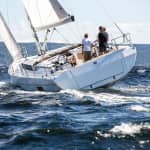
The race was great! We had the spinnaker up for 3500 nautical miles and never had to sail downwind." Felix Scheder-Bieschin
The sister ship of Mathias Müller von Blumencron's fast J/V 43 "Red" - theHere is the YACHT report on the "Special Boat" from February 2024 - built "Vineta" is made for transats, long trips and downwind fun. "These downwind routes are ideal," said Wolf Scheder-Bieschin directly after the Cape to Rio Race in the Brazilian metropolis. And also noted: "We had a really good race!" "Vineta" was 13 hours and 19 minutes faster than the "Haspa Hamburg", which finished the course six years ago as the fastest monohull yacht in the race.
Decision in the ORC overall standings still open
According to Wolf Scheder-Bieschin, it took his team two seasons to bring the boat to its current state. "Now we've only had to deal with a few little things. The boat has performed superbly." In the ORC classification, "Vineta" was initially in second place the day after crossing the finish line. The Oster Lightwave 39 "Alexforbes Angel Wings" still had around 460 nautical miles to go in the Cape to Rio Race on the afternoon of 13 January and was in first place in the overall ORC rankings.
Here it goes to the tracker, here to the intermediate results.
At the latest when "Alexforbes Angel Wings" crosses the finish line, the battle for overall ORC victory will be decided. Until then, the "Vineta" crew can enjoy Rio in air temperatures of around 40 degrees and review the race. Or - as happened on Monday - show double Olympic champion Robert Scheidt and his family the boat.
Wolf Scheder-Bieschin's race summary is a happy one: "We had such a picture-book Cape to Rio Race, just as it has always been: you always have a lot of wind around Cape Town at the start. We had that too. And then at some point you're in the trade winds. You have to manoeuvre around the high, you can't get too close because you don't want a lull. If you head north, you have more wind, but you're sailing a diversion. You have to be a bit tactical. I think we did that quite well."
Cape to Rio Race: Final spurt with oil rig slalom
The finishing straight of the Cape to Rio Race remains a glowing memory for the "Vineta" crew. Wolf Scheder-Bieschin says: "There was a lot of pressure at the end. That was cool. It was another really fast downwind reach. There are these hundreds of oil rigs off Rio, really incredible. It's super bright, looks like a big city from a distance. You have to wind your way through it."
Navigator Nick Leggatt "ate his way into the data" and also benefited from the Starlink options. "We didn't leave it running all the time, but just switched it on when there was a new weather report. If you want, you can be connected to the world 'real time' on the high seas," said Wolf Scheder-Bieschin.
First held in 1971, the Cape to Rio Race has always started in Cape Town in more than half a century of history, but has also travelled to South American ports other than Rio in between. The course to Rio is particularly popular because it offers enjoyable downwind racing. This year, the fleet was smaller than usual with twelve boats, but this did not detract from the quality of the racing and the participants' passion for the classic.
Overall ORC victory for a funding project with "angel wings"?
This Cape to Rio Race was also organised by the Springbok Ocean Racing Trust and the Clube de Rio de Janeiro in collaboration with the Cruising Association of South Africa. South Africa's sailing community appreciates the race - and also uses it to promote young talent. For example, the crew on "Alexforbes Angel Wings" is made up exclusively of students from the RCYC Sailing Academy.
After the success in 2023, when the "Alexforbes ArchAngel" with skipper Sibusiso Sizatu sailed to third place, the sponsor enthusiastically stayed on board. The RCYC Saisling Academy is committed to giving young people from disadvantaged communities opportunities in sailing and enabling careers in the maritime industry. The students train throughout the year on the "Alexforbes Angel Wings" and are involved in the ongoing race on the twelve-metre boat with the sail number SA 1178 with a mixed crew.
On "Vineta", 19-year-old Theo Scheder-Bieschin and 18-year-old Olivia Purchase formed the ambitious "junior section" of the team. Both talents want to become yacht masters, which is why the crew even had a sextant with them in the Cape to Rio Race. The almost 3700 miles sailed also help.
"Vineta" crew plans Baltic Sea summer season
The crew also experienced a lot of wildlife, especially in the early stages of the race, but less so on the course to Rio. "There were so many whales, seals and dolphins off Cape Town that you hope you don't see any. In between, we saw fewer birds and fish. Even experienced participants noticed this," reported Wolf Scheder-Bieschin from the North German Regatta Association. Flying fish, however, were out and about as usual.
The Cape to Rio Race from east to west across the South Atlantic remains one for the bucket list, a demanding challenge with plenty of sun and sporty winds due to the distance alone. "It would be nice to see larger fleets again in the future, but it was a lot of fun," says Wolf Scheder-Bieschin. He knows that it is not easy to get boats back to Europe from Rio.
"Vineta" will be transferred back to Cape Town by the majority of the crew in about a week. The boat should then be back in Kiel around the beginning of April to take part in Baltic Sea regattas. The exact regatta schedule in the home waters is still being finalised. "We haven't finished planning it yet, but we want to do a few races, a Baltic Sea programme. Maybe the Baltic 500, Round Skagen or the new race from the KYC (Red.: 400 Islands Race)", Wolf Scheder-Bieschin thought aloud in Rio de Janeiro for the time being.
The Cape2Rio Race was also advertised with this clip before the start:

Tatjana Pokorny
Sports reporter
