


Blueribboncup: Baltic Sea offshore racing at its very best – “It was incredible!”
Tatjana Pokorny
· 07.09.2026


This year, the Blueribboncup offered its challengers everything an offshore sailor could wish for: On the water, the crews of the 31 participating boats were put through their paces on the route from Kiel to Aarhus and back in all kinds of conditions – they had to overcome periods of calm as well as 40-knot winds. Thrilling battles for position were included. A warmly organised onshore programme provided a welcome change of pace in between.
Blueribboncup: a gentle start, a thrilling return leg
This late summer, the outbound leg of the regatta was characterised by rather light winds. Particularly in the Little Belt and over the final few nautical miles, patience proved to be a virtue. A prolonged calm zone just before the finish line meant that numerous yachts were virtually stuck in one spot for quite some time. For two teams, it actually came down to the wire: they missed the time limit and could no longer be included in the results.
Dr Gerhard Clausen’s Maxi Dolphin 75 ‘Calypso’ was the first yacht to reach the finish port of Aarhus. With this achievement, the crew secured the 1970 Helmsman’s Prize for the first yacht to cross the finish line in the Kiel–Aarhus race. Victory in the ORC classes went to Daniel Baum’s beautiful custom-built ‘Elida’ (ORC 1) and Tobias Brinkmann’s Pogo RC ‘MarieJo’ (ORC 2), relegating Kai Greten’s one-tonne yacht “Oromocto” and Lorenz Jensen’s JPK 10.30 “Rentnerbank” to second and third places respectively.
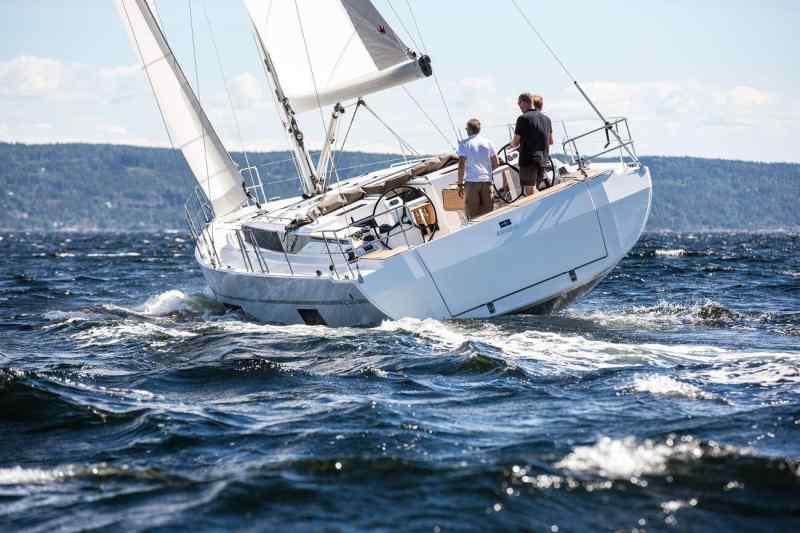
In the lighter conditions of the outbound leg, the two fast J/V 43 sister yachts, “Vineta” skippered by Wolf Scheder-Bieschin and “Red 2” skippered by Mathias Müller von Blumencron, competing in ORC 1, were unable to catch up with “Elida”, which was awarded the Aarhus Trophy, nor the second-placed Carkeek 47 “Störtebeker”, skippered by Cosima Cramer. “Red 2” sailed into third place on the Aarhus leg, whilst “Vineta” finished sixth behind Ralf Lässig’s ever-faster XP 44 “Xenia” and the Solaris 50 “FaJu”, skippered by Fabius Müller-Kauter.
The wild ride back: lost a tooth, gave up altogether, or enjoyed the wild ride
The crews used the short break in Aarhus to go on brief explorations around the city. The hot dog welcome in Aarhus, the Danish breakfast buffet the following day and, above all, the fully booked joint BBQ following the prize-giving ceremony on Friday evening brought the sailors together in high spirits before their focus shifted back to the return race. “The Danes and the KYC crew really went all out. It was unique,” enthused Mathias Müller von Blumencron – and he wasn’t the only one.
The return leg presented a completely different challenge to the outward leg. Exactly the other way round to two years ago, the Baltic Sea was now showing its teeth. Strong, at times stormy winds demanded the crews’ full concentration and sailing skills. Just how harsh the conditions were at times was illustrated by a rather unusual incident on board a yacht, where a crew member lost a tooth. Another participant even decided not to start in view of the forecast conditions, setting off on the return journey on Friday under their own steam.
On the return leg, in significantly rougher conditions in ORC 2, the crews on the “Rentnerbank” and “Oromocto” – who were once again in fine form – swapped places on the podium. The winner remained the same: “MarieJo”. The second leg of the Blueribbon Cup race in ORC 1, which was tough at times, ended differently. In the crisp winds, the strong crews aboard the just-under-three-year-old 43-foot Judel/Vrolijk ‘rockets’, ‘Vineta’ and ‘Red 2’, were now able to play to their strengths. Click here to see the results of the 2026 Blueribbon Cup.
"It was incredible to see what the boxes can achieve." Mathias Müller von Blumencron
“Vineta” skipper Wolf Scheder-Bieschin, “Red 2” skipper Mathias Müller von Blumencron and their crewmates particularly enjoyed the close, evenly matched contest. Joining Wolf Scheder-Bieschin on board were Lennart Burke, Julius Hornung, Albrecht Müller von Blumencron (brother of Blueribbon Cup rival Mathias Müller von Blumencron) and Kai Kersten. On “Red 2”, Globe40 round-the-world sailor Lisa Berger, Florian Weser and Klaas Simon were alongside their skipper.
Pure racing excitement in the Blueribbon Cup
Both crews revelled in the sheer joy of racing, just as they would on modern Class40 racers, only with boats three feet longer. “Whenever we saw ‘Vineta’ flying, we flew too,” said Mathias Müller von Blumencron, describing the top-level duel. “When the wind picked up, we were sailing at 18 to 21 knots,” said the “Red 2” owner, who recorded a top speed of 25 knots.
The “Red 2” crew reported “tricky conditions” and 40-knot winds off the southern tip of Alsen. With two reefs, the staysail and jib-top set, they sped past this stretch. ‘Vineta’ remained on the first reef during this phase. Earlier, the cover on the mainsheet had come off. Reefing any further would have been correspondingly difficult. “Vineta” helmsman Lennart Burke, who was sailing with Wolf Scheder-Bieschin on his boat for the first time, later remarked with a smile: “I think we were also looking for excuses not to reef. I reckon we wouldn’t have reefed anyway.”
"The Blueribboncup was great fun, with fantastic conditions and that Class40 atmosphere. That’s what it’s like when identical boats are battling it out all the time." Lennart Burke
The varied conditions meant that the strengths of different types of boat were once again clearly demonstrated at this 27th edition of the Blueribboncup. When asked whether the ORC system had worked fairly, Mathias Müller von Blumencron said: “I found it astonishing. We’d braced ourselves for the worst; we thought we’d never win a prize again after the measurement rule change in the winter. I think it was fair.”
Huge turnout for the Blueribboncup
From an organisational point of view, the organisers faced not only many enjoyable challenges but also a difficult one this year. For the first time, they had to limit the number of starters. Capacity constraints at the finish port of Aarhus and the high number of fully manned crews meant that not all registered boats were able to take their place on the starting line.
“Of course, it’s not easy for us to have to turn away loyal participants. At the same time, we’re delighted by the huge interest in the Blueribboncup. It shows that the regatta’s family-friendly concept has stood the test of time,” says head organiser Ecki von der Mosel following the final of the most recent edition.
Book recommendation
Regatta sailing explains strategy and tactics for all phases of a race – from preparation through to the start and the subsequent analysis. This makes the book a perfect fit for the Blueribbon Cup, where early decisions, battles for position and reliable teamwork were key to success. The checklists and clear illustrations help readers to systematically review their own regatta performance.

Tatjana Pokorny
Sports reporter