


We're about to reach the buoy and the wind is blowing at 24 knots. The boat is travelling over seven knots on the waves!" That's the message from fellow sailor Esther, which brings my time in the bunk to an abrupt end. Although: "Seven knots is good, after all, this is a regatta," is still going through my head. But it doesn't help. The wind is slightly more astern than half, so we sail into the wind on the subsequent counter-course. A 150 per cent genoa and full main are too much. "I'm coming!" I call back sleepily.
After an exhausting night, I had navigated "Valentine", a Contest 29, built in 1967, onto a long rake. Rakken is the Dutch name for the courses between the buoys on the IJsselmeer and Markermeer, the Wadden Sea and the North Sea, where the race takes place. Two hours straight ahead. Two hours of sleep for the skipper. At least. Now I get into my dungarees and boots and watch the whole thing from the companionway. Fellow sailor Frank suggests the high-aspect jib. But it needs a lot of wind and high courses. "We take the 125 per cent genoa. If that's too much pressure, we'll reef the main," I decide and then make my way to the foredeck.
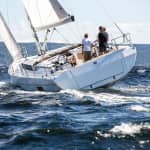
After a short, intense wrestling match in a cramped and also very moving area, the cloth is lashed to the railing waiting for its next use. Not a second too soon: the buoy is coming. "We're going round!" we hear from aft. Shortly afterwards, we set the smaller genoa. Okay, but the boat is travelling with too much pressure. So: reef the main. We wanted to avoid 22 knots of wind. "Valentine" is not exactly fast in the steep IJsselmeer waves. And besides, I don't want to put her through that kind of counter-bolting again. But now we have to get through it. Or do we?
Without further ado, we abandon the plan of travelling the old course in the opposite direction again. Instead, we choose a different waymark, one that lies before Stavoren. That's 15 degrees less height. The ship is already running. All that remains is to enter the rounding of the buoys on the organiser's website and we can continue.
Good atmosphere on board
It's a good seven miles to the waypoint. Time to eat something. The organisers recommend having meals ready in advance. For us, that means bananas, biscuits and cola. Making coffee is out of the question. The waves and heeling are too strong. Nevertheless, the atmosphere on board is good.
It is now Saturday lunchtime. We had set off the day before at half past six in the evening from Lemmer together with five other boats in order to reach the 24 uurs zeilrace to sail. This is the largest sailing event in the Netherlands and is held annually on the last weekend in August. The aim is to sail as many nautical miles as possible in 24 hours on specified routes around existing buoys.
The remaining 340 participants have chosen other starting locations. Skippers can choose from 13 starting locations around the IJsselmeer and Markermeer and, this year for the first time, on the Wadden Sea. The finish, on the other hand, is fixed and is always in Medemblik on the western shore of the IJsselmeer. There you have a time window of one hour within which you can cross the line. If you arrive up to a maximum of 60 minutes late, you will receive a time penalty. Those who fail to do so will not be counted. The first rake from the start and the last rake to the finish are mandatory. Everything in between can be freely chosen, but each route can only be sailed twice.
A challenging long haul
58 years ago, the idea behind the regatta was to entice cruising sailors from the IJsselmeer and Markermeer to take part in a challenging long-distance race. At that time, there was no electronic navigation and a battery that could power a three-colour lantern at night was considered high-tech.
Nowadays, the 24-hour regatta has become a lot more professional. The focus is on tactics: who chooses the best rakes in order to have the most miles on the log at the end? The organisers' recommendation is seemingly simple: "It's best to sail half-wind courses for 24 hours!" But the reality is different. No wonder there is now even dedicated routing software for the race.
We have set ourselves the target of leaving at least 100 miles in our wake. This much in advance: with 116.1 miles sailed in 23.5 hours, we will exceed our self-imposed target.
Start at the24 uurs zeilracewith little wind
The half wind didn't work out at our start in Lemmer. At first it was blowing weakly from the north-north-west. That was the forecast. However, another starting point was out of the question for us, as we could only make the journey to the boat on Fridays after work.
And so the first beat on the wind took us out of the bay of Lemmer to buoy SB 40. No problem for "Valentine", which was built just two years after the first edition of the 24 uurs, she runs excellently on smooth water. So much so that we initially sail higher and are almost as fast as a Dehler 36 that started with us.
"Wow, the boat is sailing really well! I didn't expect that," says a delighted fellow sailor Phillipp, who normally sails a half-tonner. "Valentine" has been improved a little over the years, strengthened here and there, a longer boom rigged for more mainsail area, good running rigging and a few trimming toys purchased and a rotary blade propeller fitted. All this gives the aged lady wings. Incidentally, it doesn't harm the rating. In the tour class in which we compete, only the waterline length counts.
Overtaking irrelevant for the result
We actually overtake another participant before the first barrel. This lifts our spirits, but is completely irrelevant for the result. Nevertheless, it's good for the feeling we start the night with. When we arrive at the first buoy, things are going so well that we decide to continue sailing due west in view of the north-westerly wind. After all, the wind is expected to shift from west to south-west at around one o'clock that night.
Knowing that weather forecasts are always a tricky thing, it is now important to position yourself in such a way that a turn does not mean suddenly getting stuck somewhere and having to cross or sail particularly deep courses. Tricky. At the SB 28, we also change our "westward plan". The tactical consideration: If the gybe comes to the west, the next possible SB 18 would be a good place. But if not, we would have to sail very deep to get away from there. As we are travelling without a spinnaker, this is not an option.
We finally decide in favour of the KG buoy. We fly towards Enkhuizen with half the wind. It gradually gets dark on the way. Frank is the first to turn in. We don't have a watch plan. Nevertheless, it's important that someone goes to bed in time to be fit when it counts. It's good to have fellow sailors like Frank who can go to sleep at any time and on command.
Weather update after midnight
With every weather update, the forecast wind shift moves backwards. But as long as it's still blowing from the north-west, we want to stay in the south of the IJsselmeer. We decide in favour of some of the shorter rakes available there. When the weather forecast announces at midnight that it won't turn until four in the morning, we have to make new plans. The wind is now blowing from the west-north-west, but the northerly component remains. That's why we now take a long southerly course towards Lelystad.
This initially goes against my gut feeling, because there is a lack of options in the south-east corner of the IJsselmeer. You have to go back the same way. Nevertheless, we take the bet. Because if anything, the wind turns in our favour. Flying southwards with a low half wind is an idea that many other crews seem to have. On the way out, it's still fine, as we sail over the port bow. On the way back, however, it gets pretty tricky: lots of traffic on the exact opposite course. Esther is constantly watching under the genoa on the lee side as the colours of the oncoming traffic change. "Go through to port!" Or: "It stays, but it fits!"
At this point at the latest, it becomes clear why the organisers insist so vehemently on the tricolour lantern. They have to be switched on at the start, otherwise you are disqualified before you even set off.
In the middle of the night, a large Lemsteraak overtakes us. On certain courses, these flat-bottomed monsters with their huge sails and powerful centreboards are really fast. What they are not: particularly manoeuvrable. At first we hear a loud roar from astern, then she boards past us. Far too close for my taste. The flat-bottomed crew probably think so too. There is a roar and we are blinded with a giant spotlight - unpleasant! Fortunately, the steel rams pass us quickly.
Usual discussions about tactics
And then the wind actually starts to pick up. At the next buoy, it's two o'clock at night and I'm too tired to make any valid decisions. Frank takes over. Half asleep, I overhear the usual discussions about tactics. "The crew are doing a great job," I think before dozing off. When I finally get up again, they have skilfully used three shorter rakes on the wind to get to Enkhuizen. Easy cruising on predetermined courses. Ideal.
The wind has finally moved to the south-west. I take advantage of the long northward leg towards the Afsluitdijk to take another nap until, yes, it blows too hard. The decision to head north downwind to Stavoren turns out to be absolutely right. From there, three full-throttle half-wind rakes follow. The miles are tumbling. However, a new weather forecast announces that the wind will drop sharply around 5 p.m. after a few thunderstorms.
Frank and I are immediately reminded of a race a few years ago. Back then, we were also travelling with "Valentine" and had made good tactical decisions. However, a thunderstorm just before the finish took all the wind with it. Together with 180 other participants, we drifted helplessly along until the clock finally ran out.
The spirit of the24 uurs zeilrace
Sailing friend Klaus from Cologne faced a similar threat this year: "We crossed the finish line just six minutes before the end of the race. We got nine minus miles for that. Anyway, it was still fun." Especially as his Contest 40 "Thalatta" is not a racer. "Perseverance, that's what counts!" says Klaus. For most of the participants, this is exactly what makes the spirit of the 24 uurs so special.
This year too, the storm claims victims. However, not because of a subsequent lull, but because the material could not withstand it. For a crew of two on an FF 6.50, a waterspout that suddenly formed in the storm shaves off the spinnaker and mast. The sea rescuers bring the crew and ship into the harbour.
The organisers have one last piece of advice: you should keep the short rakes before Medemblik open as a buffer before the finish. And so we round buoy WV 19 towards KR-A. Half wind again. The plan: if the wind holds out, round the KR-A and back to WV 19, but if it drops, we can sail straight to the finish instead. That's what the rules say.
The wind remains, we put all our eggs in one basket: but the last rake turns into a cross. And now, of all times, the air slows down. We should actually switch to the large genoa. But that costs time. Will we make up for it on the last short stretch? We give it everything we've got, seek pressure and tack a lot. We cross the line at 18:07. 23 minutes earlier than would have been possible without penalty miles.
In the end, our 116.1 miles were enough for 27th place out of 56 starters in our group. Solid midfield. We are happy when the bell rings. That was a great 24 uurs: not too much and not too little wind. Tactically demanding. A great crew. And plenty of miles on the clock for such an old and actually rather slow boat. After crossing the finish line, there are four clicks and hisses on board. A well-deserved beer.
Party atmosphere in Medemblik
Then it's time to lower the sails and take out the fenders! Together with hundreds of other ships, we enter the narrow entrance to Medemblik. There is a party atmosphere there. People stand on the piers and applaud. Some of them are friends. Goosebumps! A band is playing at the Visafslag and the whole village is on its feet.
We cross the bridge to a berth that has been assigned to us. Going out to eat? Not in the mood! It's cooked on board. Leaving "Valentine" lying around after this performance is not an option. Jan, a sailing friend, comes round. He sailed with us on the J/105 "Yalla-Yalla". How was it? "Everything was really relaxed," he says. No wonder, boat and crew were in the Fastnet Race this year. A different calibre.
Nevertheless, we are proud of our miles at the 24 uurs zeilrace 2023 and are going to celebrate. Albeit not for too long. The long day takes its toll. Tired, we all fall into our bunks. Sleep at last.
About the regatta
The 24-hour race is organised by the Dutch Coastal Sailing Association. This year it took place for the 58th time, with 345 starters. In previous years, 500 or more crews have also taken part.
With the exception of single-handed sailors, everyone is allowed to start. A measurement certificate or similar is not required. However, a built-in radio and a three-colour lantern must be on board. In addition, a life raft is required on all boats that will be sailing on the Wadden Sea or the North Sea in addition to the IJsselmeer or Markermeer.
Sailing takes place in a wide variety of classes; there are classes for regatta and cruising sailors, for crews of two, for classics and also for flat-bottomed boats. The winner is the person who logs the most nautical miles within 24 hours on predetermined courses, the rakes. The record stands at 222.06 nautical miles for monohulls and 282.66 nautical miles for multihulls.
In 2024, the 24 uurs zeilrace will take place on 30/31 August. Participation costs 115 euros. Registration usually takes place from May each year via the homepage.
- Further information: www.24uurszeilrace.nl
