


Baltic 500: Patience test for strategists - calm winds test the double-handed crews
Tatjana Pokorny
· 20.05.2023


If things go really well, the first boats could reach the finish line of the fifth edition of the Baltic 500 on Sunday afternoon. By then, the nerves of most of the participants are likely to be as frayed as if a woodpecker had mistaken them for a tree. Two days after the start on Thursday at 10.30 a.m. in Strander Bucht, organisation manager Cord Hall was suitably impressed that only three double-handed crews had thrown in the towel.
"Powerplay" defends its lead in the Øresund poker game
The front runners Oliver Schmidt-Rybandt and Felix Hauss on their Dehler 30 od "Powerplay" are not even thinking about giving up their attack on the double-handed Baltic Sea crown. But Oli Schmidt-Rybandt, when asked about key scenes so far, said: "I'll have to think about that. But you don't get a picture of the weather-related cheekiness the Baltic Sea has come up with." His team has mastered these hurdles the best so far and also led the field on the third day in the line honours classification, in ORC overall and in the Dehler 30-od class classification.
This was followed late on Saturday evening by the Polish JPK 10.30 "Pneuma" with Andrzej Rozycki and Tomasz Zukowski, the Swedish XP-44 "Xar" with Rikard Roth and Lars Jörnvi, the JPK 10.10 "Sharifa" with Baltic 500 co-organiser Rasmus Töpsch and Urs Kohler, the JPK 10.30 "Hinden" with defending champion Jonas Hallberg and Patrick Schmidt and a further 34 boats in the fleet of 39 remaining double-handed crews in this Baltic Sea rally.
The Baltic Sea Marathon continues
Cord Hall, whose organising team from the Yacht Club Strande hosts the Baltic 500 and puts a lot of work into the race, which has grown into a double-handed classic, said on the evening of the third day of racing: "I have never slept as well as I did during this Baltic 500." This time, the conductor doesn't have to worry about storm-tossed participants and stay awake through the night. After the start on the morning of 18 May, it had already taken the field more than two hours to cover the first mile to the first turning point at Kleverberg-Ost. It was crystal clear to everyone that it was going to be a very long Baltic Sea marathon.
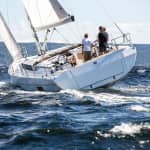
"It was clear to see there: If you messed up, you got a lot more in the end," said Cord Hall, summarising the start. Even though some crews were able to speed up a little at times, the challenge - this year around Anholt - remained a tough business. Hall observed the most amazing scenes from shore: "The Øresund in particular threw everything into disarray." Little wind and a lot of current caused problems for the field. Sometimes minutes decided whether a boat could stay underway or remain "parked" for hours.
The Øresund has so far been unable to stop the continued dominance of the "Powerplay" crew. On the night of 20 May, they had pulled away from the field in spectacular fashion. Late in the evening of 20 May, however, the lead they had built up had almost melted away. Oliver Schmidt-Rybandt and Felix Hauss still had 120 nautical miles to go to the finish. Three miles behind them, however, the "Pneuma" crew were piling on the pressure, as far as one can put it at boat speeds of around four knots.
Oliver Schmidt-Rybandt reported from on board late on Saturday evening:
"When I left for Strande, I didn't feel like it. In the meantime, I feel very comfortable and have the feeling that I belong right here. I particularly enjoy working with Felix. The last time we sailed together was three years ago and Felix hasn't sailed a D30 since then. Nevertheless, we were immediately in the flow. It works great and is fun!
The narrowness of Helsingør, which became a day-long programme, is the dark spot on this otherwise beautiful race so far. Being 'becalmed' for so long and having to watch the hard-earned lead melt away is tough. Especially as we needed it to get something out of the ORC. But there are worse things. Leading the field for so long as the smallest boat is also worth something. I'm excited to see what surprises await us until the finish."
The first Baltic 500 teams are expected to arrive in Strande on Sunday afternoon
The organisers hope to see the first boats at the finish line on the afternoon of 21 May. "Sunday afternoon should be feasible, preferably early afternoon," hoped Oli Schmidt-Rybandt at sea as he stubbornly defended his team's lead in the Øresund after 291 nautical miles.
The increases from no wind in the Øresund? Hardly any wind, little wind. That's all the Baltic Sea has to offer the Baltic 500 challengers, as Felix Hauss from "Powerplay" reports:


Tatjana Pokorny
Sports reporter
