


The Baltic 500 in May was a furious event: half of the registered boats didn't even start, and of the remaining 26 participants, just twelve made it through the stormy Baltic Sea to the finish line. Skipper Oliver Schmidt-Rybandt stands at the tiller of the boat that came third overall and first in the Dehler 30 od class with a broad grin and announces after the endurance test: "A Baltic 800 would also be perfectly fine!" Time and again, he fights his way to the top in races, gets the best out of every boat - and yet says of himself: "I'm not a real regatta sailor."
That is true. It is much more.
"You're going to take over the boat today and sail it together," announces Oli, as everyone calls him for short. A dozen or so men and women are sitting in the auditorium-sized cockpit of a former Volvo Ocean Racer. Colleagues who have been sent to Rostock by their employer for team building. Some have never set foot on a sailing boat before - and are now sitting on 64 feet with a good 14 tonnes, which they are about to sail. The main alone catches the wind with 120 square metres of cloth. Enormous forces weigh on the halyards and sheets. "Look at them and think about what they could be for. Then you'll understand better than if I tell you," Oli asks his guests. He is their skipper on this sunny day with a light breeze.

He looks boyish, no, mischievous. Not very tall, nimble in his every movement. A few blond hairs stand on end at the top of his head. When he laughs, which happens often and heartily, wrinkles form around his eyes. A full beard emphasises the sailor in him.
After casting off, Oli reminds us to kneel at the official winches and explains the power of the grinder: "This is the gear in which I am able to pull a cow by the tail through the roller." The mainsail is already up in Warnemünde and the guests take over the boat. Initially with astonished, then increasingly happy faces, they change roles or enjoy the thrill of the ride on the high edge. They speed across the Bay of Mecklenburg on the "Glashäger", a piece of sailing history: Twenty years ago, she won the legendary race around the world, back then under the name "Illbruck".

New Code Zeros gleam in the sun as the "Glashäger" and its sister ship "Ospa" majestically speed past the escort boat. Oliver designed them, he tells us later. From a young age, he calculated the optimum cut and the right cloth for his sails himself. Just as he was interested in direct current technology, astronavigation and diesel engines from an early age.
At the age of six, even before he sat in an Opti for the first time, he trimmed his cousin's sluggish toy boat so that it was ready to sail. Since then, he has found potential for improvement in every boat. Recently, he was even involved in the development of a cruiser racer. This is how it came about:
Kalle Dehler, developer at Hanseyachts, and Matthias Bröker, series boat designer at Judel/Vrolijk, will also be competing in the Silverrudder 2017. They notice a whole series of Pogos and Seascapes in the field of participants. They realise that lightweight planing yachts will not remain a niche, but will become a segment to be taken seriously in the market for new developments. They are considering using the hull of the Hanse 31.5, 2015 Yacht of the Year, for the Dehler range. They want to make them lighter and faster - and thus enter the market.
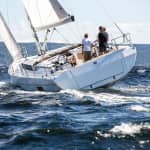
They sail a Pogo 30 with Oli - secretly, as they don't want to wake up the competition - in good winds to get an idea of this type of boat. Then they share their thoughts on the design with him. At one point or another, Oli remarks: "It won't work the way you're planning it!", adding explanations and suggestions for improvement. From then on, he is involved in the development of the Dehler 30 one design.

Not that he has studied boatbuilding or anything like that; he is simply interested. "I don't have to work hard to acquire the knowledge, it just comes to me somehow," he explains almost apologetically.
Things were different back then at school, when not everything was so interesting and the grades weren't famous. "My parents were worried that I wouldn't amount to anything." In the summer of 1989, Gorbachev had set the course, but Germany was still divided, so his parents travelled to Hungary with him and his younger sister. They are among the last to flee the republic, shortly before Günter Schabowski stammeringly announces "As far as I know ... that's immediate ... immediate." For Oli, this is one of the quotes of the 20th century.
At just eleven years old, he barely notices the change in system. Whether Magdeburg or Braunschweig: neither is hip in terms of urban development, but there are lakes that Oli can reach on his own and where he trains in his Opti as often as possible. The level of sailing is solid home cooking on both sides, "but I had top coaches who always looked after me, even when there was no training time. I'm extremely grateful for that!" he emphasises.

He regularly spends his summer holidays at training camps; sailing becomes a constant in his life. The little optics sailor becomes a serious competitor in races.
At the age of 17, he needed a break from school, he signed on to the traditional sailing ship "Fridtjof Nansen" and sailed across the Atlantic. "Until then, I had only known triangular sails. The ship had all kinds of lines and sails that I had never heard of before." He is shown around the deck for an hour, another hour below deck - and then never has to ask again what a part on board is called or where it is located. "I was amazed myself: the knowledge was just there, you just had to open the door to activate it. A reincarnation researcher would probably have a field day with me!"
He is already on the water at the age of six


He travelled on the three-master for a good nine months, weathering storms, boarding the shrouds as he ran and learning to rig and splice with triple-braided ropes. Back from the voyage, the Braunschweiger Zeitung newspaper quoted him in 1997: "The ship is one big musical instrument. You can hear the wind harping in the rigging, you can hear the water rippling, gurgling, hissing, bubbling, foaming. A powerful, indescribable symphony."
Otherwise, he is rarely drawn to faraway places. You could perhaps dream of the high southern latitudes, but: "You really have to have been to Spitsbergen and Antarctica," he enthuses and recommends the book "Big South" by Isabelle Autissier and Érik Orsenna with shining eyes. He has been travelling the world's oceans reading with them, Moitessier, Erdmann, Röttgering and many other sailing authors since his youth. But he loves his sailing area on the Baltic Sea, where there are hardly any storms or lulls and "bagfuls" of harbours, deep water and no tides.
It was here that he first sailed to Hiddensee on his grandparents' wooden boat at the age of five. "I'm very happy that I now live where my sailing life began," he says with a beaming smile. And also close to his two sons, aged eleven and 15. They live with their mum in Greifswald. As often as possible, they eat together, go sailing and the boys play on the boats while their father works.
The designer who is not a designer
Although the usual school curriculum was clearly not in line with his interests, Oli passed his Abitur as a teenager and studied nautical science in Rostock for a few years. For the sake of knowledge, he does not graduate. "I had this idea: if I was the captain of a bulk carrier on the open ocean and saw a Pogo 40 speeding past me - I'd jump off the nock to join it," he says, explaining his lack of a degree. When asked what he does for a living, he answers simply: "I'm a sailor." He doesn't fit into any mould. "Without any training, according to the usual criteria, I'm lucky if I can tie my shoes and formulate complete sentences," he says ironically.
He uses a remarkable vocabulary skilfully and incessantly. By the time he is two and a bit, he only knows two words: "daddy" and "car". It is on his first visit to the Baltic Sea that he says his first long sentence, eight words, clearly formulated. "Since then, talking has been easier than doing." He actually recites long poems off the cuff; Kästner's "The Other Possibility" and his favourite poem by Ringelnatz: "Sailing Ships". His repertoire lasts for three hours without him rereading a single line or faltering.
The company idea
Since 2012 Oli has been working at Speedsailing in Rostock. Since he and two of his colleagues took over the company, he has acted as technical manager. His day-to-day work does not end with skippering and selling boats. Owners of fine yachts such as the Pogo 40 or the Dehler 30 od entrust their boats to him for repairs, rigging work and optimisation, but also for winter storage services. If you want, you get the all-round carefree package, can come on board and set sail straight away. He rushes out when an owner needs his help and rarely leaves the boat without a tip or two on how to improve performance.

Occasionally, his colleague Felix calls and reminds him of the next job; he monitors the finances and processes at Speedsailing. "I'm good at forgetting things that need to be done on a daily basis. Felix knows that," explains Oli. Without him and without the meticulous planning of all events by the third owner Martin Kringel, he would be lost. Just as he always needs other people to keep him on track.
Friend and Volvo crew member Matthias explains: "You're never safe from surprises with Oli. But he's a good teacher. Adjusting the sails, sailing the boat on the edge of the wind - I learnt that from him. Oli is a bit of a genius in that respect." He, on the other hand, only takes some of the praise, "because I'm very polarising. You have to be able to deal with my style". Oli has been training sailors for many years, "but not for sports boat licences or the SKS. It's important to me that people learn to sail properly". Another sentence like that.
His rigging bag is always with him, because "such nautical work is highly satisfying". There is hardly a boat under his wing on which the rigging has not been stripped of its cover in places where it is not exposed to friction. If you want to be fast, you have to save weight. And be smooth.

In Greifswald, an example of his performance-improving tinkering spirit awaits the start of the Wednesday regatta. The crew of the "Asia de Cuba" is ready to repeat last year's overall victory. According to the model designation, the "Asia" is a Hanse 400, but a far cry from the condition in which she was delivered from the factory. Under water, she has been meticulously made as smooth as an Easter egg, using every possible means, from shafted through-hulls to the self-built, streamlined Rybandt-Düsentrieb saildrive casing. The steering wheel is oversized and made of carbon, all halyards and sheets have been renewed, as have the black sails, which were also designed by Oli. The "Asia", which at first glance looks like a harmless cruising yacht, has since become a hard-to-beat regatta opponent and has won many a race. Often with Oli on board. The yacht belongs to friends, and he sometimes goes on holiday with her. Apart from a 420, he has never owned a boat of his own, but there is no shortage of sailing opportunities: "People entrust me with their boats," he says.
He doesn't remember when and where he won his first regatta. "As a child in an Opti here and there. I only won regattas with the 'Asia de Cuba'. Before that, they were only minor successes at best. I also haven't sailed in any regattas with a significant level of performance. So I'm really not a real regatta sailor," he piles deep.
In fact, he doesn't often take part in competitions, "but when I do, I like to win them," he adds with a grin. In 2016, for example, he won the Pantaenius around Skagen with the "Asia". In 2017, he won the long-distance race around Bornholm with the VOR "Ospa", and in 2018 with "Glashäger" in the Legends Race from Gothenburg to The Hague. In 2020, he took the lead in the new Dehler 30 od class at the Baltic 500 and the Blueribboncup. Finally, in 2021, he fought an exciting duel with match racer Max Gurgel in the Silverrudder on his Dehler 30 od "Powerplay". He wins by a hair's breadth.

A few second and third places are added to this already incomplete record. On one occasion, however, he let the chance of victory slip away: when the hapless Max Gurgel got caught in a fishing net near Bågø during the doldrums of the 2020 Silverrudder, the boats behind him sailed a long way round his boat, which was caught in the net. Meanwhile, Oli takes down the sails, starts the engine and frees Gurgel from his predicament. He loses an hour of time, but still manages to finish ninth in his class.
"Every time I sail my little regattas, I ask myself whether it's such a good idea. When a boat like that flies over the water at 15 knots or bolts against three-metre waves, it's exhausting," he laughs again when asked whether one of these famous single-handed long-distance regattas might be a good idea for him; a good result wouldn't be out of the question. But Oli waves it off: "No. I'm doing very well as it is. Fate has been extremely kind to me so far, and I'm extremely grateful for that.
11 questions for Oliver Schmidt Rybandt
Storm or calm?
Both and. Fortunately, I have never experienced a really severe storm.
Single-handed or with a crew?
Single-handed means fewer people, more sensory impressions; co-operation with the boat and the elements; reward, punishment, pleasure. But I also enjoy sailing with a crew.
Map or plotter?
Map as a hobby, ECDIS at work. But never forget how to use a map, compass and sextant! Many thanks at this point to Bobby Schenk! He taught me through his books.
Cruising or regatta sailing?
Is there a difference? Dennis Conner once said that sailing fast is part of good seamanship.
Emotion or reason?
Mind! But I also have feelings: I feel cold, and even worse, I feel hot.
White or black sails?
Depends on the boat. Mostly black, which is not dazzling and is a good contrast to the trim strips.
Functional trousers or chinos?
Functional trousers - my wife rolls her eyes.
Docksides or trainers?
Musto Dynamic Pro Lite. This is not meant to be an advert. I've tried a lot of shoes - these have turned out to be the best fit for my feet so far.
Pølser or fish sandwiches?
Pølser in Denmark, fish rolls in Greifswald-Wieck.
Cooking or packet food?
Both!
North Sea or Baltic Sea?
Baltic Sea!!!

Ursula Meer
Redakteurin Panorama und Reise
