


Dear readers,
It's the summer holidays, time for the important things in life - like sailing. At last! It's high time, I think, because the summer has passed me by in a rush. So quickly that a question arose that usually only arises in late summer: "Did I get out on the water often enough this year?"
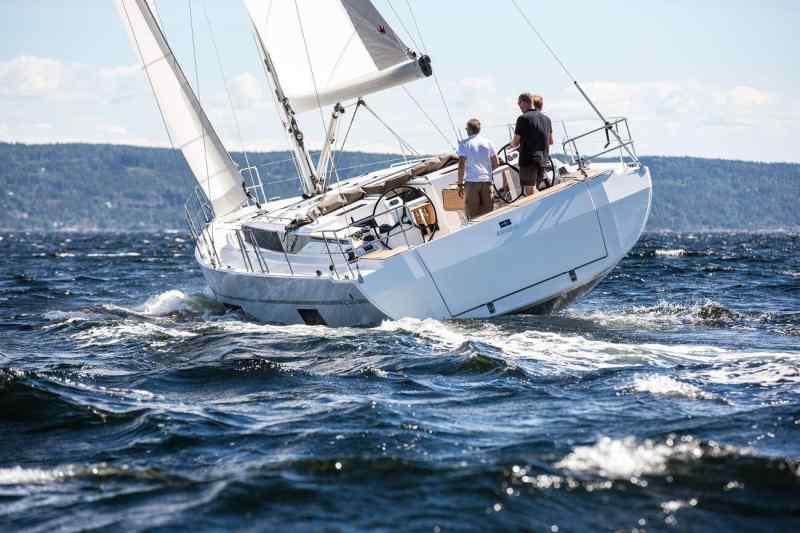
I usually suppress this question with phrases like "Don't think so negatively" or "That's not important". But this time it's different, because it accompanies a thesis that I've come across again and again recently: sailors spend a lot of time on board, but less and less time on the water; the sailing yacht is increasingly becoming a floating summerhouse.
This topic only recently came up in conversation with the petrol station attendant at a yacht filling station, whom I accompanied for a report. During the season, he has a perfect view of the fully occupied rows of jetties from his ticket office. He told me that some boats in the harbour are hardly ever moved, perhaps only for craning at the beginning and end of the season. The rest of the year he could watch the GRP weathering. More skippers also have difficulties with standard manoeuvres for cruising sailors, such as mooring and casting off, which he attributes to a lack of practice.
Sure, these are isolated cases, and don't worry, my little mid-season crisis isn't that drastic. But the conversation made me curious.
If you look for figures on whether sailors really do get out on the water less often, the results are pretty meagre. The problem is that the studies are either regionally limited or outdated. Nevertheless, they offer a certain amount of guidance.
A 2010 survey for Berlin-Brandenburg shows that boats are in use there for an average of 20.9 days a year. With a season from May to September, that is almost every weekend. The Research Association for Sport and Recreational Boating provides similar results. According to this, private pleasure craft are used between 10 and 20 days a year.
Not bad at all, I think. But what does "utilised" mean? Does it refer to the hunt for nautical miles or the regular sundowner on board? That's not clear from the surveys. The fact that the latter seems to be more popular today can be seen in the boat market.
Browsing the shipyard websites in search of the latest boat models reveals numerous sundowner atmospheres in extra-wide cockpits, padded sun decks where whole families can relax side by side, or splash about on electrically extendable bathing platforms.
In the past, when I was still leafing through old YACHT magazines as a child, the adverts looked different: crews in robust oilskins navigating through stormy waters with reefed sails. The message was clear: this boat can withstand any weather. Today, comfort and lifestyle take centre stage. This was also evident in the Boat show in Düsseldorf in Januarywhere I noticed the many voluminous, almost bulky hull shapes.
Certainly boats like the Oceanis 40.1 or Bavaria C42 true space miracles below deck. But at the beginning of the year, I asked myself the question: Do they sail well? My colleagues from the test and technology editorial team know more about this, because they have Many of the boats have already been trialled - and, in my opinion, come to some surprising conclusions. Small spoiler: they are obviously better than I expected.
But what do these impressions, data and trends mean? I asked myself: Can you really measure the value and importance of a boat by how often it is moved?
I don't think so, because the fascination of sailing goes far beyond the nautical miles recorded in the logbook. I realised that the more I looked into it. Ultimately, it's the reveries that begin to emerge during winter storage, the promise of balmy summer nights in the cockpit. It's the afternoon naps on deck and the rainy days when you find shelter under the tarpaulin with coffee and cake.
For some, the boat is a meeting place to keep in touch with friends or neighbours - whether for reasons of age or because their partner is afraid to leave the harbour. Some use the boat as a floating office or as a retreat from relatives.
And with all these things, it ultimately doesn't matter whether you are far away from your home harbour or in your own box. The demands that everyone places on their boat are highly individual - and that's a good thing.
For me, the first step on board means leaving the world beyond the railing behind me. And if there's still time for sailing, what could be better? With this in mind, enjoy the summer of sailing and treat yourself to some time out.
Fabian Boerger
YACHT editor
Recommended reading from the editorial team

Malizia 4
First the damage to the foil, now the mainsail has torn

First the damage to the foil, then broken hull reinforcements, and now a tear in the mainsail. Two new videos show how Team Malizia is repairing and further developing the IMOCA ahead of the Route du Rhum.
Silting up of the Elbe
Small ports are fighting for every metre of water depth

The Lower Elbe is silting up, time windows are shrinking and ports are becoming difficult to reach. With flat-bottomed boats and homemade dredgers, sailors are fighting to preserve their fishing grounds.
Propulsion
Max Bianchi variable-pitch propeller, which adjusts its pitch whilst the aircraft is in flight

A variable-pitch propeller that automatically adjusts its pitch whilst in flight: this is what Max Prop’s Max Bianchi model is designed to achieve in powered flight and motor-sailing.
Interview
What is it like to work on board the ‘Thor Heyerdahl’?

The ‘Thor Heyerdahl’ has been sailing the world’s oceans for more than 40 years. YACHT editor Fabian Boerger explains why this historic vessel remains relevant.
Hurricanes 2026
Dramatic rescue off the coast of California – El Niño shapes the storm season

A lifeguard rescues a sailor from a partially flooded yacht off the coast of California. Why the 2026 hurricane season is turning out so differently between the Atlantic and the Pacific.
Blue-water yachts
These five are heading to the ends of the earth

Five blue-water yachts, five designs: the Boréal 56, Kraken 58, Pure 49, Stem 50 and Breehorn 55 demonstrate their strengths and weaknesses on a long-distance voyage.
Record low water level in Lake Zurich
Sailing yacht flown by helicopter to its winter storage facility

Water levels in Lake Zurich are below the previous record low. Because his sailing yacht was stuck in the shallow water and in danger of capsizing, a 65-year-old owner had his boat airlifted out by helicopter. The operation cost around 2,000 francs and highlights just how much the exceptionally low water level is now affecting navigation.
Series of thefts continues
Thieves make off with two 300 PS outboard motors from Wieltsee

Thieves have struck again at Wieltsee: they have stolen two boats and removed heavy outboard motors. This is already the fourth such incident in three months.
Second-hand boat of the week
Arietta 31 – the dawn of an era

A narrow waist, mahogany hull and elegant overhangs: the Arietta 31, designed by Olle Enderlein, prioritises balanced lines and seaworthiness over maximum living space. As a forerunner of later Scandinavian cruising yachts, it is now an interesting classic for sailors seeking a traditional, compact cruising yacht.
Breehorn 55 review
Is it the ideal home at sea?

A pilothouse, teak fittings and an unusually accessible service tunnel: this is how the Breehorn 55 works below deck, and these compromises remain.
Newsletter: YACHT-Woche
Der Yacht Newsletter fasst die wichtigsten Themen der Woche zusammen, alle Top-Themen kompakt und direkt in deiner Mail-Box. Einfach anmelden: